

AP Syllabus focus:
‘Together, phospholipids and embedded molecules maintain the cell’s internal environment by controlling interactions between cytosol and external surroundings.’
Plasma membranes are not just boundaries; they are dynamic, selective interfaces.
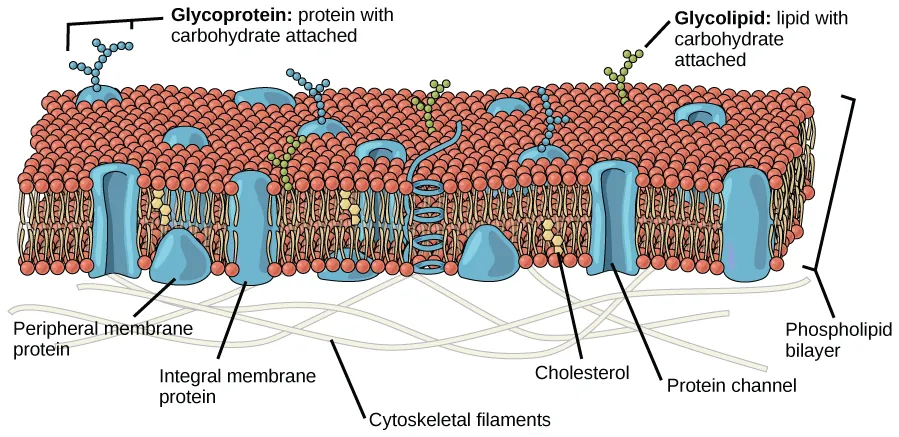
Fluid mosaic model diagram showing a phospholipid bilayer with embedded integral/peripheral proteins, cholesterol, and outward-facing carbohydrate chains on glycoproteins and glycolipids. This image visually ties membrane structure to function: a hydrophobic core forms a barrier, while proteins and surface sugars enable selective transport and cell recognition. Source
Their molecular components work together to stabilise conditions inside cells, regulate communication, and coordinate controlled exchange with the external environment.
Core idea: controlling the internal environment
Cells must keep cytosolic conditions within ranges that allow enzymes and metabolic pathways to function. The membrane accomplishes this by combining a stable barrier with regulated, information-rich contact points.
Homeostasis: Maintenance of relatively stable internal conditions (e.g., ion concentrations, pH, water balance) despite changes in the external environment.
How membrane components work together
Phospholipids: the baseline barrier and interface
Phospholipids create the fundamental boundary between cytosol and extracellular fluid.
Hydrophobic interior reduces uncontrolled interaction between cytosolic water and many external solutes
Hydrophilic surfaces allow the membrane to exist in aqueous environments on both sides
Lateral movement of lipids supports resealing after minor damage and redistribution of components for local needs
Proteins: specific control points at the boundary
Membrane proteins provide most of the membrane’s selective interactions, enabling the cell to “choose” what information and materials are permitted to influence the cytosol.
Transport specificity: proteins act as selective gateways that help maintain distinct internal concentrations of key solutes
Receptors and signal transduction: receptor proteins bind external ligands (e.g., hormones), triggering intracellular responses that adjust cytosolic activity
Enzymatic organisation: membrane-associated enzymes position reactions near particular substrates or signalling complexes
Anchoring and structure: proteins connect to the cytoskeleton and/or extracellular structures, helping maintain cell shape and stabilising protein placement for consistent responses
Carbohydrates: recognition and controlled interactions
Short carbohydrate chains attached to membrane molecules create identity and interaction cues at the cell surface.
Glycoproteins (protein + carbohydrate) and glycolipids (lipid + carbohydrate) form cell-specific “tags”
Support cell-cell recognition, helping cells interact appropriately with neighbours and avoid inappropriate binding
Contribute to the extracellular matrix interactions that influence cell behaviour and internal cytosolic organisation
Steroids (cholesterol): tuning membrane behaviour
In many eukaryotic membranes, cholesterol helps maintain an internal environment by stabilising membrane physical properties.
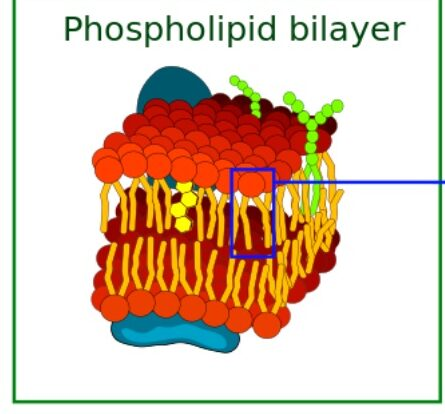
Diagram of plasma membrane structure emphasizing how cholesterol sits among phospholipid tails within the bilayer. By intercalating into the hydrophobic interior, cholesterol helps modulate packing of fatty acid tails, which in turn influences membrane permeability and the functional behavior of embedded proteins. Source
Buffers membrane fluidity, supporting consistent protein function under temperature changes
Helps reduce excessive permeability to small molecules, reinforcing controlled separation of cytosol from external surroundings
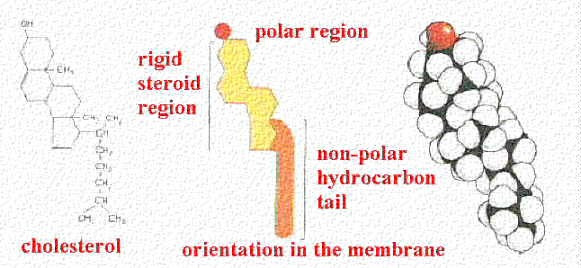
Illustrations showing cholesterol’s steroid-ring structure and how cholesterol aligns within a phospholipid bilayer (polar -OH near phospholipid head groups, rigid rings among fatty-acid tails). This placement restricts excessive tail movement and reduces permeability to small water-soluble molecules, helping stabilize the cell’s internal environment across temperature changes. Source
Promotes formation of local regions with distinct composition that can concentrate signalling proteins
Maintaining boundaries while enabling communication
Selectivity is both chemical and informational
Membranes maintain the internal environment not only by limiting chemical mixing, but also by shaping what the cell “perceives” outside.
Chemical control: the bilayer limits many spontaneous interactions between external solutes and the cytosol, while proteins provide regulated entry/exit routes
Informational control: receptors convert external signals into internal changes (gene expression, enzyme activity, cytoskeletal rearrangement) without requiring bulk movement of external molecules into the cytosol
Membrane composition is adaptable
Cells adjust membrane composition to preserve internal conditions as demands change.
Changing the abundance or activity of particular transporters or receptors alters how strongly the external environment can influence cytosol
Altering lipid composition (including cholesterol content) changes membrane flexibility and protein performance, helping maintain stable internal function across conditions
Practice Questions
Explain how phospholipids and membrane proteins together help a cell maintain a stable internal environment. (2 marks)
1 mark: Phospholipid bilayer forms a hydrophobic barrier that limits uncontrolled interaction/mixing between cytosol and external surroundings.
1 mark: Membrane proteins provide selective control points (e.g., specific transport or receptors) that regulate what affects the cytosol.
Describe three distinct roles of membrane components (phospholipids, proteins, carbohydrates, cholesterol) in controlling interactions between the cytosol and the external environment. (5 marks)
1 mark: Phospholipids create a boundary with a hydrophobic core limiting many solute interactions with cytosol.
1 mark: Transport proteins enable selective movement that helps maintain internal concentrations.
1 mark: Receptor proteins detect external signals and trigger intracellular responses without needing bulk entry of substances.
1 mark: Glycoproteins/glycolipids mediate cell recognition/appropriate external interactions.
1 mark: Cholesterol stabilises membrane properties (e.g., fluidity/permeability), supporting consistent internal conditions.
FAQ
Cells can insert or remove specific lipids and proteins via targeted trafficking and turnover.
Changes are usually localised, preserving overall bilayer integrity while tuning responsiveness at particular membrane regions.
They may express different receptor types, receptor densities, or intracellular coupling proteins.
As a result, identical external ligands can trigger distinct cytosolic pathways and outcomes.
Carbohydrates are added to lipids/proteins on the lumenal side of membrane compartments during processing.
When delivered to the plasma membrane, this orientation places carbohydrate chains on the extracellular surface.
Clustering receptors and associated proteins into microdomains increases local concentration and collision frequency.
This can reduce the number of steps needed for signal relay to cytosolic targets.
No. Some proteins require specific lipid environments to maintain shape and activity.
Others are more tolerant, so fluidity shifts can selectively alter which interactions most strongly influence the cytosol.
