

AP Syllabus focus:
‘Small nonpolar gases like oxygen, nitrogen, and carbon dioxide diffuse freely, while ions and large polar molecules require channels or transport proteins.’
Diffusion across membranes explains how cells rapidly exchange respiratory gases while tightly regulating charged and polar solutes. Understanding which molecules cross unaided versus requiring proteins links membrane chemistry to homeostasis and cell function.
Diffusion of small nonpolar gases
Oxygen (O₂), carbon dioxide (CO₂), and nitrogen (N₂) are small, nonpolar molecules. Because the membrane’s interior is hydrophobic, these gases dissolve in the lipid bilayer and cross by simple diffusion without assistance.
Diffusion: Net movement of particles from higher concentration to lower concentration due to random molecular motion.
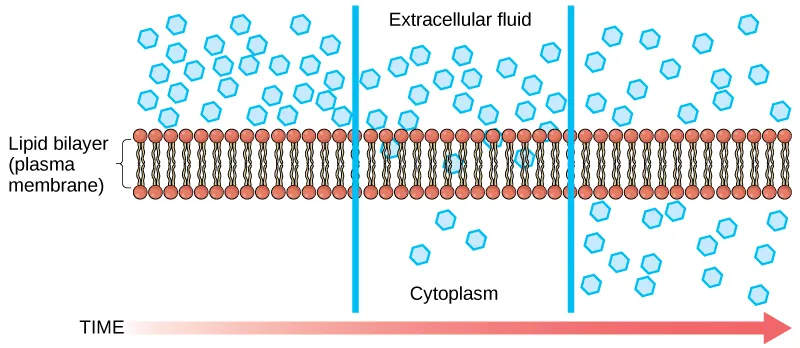
Diffusion proceeds as particles move randomly, but with a net flow from high to low concentration until concentrations equalize on both sides of a permeable membrane. The three panels emphasize that equilibrium stops net movement even though molecules continue moving (dynamic equilibrium). Source
Key implications for cells:
Net movement depends on the concentration gradient (steeper gradient → faster net diffusion).
Diffusion continues until dynamic equilibrium (molecules still move, but no net change).
Gas exchange is efficient because these molecules are both small and lipid-soluble.
What controls the rate of gas diffusion?
Membranes are barriers of finite thickness, so diffusion rate is influenced by:
Surface area (SA): more membrane area increases diffusion.
Diffusion distance (thickness): thicker barriers slow diffusion.
Permeability (P): higher lipid solubility increases permeability.
Gradient magnitude: larger concentration differences increase net movement.
A compact way to express these dependencies is Fick’s law:
= Membrane surface area
= Permeability of the molecule in the membrane
= Concentration difference across the membrane
= Diffusion distance (membrane thickness)
In living systems, cells help maintain gas gradients through cellular respiration (consuming O₂, producing CO₂) or other metabolic processes, sustaining net diffusion.
Why ions and large polar molecules need transport proteins
In contrast, ions (e.g., Na⁺, K⁺, Cl⁻) and many large polar molecules (e.g., glucose, amino acids) do not readily cross the hydrophobic core:
Charge is energetically unfavorable in the nonpolar bilayer interior.
Polarity and size reduce solubility in membrane lipids and slow diffusion to negligible rates.
Therefore, movement typically requires channels or transport proteins embedded in the membrane, providing a hydrophilic route.
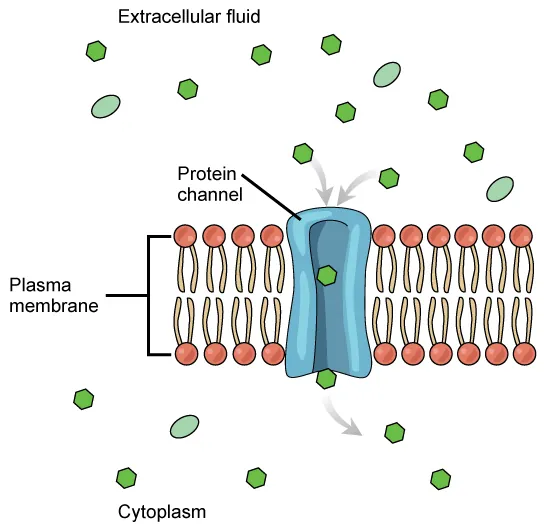
Channel proteins provide an aqueous pathway across the lipid bilayer, allowing selected ions or polar molecules to diffuse without contacting the hydrophobic membrane interior. The figure highlights how the pore creates a low-energy route compared with attempting to pass through the nonpolar core of the bilayer. Source
Transport proteins: channels vs. carriers
Channel proteins (pores)
Channel proteins form selective, water-filled pathways that allow specific solutes to diffuse down their gradients.
Often highly selective (size/charge filters).
May be gated (open/close in response to ligand binding, voltage, or mechanical stress).
Enable rapid movement of ions because they bypass the hydrophobic interior.
Carrier proteins (bind-and-shuttle)
Carrier proteins bind a specific solute and change shape to move it across the membrane.
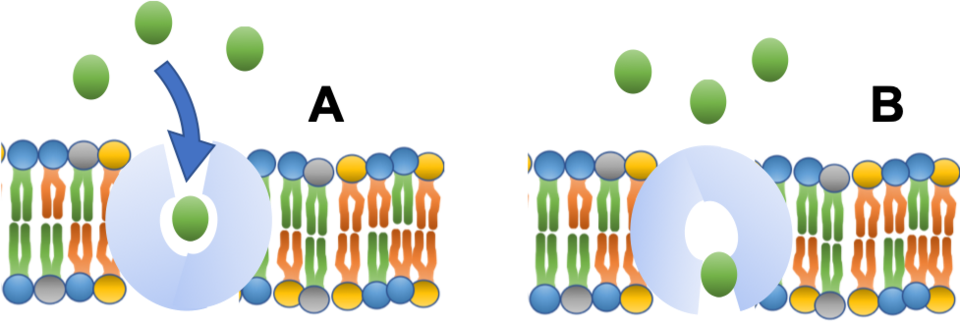
Carrier proteins transport solutes by alternating access: binding on one side of the membrane triggers a conformational change that exposes the binding site to the other side. This mechanism contrasts with channels (continuous pores) and helps explain why carriers can show a maximum rate when all binding sites are occupied (saturation). Source
Still passive when moving down a gradient (no ATP directly required).
Typically slower than channels due to required conformational changes.
Show saturation: a maximum rate when all carriers are occupied.
What “require channels or transport proteins” means in practice
For ions and large polar molecules:
Transport proteins provide specificity (only certain solutes pass).
They allow regulated flux, supporting stable internal conditions even when external concentrations vary.
Without these proteins, diffusion of these solutes would be too slow or effectively blocked.
Practice Questions
Explain why O diffuses across the plasma membrane without a transport protein, but Na typically does not. (2 marks)
O is small and non-polar/lipid-soluble so it passes through the hydrophobic bilayer by simple diffusion. (1)
Na is charged (ion) and is impeded by the hydrophobic core, so it requires a channel/transport protein. (1)
Describe two differences between channel proteins and carrier proteins in moving polar or charged substances across membranes, and explain how concentration gradients determine the direction of movement for both. (5 marks)
Channel proteins form a hydrophilic pore/pathway through the membrane. (1)
Carrier proteins bind the solute and undergo a conformational change to move it across. (1)
Channels generally allow faster transport than carriers (no binding-and-flip step). (1)
Carriers show saturation due to limited binding sites/maximal rate when occupied. (1)
For both, net movement (in passive transport) is down the concentration gradient (from higher to lower concentration). (1)
FAQ
Cholesterol can reduce bilayer fluidity at moderate temperatures, which may lower permeability for some small molecules.
Effects vary with temperature and lipid composition, so the same change can have different outcomes in different membranes.
CO$_2$ is lipid-soluble and crosses readily, and cells often maintain a gradient by continual production inside and removal outside (e.g., by circulation/ventilation).
This keeps net diffusion directed outward.
By consuming O$_2$ rapidly in respiration, intracellular O$_2$ stays low.
High external O$_2$ availability plus continual use sustains inward diffusion.
Selectivity arises from the channel’s pore size and the chemical environment of its selectivity filter.
Precise interactions stabilise one ion (often based on ionic radius and hydration shell) more than another.
Yes. If a carrier or channel is not directionally driven by ATP or coupling, net movement depends on the gradient.
If the gradient reverses, net flux can reverse as well.

