

AP Syllabus focus:
‘Cell walls in bacteria, archaea, fungi, and plants provide structural support, selective permeability, and protection against osmotic lysis.’
Cell walls are extracellular layers that shape cells and buffer them from mechanical and osmotic stress. In AP Biology, focus on how wall composition differs across domains and how walls affect permeability and survival.
What a cell wall does (structure, support, protection)
A cell wall sits outside the plasma membrane and is typically rigid or semi-rigid. Because many walls are built from cross-linked polysaccharides (or related polymers), they resist stretching and help maintain cell shape.
Cell wall: A protective extracellular layer outside the plasma membrane that provides structural support and helps prevent osmotic swelling; composition varies among bacteria, archaea, fungi, and plants.
Key functions emphasized in this topic:
Structural support: helps cells maintain a stable shape and resist deformation.
Protection against osmotic lysis: counters internal water pressure when water enters the cell.
Selective permeability (at the wall level): many walls are porous, allowing water and some solutes through while slowing or excluding larger particles; final “selectivity” is largely enforced by the plasma membrane.
Osmotic lysis and why walls matter
When a cell is placed in a hypotonic environment, water tends to enter. A sturdy wall resists expansion, preventing rupture.
Osmotic lysis: Cell bursting caused by excessive water uptake that increases internal pressure beyond what the membrane can withstand.
A cell wall helps prevent osmotic lysis by:
providing a rigid boundary that limits swelling
allowing internal pressure to build without membrane rupture (especially important for walled cells in freshwater or fluctuating environments)
Cell wall permeability: “selective,” but not a membrane
Cell walls are not phospholipid bilayers and do not contain a hydrophobic core. As a result, they generally do not block molecules based on polarity the way membranes do. Instead, permeability is mainly determined by:
pore size within the wall matrix
degree of cross-linking between wall components
presence of additional outer layers (common in some bacteria)
Practical implications:
Small molecules and water often diffuse through the wall relatively easily.
Large macromolecules and many particles are slowed or excluded.
The plasma membrane beneath the wall remains the primary barrier controlling what enters the cytosol.
Differences among groups (composition and consequences)
Bacteria
Most bacterial cell walls contain peptidoglycan, a polymer-like mesh that forms a strong, supportive layer.
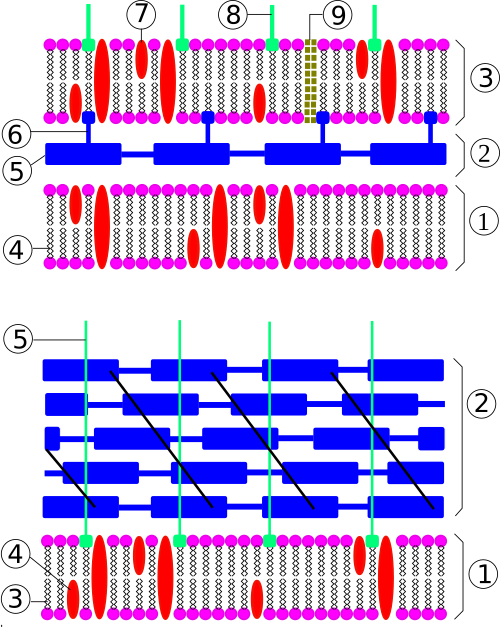
Labeled cross-sections compare Gram-negative and Gram-positive bacterial cell envelopes. The diagram highlights the thin peptidoglycan plus outer membrane (with porins/LPS) in Gram-negative bacteria versus the thick peptidoglycan layer in Gram-positive bacteria. This supports why Gram-negative cells often have an additional diffusion barrier beyond peptidoglycan alone. Source
The peptidoglycan network gives bacteria mechanical strength and helps prevent osmotic lysis.
Wall architecture influences permeability:
Thicker peptidoglycan can be physically protective.
Some bacteria possess an additional outer layer, which can further restrict diffusion of certain substances and affect what reaches the membrane.
Archaea
Archaea lack true peptidoglycan.
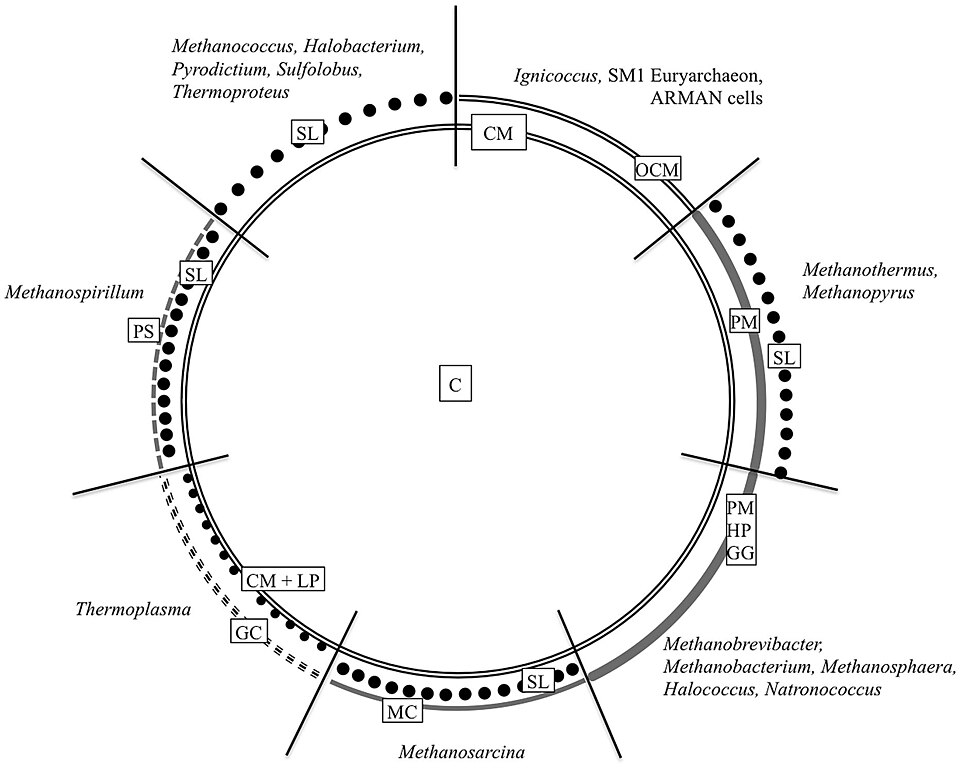
This schematic summarizes common archaeal cell wall organizations across different groups. It emphasizes that many archaea rely on an S-layer and/or distinct polysaccharide or pseudomurein-based layers instead of bacterial peptidoglycan. Seeing the alternative architectures side-by-side helps connect wall chemistry to protection and permeability differences. Source
Instead, their walls may include:
pseudopeptidoglycan (in some species)
protein-rich S-layers or other polysaccharides
These alternative structures still provide:
support and shape
protection against osmotic stress
a porous barrier that can influence movement of solutes toward the plasma membrane
Fungi
Fungal walls are primarily built from chitin and other polysaccharides.
Chitin contributes tensile strength (toughness) and helps fungi withstand osmotic and mechanical stress.
The wall is typically porous to water and small solutes, while helping protect the cell from physical damage and rapid osmotic changes.
Plants
Plant cell walls are primarily composed of cellulose embedded in a matrix of other carbohydrates.
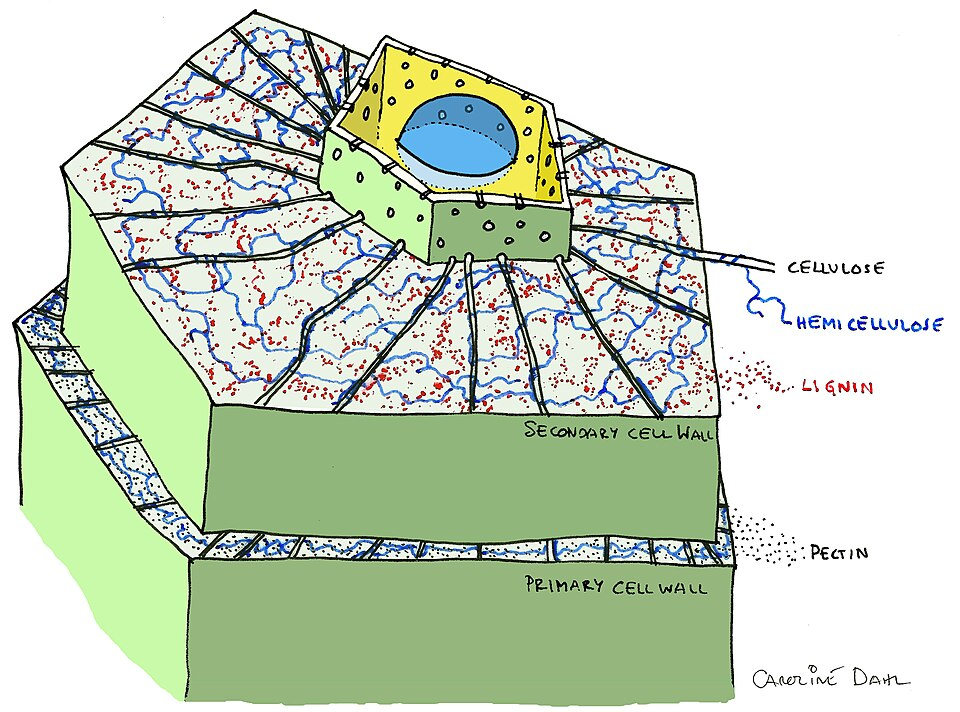
This diagram shows how a growing plant cell builds a primary cell wall, and how some cells later deposit a thicker secondary wall inside it. The figure helps link cellulose-rich wall layers to mechanical support and resistance to turgor-driven expansion. It also reinforces that wall layering changes functional properties such as stiffness and protection. Source
The wall provides strong structural support, enabling upright growth and resistance to turgor changes.
Plant walls are porous, allowing movement of water and many dissolved substances through the wall space, while the plasma membrane regulates entry into the cell’s cytoplasm.
By resisting expansion, the wall helps prevent bursting under high internal water pressure.
How wall structure connects to survival in changing environments
Because walls protect against osmotic lysis, they are especially advantageous when external solute concentration changes quickly.
In hypotonic conditions, water influx increases internal pressure; a wall resists overexpansion.
In less favorable conditions, the wall can help maintain cell integrity even when the membrane alone would be vulnerable.
Cell wall “selective permeability” in this syllabus context means:
walls act as filters that influence what can physically approach the membrane
walls contribute to homeostasis indirectly by stabilising cell volume and reducing the risk of membrane rupture
the exact permeability profile depends on wall chemistry (peptidoglycan vs chitin vs cellulose vs archaeal wall types) and wall organisation (density, layering)
Practice Questions
State two functions of cell walls in bacteria, archaea, fungi, and plants. (2 marks)
Provides structural support/maintains cell shape (1)
Provides protection against osmotic lysis (1)
Accept selective permeability/filtering as an alternative second point (1)
Explain how cell wall structure contributes to permeability and survival in hypotonic environments, and describe how wall composition differs between bacteria, archaea, fungi, and plants. (6 marks)
Cell walls are generally porous; allow water/small solutes through while limiting larger particles (1)
Plasma membrane remains the main selective barrier controlling entry to cytoplasm (1)
In hypotonic environments, water enters; wall resists expansion and helps prevent osmotic lysis (1)
Bacteria: walls contain peptidoglycan (1)
Fungi: walls contain chitin (1)
Plants: walls contain cellulose; archaea lack peptidoglycan and have alternative wall materials (e.g. S-layer/pseudopeptidoglycan) (1)
FAQ
Gram-negative bacteria have an additional outer layer that can reduce entry of certain molecules.
Gram-positive bacteria lack this outer layer and often have a thicker peptidoglycan layer, which changes how substances diffuse and bind.
Yes—plants have specialised channels between cells that allow movement of certain solutes and signalling molecules.
Transport capacity depends on channel size and regulation, and it can change during development or stress.
Some bacterial walls incorporate waxy lipids that decrease permeability.
This can slow diffusion of many drugs and disinfectants, increasing resistance and requiring longer treatment.
No. Archaeal walls are diverse and can be protein-dominated or polysaccharide-based.
This diversity reflects adaptation to different environments, including extreme salinity, temperature, or acidity.
They break bonds in wall polymers, weakening the mesh.
As structural integrity decreases, the membrane is more likely to rupture in hypotonic conditions, especially if internal pressure rises quickly.



