

AP Syllabus focus:
‘Carrier proteins and aquaporins enable energy-independent movement of large polar molecules and rapid water transport down concentration gradients.’
Cells rely on membrane proteins to move substances that cannot pass through the hydrophobic lipid bilayer. Carrier proteins and aquaporins are central to selective, efficient transport without ATP when molecules move down existing gradients.
Core idea: protein-mediated movement down gradients
Facilitated diffusion: Passive transport in which specific membrane proteins help substances move down their concentration gradient (high to low) without cellular energy input.
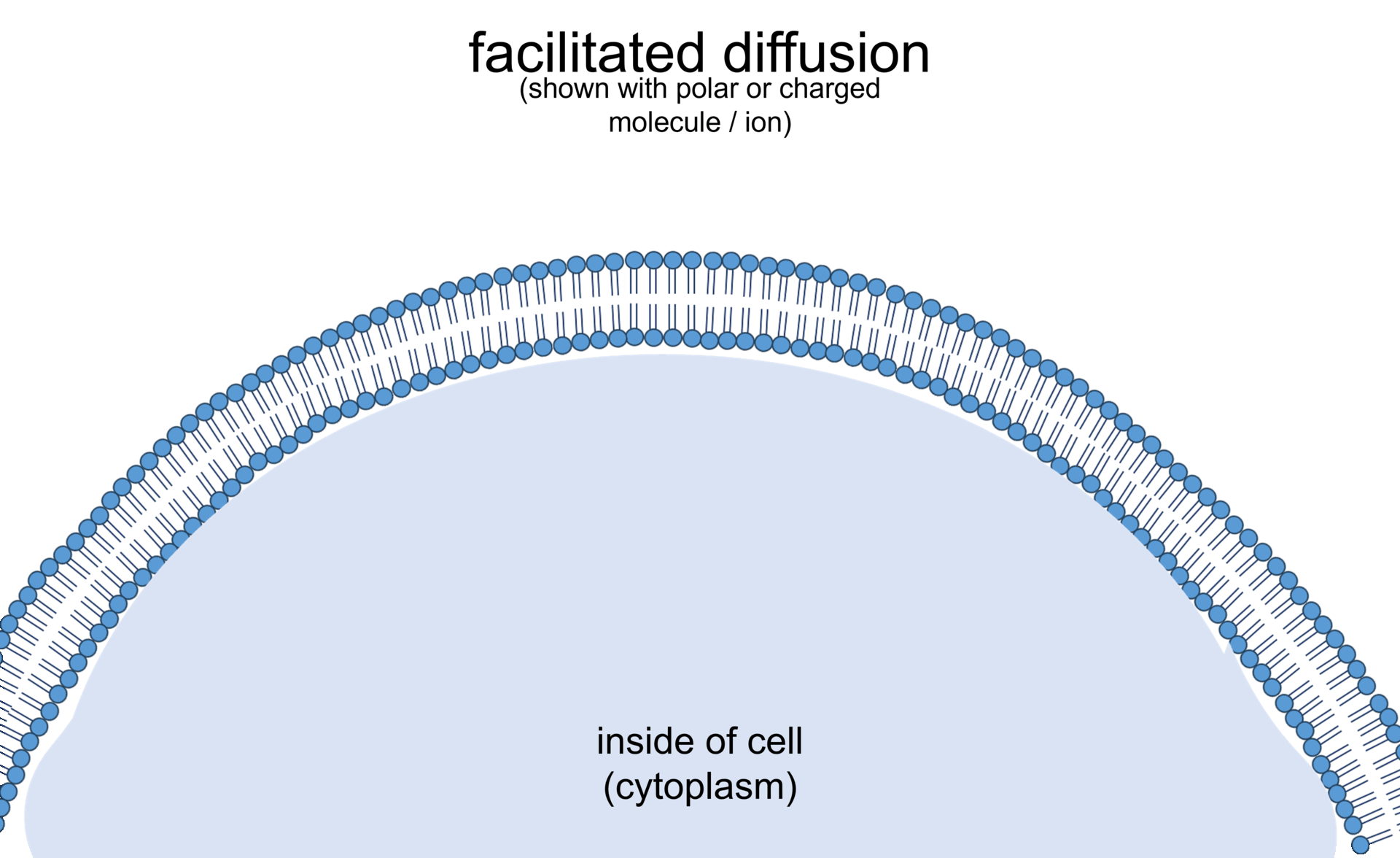
This animation visualizes facilitated diffusion across a membrane when the solute concentration is higher outside the cell than inside. Molecules move through a membrane protein pathway, with net flux proceeding down the concentration gradient until the gradient diminishes. The motion highlights how proteins provide a selective route for substances that cannot cross the hydrophobic bilayer efficiently. Source
Because the phospholipid bilayer blocks most large polar molecules, cells use embedded proteins to provide an alternative pathway that preserves membrane selectivity.
What “down a gradient” implies
Net movement occurs from higher to lower concentration until equilibrium is approached.
The rate depends on:
Size of the gradient
Number and activity of transport proteins
Whether proteins become saturated (all binding sites occupied)
Carrier proteins: moving large polar molecules without ATP
Carrier protein: A transmembrane protein that binds a specific solute and changes shape to shuttle that solute across the membrane, enabling passive movement down a concentration gradient.
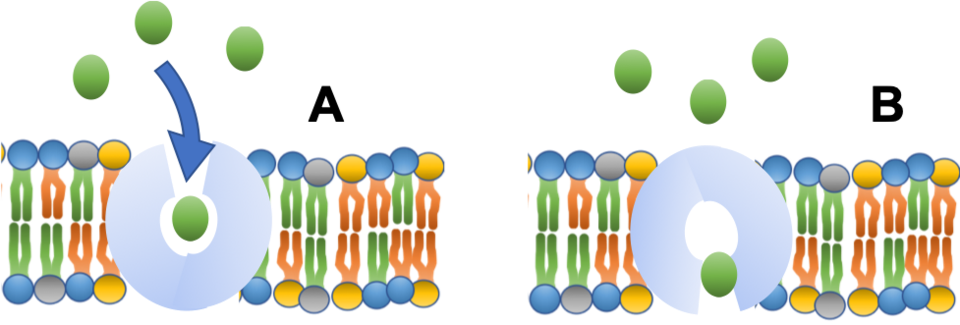
This diagram illustrates carrier-mediated facilitated diffusion: a polar solute binds a specific carrier site, then the protein shifts conformation to expose the binding site to the opposite side of the membrane. The solute is released where its concentration is lower, and the carrier returns to its original state, enabling repeated down-gradient transport. Source
How carrier proteins work
Specific binding: the solute fits a binding site based on shape and chemical properties.
Conformational change: binding triggers the protein to shift from outward-facing to inward-facing (or vice versa).
Release: the solute is released on the side with lower concentration.
Key features AP Biology students should know
No ATP is used directly: transport is powered by the solute’s own concentration gradient.
Selectivity: different carriers transport different molecules; similar molecules may compete for the same carrier.
Saturation: there is a maximum rate once all carriers are busy, unlike simple diffusion through a membrane.
Directionality depends on the gradient: if the gradient reverses, net movement can reverse.
Aquaporins: rapid water transport
Aquaporin: A channel protein specialised for water that greatly increases membrane permeability to HO, allowing rapid passive movement down a water concentration gradient.
Water can diffuse across membranes slowly, but many cells require much faster movement to maintain appropriate internal conditions. Aquaporins provide a high-throughput route for water while keeping the membrane selectively permeable.
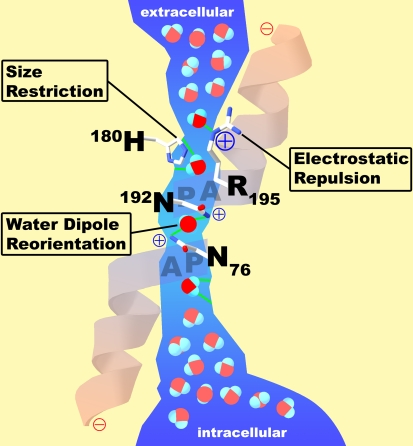
This schematic of aquaporin-1 (AQP1) shows water moving through the channel in single file between extracellular and intracellular vestibules. It also labels structural features that impede proton () transport, explaining how aquaporins can greatly increase water permeability without allowing ions to leak across the membrane. The figure reinforces the idea of rapid, passive water movement driven by a water concentration gradient. Source
Why aquaporins are necessary
They enable rapid water transport without changing the membrane’s barrier to ions and many solutes.
They support fast volume adjustments in cells exposed to changing external water availability.
Selectivity and efficiency
Aquaporins are shaped to favour water molecules while excluding most other substances.
Many aquaporins limit passage of ions (such as H), helping maintain electrical and chemical stability while still allowing high water flow.
What aquaporins and carriers have in common
Both are forms of facilitated diffusion.
Both are energy-independent for movement down gradients.
Both increase transport rate compared with direct diffusion through the lipid bilayer (which is very limited for large polar molecules, and relatively slow for water without aquaporins).
Practice Questions
Explain how a carrier protein enables a large polar molecule to cross the plasma membrane without ATP. (2 marks)
Binds the specific large polar molecule at a binding site (1)
Undergoes a conformational change to move and release it on the other side down its concentration gradient / without ATP (1)
A cell is placed into a solution that causes rapid water entry. Describe the role of aquaporins in this response and give two features that make aquaporin-mediated transport effective and selective. (5 marks)
Aquaporins provide a protein pathway that increases water permeability of the membrane (1)
Water moves through aquaporins by facilitated diffusion down a water concentration gradient / without ATP (1)
Transport is rapid/high-throughput compared with diffusion through the bilayer (1)
Aquaporins are selective for water due to pore structure/size and polarity (1)
Aquaporins exclude ions/charged solutes, helping maintain chemical/electrical conditions (1)
FAQ
Often no; channels can allow higher flux.
Carriers are limited by binding and conformational cycling, so they commonly show a lower maximum rate than open channels.
Mainly solute size and polarity.
Large polar molecules cannot cross the hydrophobic bilayer efficiently, so they require a protein with a compatible binding site.
They constrain water movement through a narrow pore and orient water molecules.
This disrupts continuous proton “hopping” pathways, reducing H$^+$ passage compared with bulk water flow.
Many aquaporins function as constitutively permeable pores, but some can be regulated.
Cells may adjust aquaporin abundance by inserting or removing them from membranes to tune water permeability.
Facilitated diffusion depends on a finite number of protein sites.
When all carriers (or relevant binding sites) are occupied, increasing solute concentration cannot proportionally increase transport rate.


