

AP Syllabus focus:
‘Osmoregulatory mechanisms maintain water balance and solute levels, supporting organismal growth, cellular homeostasis, and survival.’
Osmoregulation is how organisms keep water and dissolved solutes within tolerable limits. Because water movement affects cell volume, membrane function, and metabolism, tight regulation is essential for stable internal conditions and survival.
Core concepts: water balance as a homeostatic problem
Key terms you must use precisely
Osmoregulation: The regulation of body water content and dissolved solute concentrations to maintain stable internal conditions.
Osmoregulation is a specific part of maintaining an organism’s internal environment, especially the balance of water and ions (such as Na⁺, K⁺, and Cl⁻) in body fluids.
Homeostasis: The maintenance of relatively stable internal conditions despite external change, typically via feedback control mechanisms.
Water balance is central to homeostasis because changes in hydration shift osmolarity (total solute concentration), which can alter cell volume and disrupt protein function.
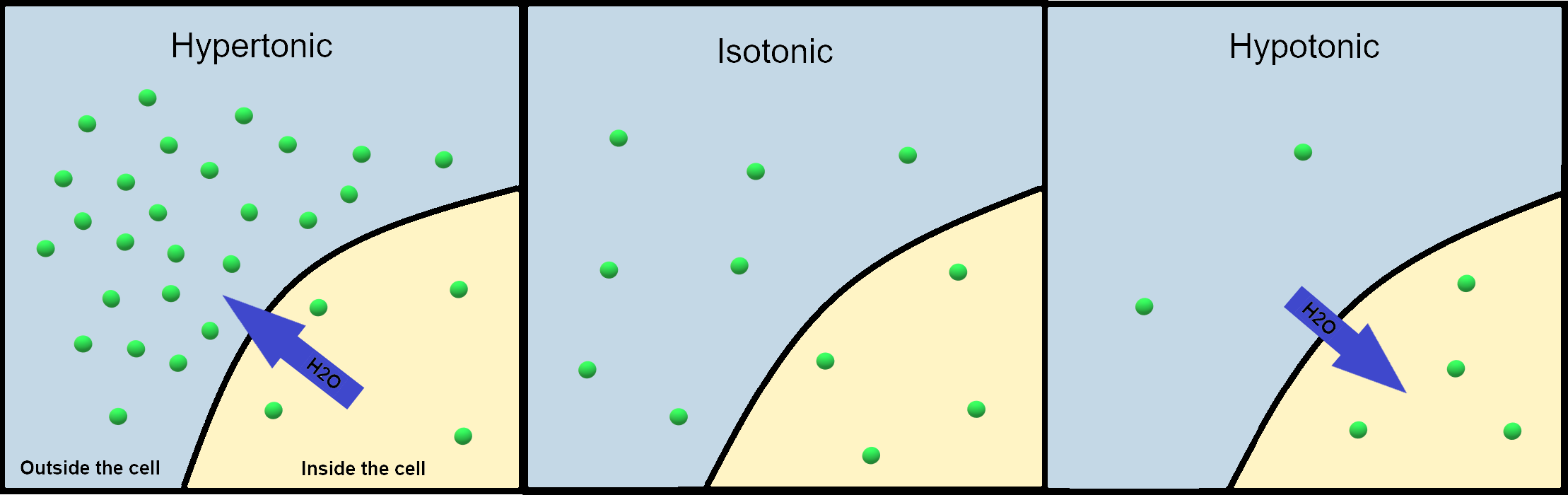
This diagram compares a cell placed in hypertonic, isotonic, and hypotonic solutions, emphasizing how tonicity determines the direction of net water movement. It visually links solute concentration differences to predictable changes in cell volume (shrink, no net change, swell). Source
Why water and solutes must be regulated
Water gain/loss changes cell volume
Excess water entering cells can cause swelling and stress membranes.
Excess water leaving cells can cause shrinking, impairing enzymatic reactions.
Solute levels affect physiological function
Ion gradients support essential processes (for example, transport and electrical signalling).
Abnormal ion concentrations can destabilise proteins and change pH buffering capacity.
Organismal consequences
Maintaining internal balance supports organismal growth, cellular homeostasis, and survival (as emphasised in the syllabus focus).
Osmoregulation mechanisms (how organisms achieve balance)
Sensing and responding to change
Osmoregulation begins with detecting shifts in internal fluid concentration or volume, then coordinating responses that change water and solute movement.
Sensors detect internal changes (e.g., osmolarity, blood volume, or pressure).
Control centres compare values to a set range.
Effectors adjust transport of water/solutes and modify excretion or intake.
Moving solutes to control water movement
Because water follows solutes, controlling solute transport is a primary method of controlling hydration state.
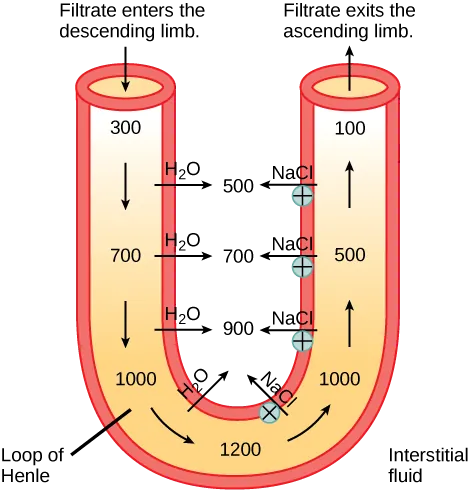
This figure shows the loop of Henle acting as a countercurrent multiplier: the descending limb loses water, while the ascending limb exports and but is impermeable to water. The result is a steep osmotic gradient in the renal medulla (increasing to about 1200 mOsm), which is essential for reabsorbing water and concentrating urine. Source
Active transport of ions can create gradients that drive water movement indirectly.
Selective permeability of epithelia (cell layers) determines which solutes are retained versus excreted.
Regulated excretion removes excess solutes and/or water to restore balance.
Behavioural and physiological adjustments
Osmoregulation is not only cellular; organisms also use whole-body strategies.
Behavioural responses
Adjusting drinking behaviour or seeking/avoiding salty environments.
Physiological responses
Modifying the concentration of excreted fluids (dilute vs concentrated) to match water availability.
Altering salt uptake or salt loss depending on external conditions.
Feedback control links osmoregulation to homeostasis
Negative feedback as the dominant control logic
Negative feedback: A control process in which a change in a variable triggers responses that counteract the change, returning the variable toward a set range.
A rise in internal solute concentration (higher osmolarity) typically triggers responses that increase water retention and/or reduce solute concentration; a drop triggers the opposite.
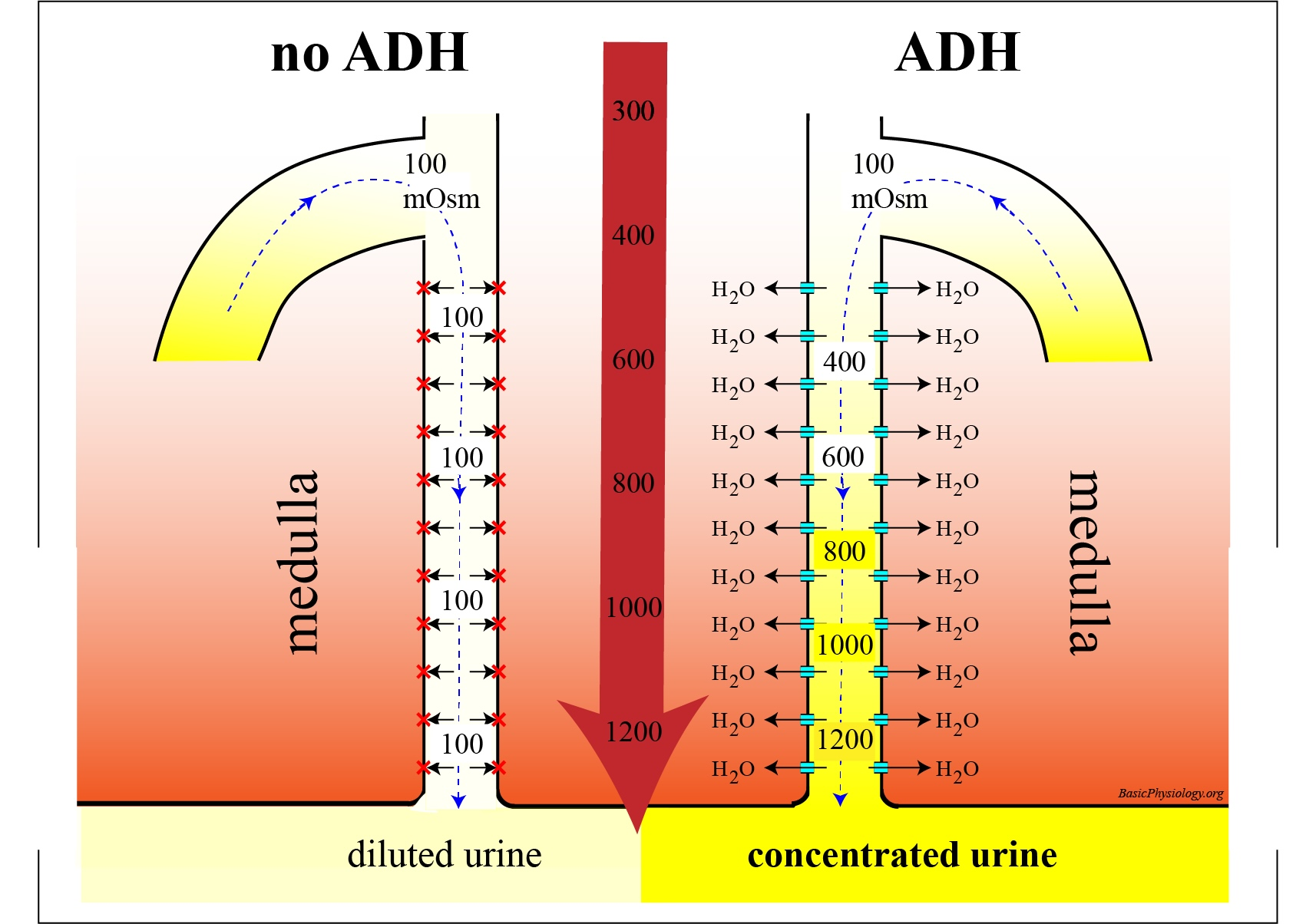
This diagram contrasts collecting duct behavior in the absence versus presence of ADH, showing how ADH increases water permeability so water can leave the tubule down the medullary osmotic gradient. It highlights why ADH produces a smaller volume of more concentrated urine, whereas low ADH produces dilute urine. Source
This stabilises internal conditions over time.
Coordination across levels of organisation
Osmoregulation integrates:
Cellular-level regulation
Cells adjust ion transport and water permeability to protect cell volume and biochemical reactions.
Tissue and organ-level regulation
Specialised epithelia coordinate directional movement of ions and water, controlling body fluid composition.
Organism-level regulation
Multiple systems act together so that water balance supports metabolism, circulation of nutrients, and stable conditions for growth.
What AP Biology expects you to connect
Mechanism to purpose: Osmoregulatory mechanisms are not just “about water”; they preserve conditions required for normal cellular function.
Homeostasis to survival: Stable internal osmolarity supports enzyme activity, membrane integrity, and physiological performance in changing environments.
Growth depends on regulation: Organisms must maintain appropriate hydration and solute levels to build biomass and sustain cell division and expansion.
Practice Questions
Explain how osmoregulation contributes to maintaining cellular homeostasis. (2 marks)
States that osmoregulation controls water balance and solute concentrations (1).
Links this control to maintaining stable cell volume/conditions for normal cellular function (1).
Describe how negative feedback can regulate internal water and solute balance when an organism becomes dehydrated. (6 marks)
Identifies dehydration leads to reduced body water and/or increased osmolarity (1).
Describes detection by sensors and comparison to a set range (1).
Describes signalling to effectors (1).
Explains effectors increase water retention and/or reduce water loss (1).
Explains effectors adjust solute handling to help restore osmolarity (1).
States the response reduces the original change (negative feedback), returning conditions towards normal (1).
FAQ
Marine environments tend to promote water loss and salt gain, while freshwater tends to promote water gain and salt loss.
Key difference: the direction of passive movement of water and ions relative to body fluids.
Some cells accumulate organic molecules (e.g., certain amino acid derivatives) that adjust internal osmolarity without disrupting proteins.
This supports enzyme function under osmotic stress.
Plant cells can shift solutes between compartments to adjust cytosolic conditions while maintaining water uptake.
This helps stabilise metabolism during changing external water availability.
Fast changes in osmolarity can drive water into or out of cells, altering cell volume.
In nervous tissue, this can disrupt signalling and damage delicate cell architecture.
Persistent osmotic changes can activate signalling pathways that alter transcription.
Outcomes may include changed expression of transport proteins and enzymes involved in synthesising osmoprotective molecules.

