AP Syllabus focus:
‘Use the constant multiple rule to differentiate functions of the form c·f(x), recognizing that the derivative is c·f′(x) when c is a constant and f is differentiable.’
The constant multiple rule provides a foundational strategy for differentiating functions efficiently, emphasizing how constant factors influence instantaneous rates of change while preserving the structure of the original function.
The Constant Multiple Rule in Differentiation
The constant multiple rule is one of the core derivative rules used to simplify expressions before differentiating. It states that when a differentiable function is multiplied by a constant, the derivative distributes through the constant without altering the functional form of . This idea connects directly to the concept of scaling in calculus: multiplying a function by a constant stretches or compresses its graph, and the rate at which the function changes is scaled by the same constant.
Constant Multiple Rule: If is a constant and is differentiable, then the derivative of is .
This concise principle plays a critical role in efficiently differentiating polynomial, trigonometric, exponential, logarithmic, and composite expressions whenever constant coefficients appear.
Why the Constant Multiple Rule Holds
When considering average and instantaneous rates of change, multiplying the entire output of a function by a constant scales every secant line slope and every tangent line slope by that same factor. The derivative, which measures instantaneous slope, naturally inherits this scaling property. Thus, the constant multiple rule arises as a direct consequence of how linear scaling affects difference quotients.
To show this relationship, recall that differentiation relies on the limit definition of the derivative. Applying that definition to a constant multiple preserves the constant through the limit process, reinforcing the rule's mathematical consistency.
= constant multiplier
= differentiable function
= derivative of the function with respect to
Because constants remain unchanged in limits, the derivative simply passes through the constant.
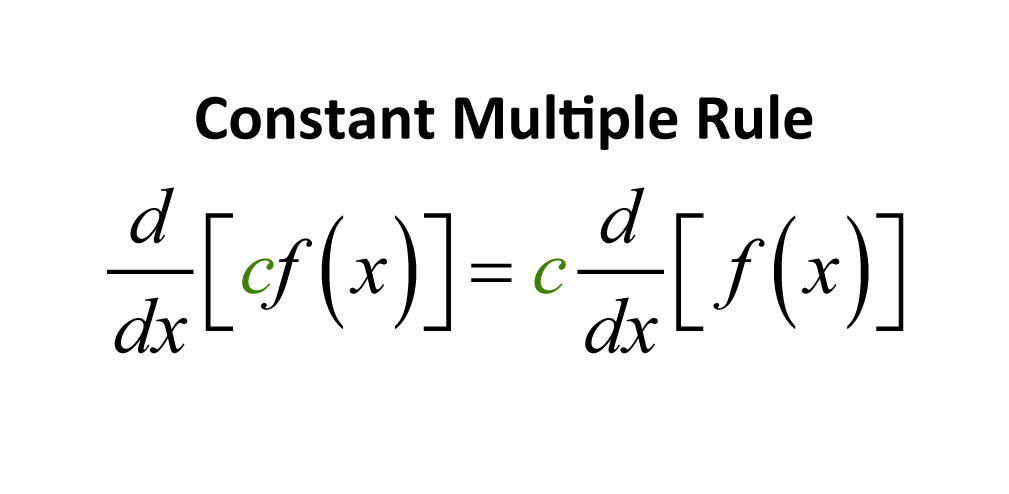
This diagram states the constant multiple rule in compact symbolic form, showing that when is a constant. It emphasizes that the constant factor is carried unchanged into the derivative. The image aligns with the AP requirement to recognize that the derivative is for differentiable functions multiplied by a constant. Source.
Key Characteristics and Interpretive Ideas
Understanding how the constant multiple rule affects a function’s graph and contextual meaning enriches a student’s ability to interpret derivatives beyond symbolic manipulation.
Graphical Interpretation
Multiplying a function by a constant vertically scales its graph:
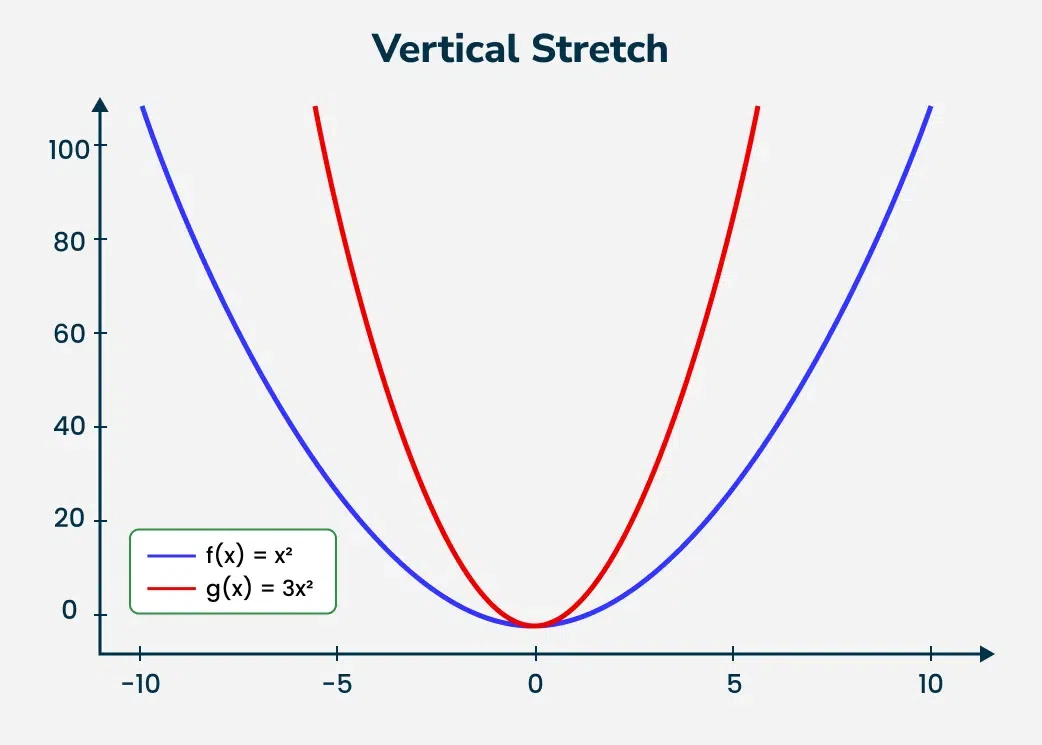
This graph compares the base function with its vertically stretched version . The red curve illustrates how multiplying by a constant increases steepness, scaling all slopes and therefore the derivative by the same factor. The visual focuses solely on vertical stretch, supporting conceptual understanding of the constant multiple rule. Source.
If , the graph stretches vertically, increasing all slopes proportionally.
If , the graph compresses, decreasing the steepness of all slopes.
If , the graph reflects across the -axis, reversing slope direction.
Because the derivative represents slope, each of these geometric effects directly influences :
Steeper graph → larger magnitude derivative
Flatter graph → smaller magnitude derivative
Reflection → opposite-signed derivative
These interpretations reinforce why the derivative of must be .
Contextual Interpretation
When applying the rule in real-world problems, constant multiples often represent scaling factors such as conversion units, pricing coefficients, or physical constants. The derivative then acquires a correspondingly scaled interpretation:
If models a quantity, may model cost, energy, or another scaled output.
The derivative then describes how quickly this scaled quantity changes with respect to the input variable.
This ensures consistency between the mathematical rule and its applied meaning.
Recognizing When the Rule Applies
Students must identify constants correctly to apply the rule efficiently. The rule applies only when:
The multiplier is a constant, not a variable.
The function being multiplied is differentiable.
No additional structure (such as products or compositions) requires other derivative rules.
A constant may be:
A real number (e.g., 5, –3, )
A symbolic constant (e.g., , )
A physical constant (e.g., gravitational constant, growth factor)
If the multiplier involves or any expression that varies with , then the constant multiple rule alone does not apply; instead, the product rule is required.
Strategic Use in Simplifying Derivatives
The constant multiple rule often appears in combination with other differentiation rules. It provides a first step in streamlining expressions before applying more advanced derivative techniques.
Students should adopt the habit of:
Pulling out constant factors before differentiating.
Separating complex expressions into manageable parts using sum and difference rules.
Avoiding unnecessary algebra by recognizing when constants can simplify derivative steps.
This rule is particularly powerful when differentiating polynomials, trigonometric functions with coefficients, and exponential functions multiplied by real-number constants.
Practical Structure for Applying the Rule
To apply the constant multiple rule consistently, follow this layered approach:
Identify any constant multipliers in the function.
Confirm that the function multiplied by the constant is differentiable.
Factor out the constant before taking the derivative.
Differentiate the remaining function using the appropriate rule.
Multiply the resulting derivative by the constant to obtain the final expression.
This structured method ensures clarity and reduces the likelihood of common mistakes such as differentiating the constant itself or incorrectly applying other derivative rules.
By mastering the constant multiple rule, students strengthen their foundational differentiation skill
Practice Questions
Question 1 (2 marks)
A differentiable function f has derivative f'(x) = 7x - 3.
Consider the function g defined by g(x) = -4 f(x).
(a) Use the constant multiple rule to find g'(x). (2 marks)
Question 1
(a)
• Correct application of the constant multiple rule: g'(x) = -4 f'(x). (1 mark)
• Substitution of f'(x) leading to g'(x) = -4(7x - 3) = -28x + 12. (1 mark)
Question 2 (5 marks)
A company models its production rate with a differentiable function P, where P(t) represents output in units per hour at time t.
A new process scales production by a constant factor k, creating a new function Q(t) = k P(t).
(a) Explain, using calculus reasoning, why Q'(t) = k P'(t). (2 marks)
(b) If k = 5 and P'(3) = 12, interpret the meaning of Q'(3) in the context of production. (2 marks)
(c) State one condition required for the constant multiple rule to apply. (1 mark)
Question 2
(a)
• States that multiplication by a constant scales all rates of change, so differentiation preserves the constant factor. (1 mark)
• Gives a correct calculus-based explanation, e.g., referencing the limit definition or slope scaling. (1 mark)
(b)
• Correct value: Q'(3) = 5 × 12 = 60. (1 mark)
• Correct interpretation: At t = 3 hours, production is increasing at 60 units per hour per hour (or an equivalent correct rate-of-change statement). (1 mark)
(c)
• States any valid condition such as: P must be differentiable; k must be a constant; the domain value must lie within the domain of differentiability. (1 mark)
FAQ
A number is a constant if it does not depend on the variable of differentiation and remains fixed for all values of that variable.
In practice, this means checking whether the quantity changes when x changes. If it does not vary, it qualifies as a constant and may be factored out before differentiating.
Differentiation is linear, meaning it preserves both addition and multiplication by constants.
The constant multiple rule reflects this by ensuring that derivatives respond proportionally to scaling. This linear behaviour allows more complex functions to be broken down into manageable components using constant factors.
Yes, provided the piece in which the constant multiple appears is differentiable on the interval of interest.
If either the constant changes between pieces or the underlying function is not differentiable at a boundary point, the rule may not apply there. Differentiability of the specific segment is essential.
Multiplying a model by a constant scales both the function’s values and the units of its derivative.
For example:
• If f(x) measures distance, c f(x) might measure scaled distance such as cost or weighted distance.
• The derivative’s units scale by the same constant, preserving meaningful interpretation.
Yes. Identifying constants early allows you to reduce clutter before applying other rules.
Useful strategies include:
• Factoring constants out of brackets or sums.
• Pulling constants out before applying product, quotient, or chain rules.
This minimises algebraic error and clarifies the structure of the function prior to differentiation.