

AP Syllabus focus: ‘Use dimensional analysis and the relationship n = m/M to convert between mass, moles, and number of particles for a pure substance.’
Chemistry often connects what you can measure directly (mass) to what reacts at the microscopic level (particles). Dimensional analysis provides a reliable, unit-driven path between grams, moles, and particle counts for a pure substance.
Core idea: the mole as a bridge
Dimensional analysis
Dimensional analysis is a unit-based problem-solving approach: you multiply by conversion factors so units cancel until the desired unit remains.
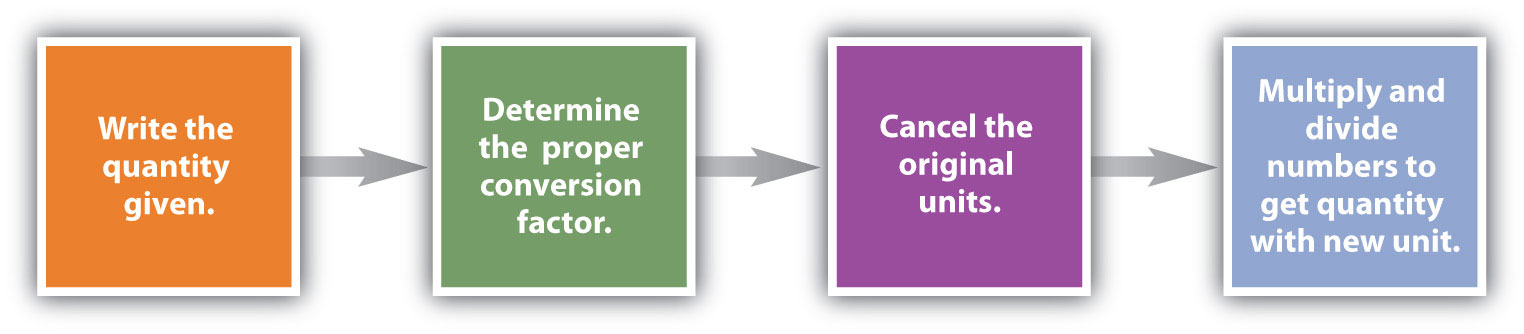
Flowchart-style summary of the factor-label method, emphasizing that conversion factors are chosen so units cancel cleanly. This reinforces dimensional analysis as a structured setup (not guesswork) where the units dictate the required arithmetic operations. Source
Dimensional analysis: A method that tracks and cancels units through multiplication by conversion factors to ensure a calculation is set up correctly.
In this subtopic, the key conversion factor comes from molar mass, which depends on the substance’s chemical identity and (if applicable) its formula.
The relationship
What each symbol means and how units control the setup
= amount of substance (mol)
= sample mass (g)
= molar mass (g·mol)
Use this relationship as a conversion between grams and moles.
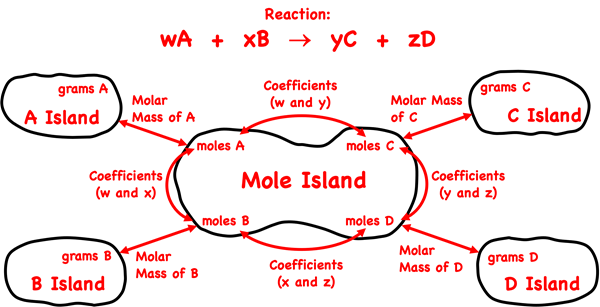
A “Mole Island” organizer that visualizes conversion routes between grams and moles using molar mass as the key link. While designed for reaction stoichiometry, the mass↔mole arrows emphasize the same one-step relationship your notes capture with and . Source
If you start with grams and divide by , the grams cancel, leaving moles; if you start with moles and multiply by , you obtain grams.
Converting among mass, moles, and particles
Mass ↔ moles (single-step with )
Mass to moles: choose the correct molar mass , then apply .
Moles to mass: rearrange conceptually to (often done directly as a factor-label step).
Moles ↔ particles (Avogadro conversion)
To connect moles to a count of particles, use Avogadro’s constant, particles per mol, as a conversion factor.
“Particles” must match the substance: atoms, molecules, ions, or formula units (for ionic solids).
Mass ↔ particles (two linked conversions)
A mass-to-particles conversion is typically built as:

Conversion pathway diagram showing mass (g) converting to amount (mol) by dividing by molar mass, followed by converting mol to particle count by multiplying by Avogadro’s number. The labels make the unit logic visible, reinforcing that the intermediate mole step is the bridge between macroscopic mass and microscopic entities. Source
grams → moles (using )
moles → particles (using Avogadro’s constant)
Dimensional analysis is especially valuable here because it forces every step to carry units, making it harder to mix up dividing vs. multiplying.
Choosing the correct molar mass
Pure substance identity matters
Selecting correctly is the most important chemistry decision in these conversions.
For an element measured as individual atoms (e.g., He), is the atomic molar mass from the periodic table.
For a molecular substance (e.g., CO), is the sum of atomic molar masses in the molecular formula.
For an ionic compound (e.g., CaCl), corresponds to one formula unit.
Be explicit about what one “particle” represents before converting to a particle count, so the final unit (atoms vs molecules vs formula units) matches the question’s wording.
Unit discipline and reporting
Practical checks (without doing extra chemistry)
Treat conversion factors as fractions designed to cancel units; write units on every quantity.
Convert metric prefixes when needed (e.g., mg to g) before using in .
Significant figures should generally follow the measured data; molar masses from the periodic table are typically treated as having many significant figures unless the problem states otherwise.
Practice Questions
(2 marks) A student has of MgCl. Calculate the amount, in moles, of MgCl present.
Uses with correct (1)
Correct substitution and answer in mol with appropriate significant figures (1)
(5 marks) Calculate the number of chloride ions, Cl, present in of AlCl. Use .
Determines correct from formula (1)
Converts mass to moles using (1)
Converts moles of AlCl to moles of Cl using 3:1 ratio (1)
Converts moles of Cl to number of ions using (1)
Correct final value with unit/meaning (ions) and appropriate significant figures (1)
FAQ
Match the wording to the substance.
Elemental metals/noble gases: particles are typically atoms.
Covalent substances (e.g., CO$_2$): particles are molecules.
Ionic solids (e.g., NaCl): particles are formula units unless ions are explicitly requested.
If ions are requested, use the formula to relate formula units to individual ions.
Do a unit-only check.
Write the intended unit after each step. If converting $g \rightarrow mol$, grams must cancel with the grams in $g\cdot mol^{-1}$. If grams do not cancel, the conversion factor is upside down.
Convert the given mass to grams first.
$1\ \text{kg} = 10^3\ \text{g}$
$1\ \text{mg} = 10^{-3}\ \text{g}$
Keeping everything in grams avoids unit mismatches when applying $n=\dfrac{m}{M}$.
Yes, if the question specifies ions (e.g., “number of Na$^+$ ions”).
You must:
find moles of formula units,
use subscripts to convert to moles of the specified ion,
then apply $N = nN_A$.
Avoid rounding early.
Carry at least 3–4 significant figures through intermediate steps, then round the final answer to match the limiting measured quantity in the problem (often the given mass).
