

AP Syllabus focus: ‘Use elemental composition by mass (often percent composition) to determine the empirical formula by converting masses to moles and simplifying to whole-number ratios.’
Percent composition data describe how elements contribute to a compound’s mass. In AP Chemistry, you use those mass relationships to deduce the simplest whole-number atom ratio, reported as an empirical formula.
Core idea: turning mass information into atom ratios
What you are solving for
Empirical formula: the chemical formula showing the lowest whole-number ratio of atoms of each element in a compound.
Percent composition gives relative masses of each element, but formulas require relative numbers of atoms.
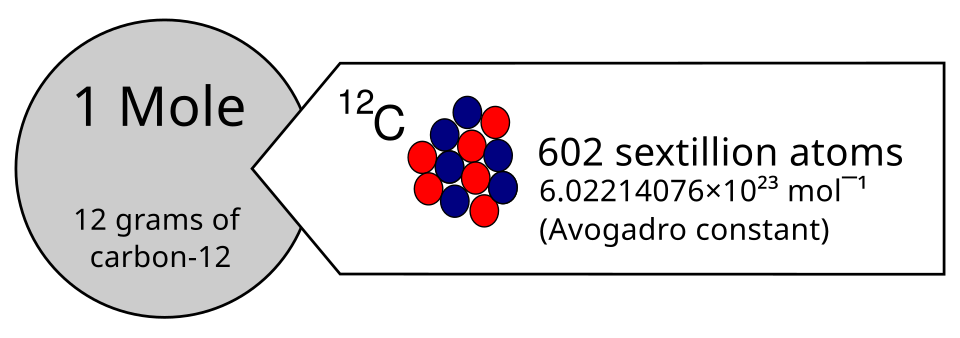
Schematic depiction of 1 mole as a defined-count chemical unit (historically illustrated via carbon-12). It helps connect the idea that mole ratios correspond directly to atom-count ratios, which is why empirical formulas come from comparing moles rather than grams. Source
Converting masses to moles bridges that gap because moles count particles proportionally.
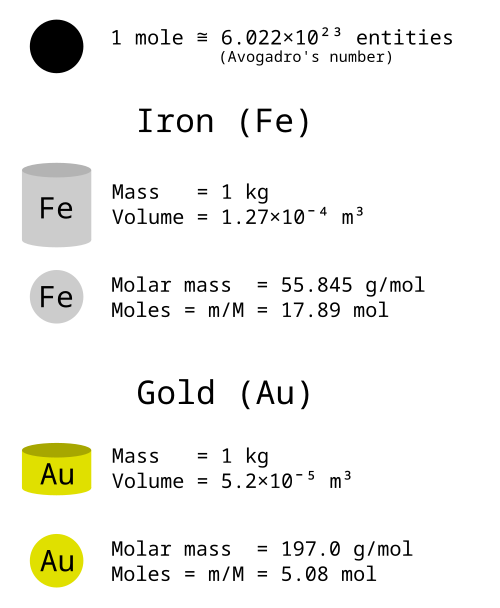
Diagram contrasting mass with amount (moles) and showing that molar mass is the proportionality constant relating them. This reinforces why percent composition (a mass relationship) must be converted into moles before an atom ratio can be inferred. Source
The essential conversion
= amount of substance in moles,
= mass of the element in the sample,
= molar mass of the element,
Use each element’s molar mass from the periodic table; keep enough significant figures to avoid rounding away a near-integer ratio.
Standard procedure (percent composition → empirical formula)
Step 1: Choose a convenient basis
If the composition is given in percent by mass, assume 100.0 g of compound.
Then each percent value becomes a mass in grams (e.g., 24.0% → 24.0 g).
If the problem gives actual masses (not percents), you may use those directly as your basis.
Step 2: Convert each element’s mass to moles
For each element:
Identify its mass in the chosen basis.
Convert grams to moles using .
Record the mole amounts clearly; these are proportional to the number of atoms of each element.
Step 3: Form the simplest mole ratio
Divide every element’s mole value by the smallest mole value calculated.
The resulting numbers represent the relative atom ratio, but may not yet be whole numbers due to rounding or fractional subscripts.
Step 4: Convert to whole-number subscripts
If the ratios are already close to whole numbers (e.g., 1.00, 2.00, 3.00), use them as subscripts.
If one or more ratios are near common fractions, multiply all ratios by the smallest integer that clears the fraction. Common targets include:
Values near 0.50 → multiply by 2
Values near 0.33 or 0.67 → multiply by 3
Values near 0.25 or 0.75 → multiply by 4
After scaling, subscripts should be the lowest whole-number set that preserves the ratio.
Step 5: Write the empirical formula
Write element symbols with the whole-number subscripts from Step 4.
Omit any subscript of 1.
The empirical formula expresses composition at the simplest ratio level; it does not by itself indicate the actual molecular size.
Practical checkpoints to avoid ratio mistakes
Consistency checks
The ratio division step should produce a 1 (or very close to 1) for at least one element.
Whole-number subscripts should not share a common factor (e.g., 2:4 should be reduced to 1:2).
Units and data handling
Percent values are mass-based, not mole-based; converting to moles is mandatory.
Molar masses must match the elements exactly as written (including correct atomic masses and units).
Keep intermediate values unrounded until the final ratio decision, especially when ratios are near fractional boundaries.
Practice Questions
(1–3 marks) A compound is 40.0% C, 6.7% H, and 53.3% O by mass. Determine the empirical formula.
Uses 100 g basis and converts each element to moles using (1)
Divides by the smallest mole value to obtain a ratio near integers (1)
Correct whole-number ratio and empirical formula: (1)
(4–6 marks) A compound contains 52.14% N and 47.86% O by mass. Determine the empirical formula, showing how you obtain whole-number subscripts from the mole ratio.
100 g basis (or equivalent) to obtain masses of N and O (1)
Correct moles for N and O using with appropriate molar masses (2)
Correctly divides by the smaller mole amount to obtain a non-integer ratio (1)
Identifies the needed multiplier to clear the fraction (e.g., near ) (1)
Correct empirical formula: (1)
FAQ
Percent by mass is a ratio. Choosing 100 g simply converts each percentage into grams without changing relative amounts.
Any other basis (e.g., 1.00 g or 250 g) gives the same final whole-number mole ratio after normalisation.
A practical tolerance depends on significant figures, but you should be cautious when values sit between common fractions.
If a value is not convincingly near an integer, test small multipliers (2, 3, 4) to see whether all ratios become near whole numbers together.
Treat this as rounding in the data. Use the given values as-is to compute moles.
Only consider adjusting (e.g., renormalising) if explicitly instructed; otherwise, the mole-ratio step typically absorbs small total-percent errors.
Check which multiplier makes all elements simultaneously land closest to whole numbers.
Prefer the smallest multiplier that produces a consistent set of near-integers and yields the lowest whole-number ratio overall.
Yes, if the total composition is otherwise defined. For example, if only one element’s percent is missing and the compound is stated to contain only those elements, you can find the missing percent by subtraction from 100%.
Then proceed with the same mass → moles → ratio workflow.
