

AP Syllabus focus:
‘Explain how resource availability shapes interactions among species, including predation, symbiosis, and competition.’
Species do not interact in a vacuum: the type, strength, and outcome of interactions depend on how much energy, nutrients, water, and space are available. Shifting resources can quickly reorganize communities.
Resource availability as the driver
What counts as a resource
Resource: any physical or biological requirement that organisms use for survival, growth, or reproduction (e.g., food, water, nutrients, light, nesting sites, territory).
Resources can be abiotic (water, minerals, sunlight, oxygen) or biotic (prey, host tissue, nectar). When resources are abundant, organisms may tolerate neighbours; when scarce, interactions intensify and trade-offs become more consequential.
Limiting resources and ecological “pressure”
Limiting resource: the resource in shortest supply relative to demand, which therefore constrains population growth, distribution, or performance.
A limiting resource increases selection pressure for behaviours and traits that improve acquisition (e.g., hunting efficiency, root depth, aggressive defence), which in turn changes how species affect one another.
How resources shape key interaction types
Predation responds to prey availability
Predation is often strongest where prey density and prey vulnerability are high.
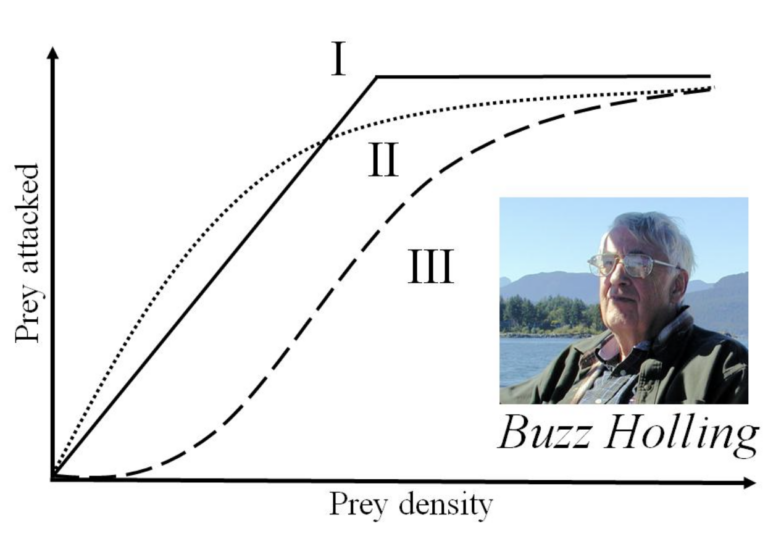
Holling functional response curves (Types I–III) showing how the number of prey attacked increases with prey density. The Type II curve highlights diminishing returns at high prey density as predator time becomes increasingly constrained by handling/processing prey, while Type III illustrates low consumption at low prey density followed by acceleration (often linked to learning or prey switching). Source
When prey is plentiful, predators may:
Spend less time searching and more time handling/consuming prey.
Specialise on the most profitable prey (high energy gain per effort).
Support higher predator reproduction and survival, increasing predator abundance.
When prey becomes scarce, predators may:
Switch prey types (altering pressure on multiple prey populations).
Expand territories or range farther (raising energetic costs).
Increase competition with other predators for the remaining prey.
Resource availability also shapes anti-predator strategies: scarce food can force prey to forage in riskier areas, increasing encounter rates and strengthening predator–prey interactions.
Symbiosis varies along resource gradients
Symbiosis: a long-term, close association between individuals of different species, ranging from beneficial to harmful depending on costs and benefits.
Resource scarcity can make cooperation more advantageous. For example, when nutrients are limited, organisms may rely more on mutualisms (both benefit) that improve resource access. When conditions change, the same partnership can shift along a continuum:
If one partner gains resources while the other pays increasing costs, the interaction can trend toward parasitism (one benefits, one harmed).
If one partner benefits and the other is largely unaffected, it trends toward commensalism.
In general, symbioses are most stable when resource exchange is reliable and the net benefit remains positive under prevailing conditions.
Competition intensifies when resources are limited
Competition: an interaction in which organisms reduce each other’s access to a shared limiting resource, lowering survival, growth, or reproduction of at least one participant.
Competition can occur:
Within a species (intraspecific), often strongest because individuals share similar needs.
Between species (interspecific), especially when niches overlap.
Low resource availability increases:
Exploitative competition (indirect): one species depletes a resource, leaving less for others.
Interference competition (direct): aggression, territoriality, or chemical inhibition prevents access.
As resources become limiting, competitive outcomes become clearer: one species may decline, shift habitat use, or experience reduced reproduction due to lower energy intake and higher stress.
Community-level outcomes of changing resources
Resource changes create indirect effects because altering one interaction cascades to others. Examples include:
Nutrient enrichment increasing plant growth, which can increase herbivore populations, changing predation pressure.
Water limitation concentrating organisms at remaining water sources, increasing both competition and predation encounters.
Human-altered resource availability
People modify resources through irrigation and dams (water), fertilisers (nutrients), logging (habitat structure), and overharvest (prey biomass). These shifts can:
Intensify competition by reducing habitat or food.
Disrupt symbioses by removing partners or altering timing (e.g., flowering vs pollinator activity).
Change predation by simplifying habitats, making prey easier or harder to catch.
Practice Questions
Explain how a decrease in a limiting resource can change the intensity of competition between two species. (2 marks)
States that reduced availability of a limiting resource increases competition because individuals/species overlap in demand (1).
Explains that reduced access lowers growth/survival/reproduction of one or both species (1).
A prolonged drought reduces plant biomass and freshwater availability in a grassland. Describe how this resource change could affect (i) predation, (ii) symbiosis, and (iii) competition among species. (5 marks)
Predation: less plant biomass lowers herbivore abundance/condition, reducing prey availability for predators OR forces prey into riskier foraging, altering encounter rates (1–2).
Predation: predators may switch prey, expand ranges, or experience reduced reproduction/survival (1).
Symbiosis: scarcity can increase reliance on beneficial partnerships that improve resource access OR shift cost–benefit balance so an interaction trends towards parasitism/commensalism (1).
Competition: reduced water/food increases exploitative or interference competition within/between species, lowering fitness (1).
FAQ
Yes. If environmental conditions alter costs or benefits, a relationship can shift along a continuum.
Resource scarcity may increase benefits of exchange (more mutualistic).
If one partner can obtain resources elsewhere, it may reduce investment, increasing net costs to the other (more parasitic).
Pulses can temporarily relax competition and boost reproduction.
After the pulse, populations may overshoot and then crash, intensifying competition and predation. Timing matters: species that respond fastest can gain a lasting advantage.
Fragmentation redistributes resources into smaller patches and increases edge effects.
This can crowd individuals into fewer high-quality areas, raising encounter rates and interference competition, while also limiting movement to track seasonal resources.
Species differ in nutrient requirements and uptake strategies.
If one nutrient becomes relatively scarcer, species efficient at acquiring or conserving that nutrient gain a competitive advantage, even if total biomass is similar.
A functional response describes how a predator’s consumption rate changes with prey density.
At low prey density, intake often drops due to search time; at higher density, intake can plateau due to handling limits. This helps predict when predation pressure will weaken or stabilise.
