

AP Syllabus focus:
‘Competition within or between species occurs when resources are limited; resource partitioning can reduce competition by using resources differently in space or time.’
Competition is a core ecological interaction that intensifies as essential resources become scarce. Understanding how species avoid or reduce competition helps explain biodiversity patterns, species coexistence, and how ecosystems respond when resource availability changes.
Competition in ecosystems
What competition is and when it occurs
Competition: an interaction in which organisms require the same limited resource, so use by one individual reduces availability for another.
Competition is strongest when key resources become limiting, such as:
Food/energy sources (seeds, prey, nectar)
Water (especially in arid or seasonal climates)
Space/territory (nest sites, burrows, reef surface)
Light (in forests and aquatic systems)
Nutrients (notably in nutrient-poor soils)
Types of competition
Intraspecific competition (within a species)
Often density-dependent: as population size rises, per-capita resources fall.
Can regulate population growth through reduced survival and reproduction.
Interspecific competition (between species)
Can reduce access to resources for one or both species.
May lead to shifts in habitat use, feeding behavior, or activity times.
Ecological consequences
Competition affects:
Population distribution (where organisms can persist)
Community composition (which species are present and in what abundance)
Resource use patterns (how species “divide up” limiting factors)
Sustained, strong interspecific competition can sometimes result in competitive exclusion, where one species is outcompeted locally; however, many communities persist because species reduce direct overlap in how they use resources.
Resource partitioning
Core idea
Resource partitioning: the differentiation of resource use that reduces competition by using resources differently in space or time (and often by type or method of use).
Resource partitioning is best understood through the idea that each species has a niche—the set of conditions and resources it uses to survive and reproduce.
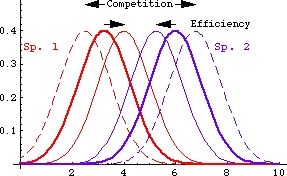
This niche-overlap diagram plots two species’ resource use along a single resource axis (e.g., seed size), with curve height representing frequency of use. It visually highlights how heavy overlap implies stronger interspecific competition, while divergence of the curves represents resource partitioning that reduces overlap and supports coexistence. The figure also helps distinguish broad potential resource use (fundamental niche conceptually) from narrower, competition-shaped use patterns. Source
When niches overlap strongly and resources are limited, competition increases; partitioning lowers overlap and supports coexistence.
Common forms of partitioning
Spatial partitioning (space)
Species use different habitats or microhabitats (e.g., canopy vs understory; shoreline vs open water).
Can involve vertical layering, patch use, or different territory sizes.
Temporal partitioning (time)
Species use the same resource at different times (day vs night; different seasons; different tidal stages).
Also includes timing differences in reproduction or peak foraging.
Dietary or resource-type partitioning (what is used)
Different prey sizes, plant parts, or nutrient sources.
Often associated with different feeding structures or strategies.
Behavioural/method partitioning (how it is used)
Different hunting methods, foraging heights, or search patterns, even within the same area.
Why partitioning reduces competition
Decreases direct overlap in limiting resources, lowering the strength of competition.
Allows each species to maintain a viable population without requiring one to eliminate the other.
Promotes species richness by enabling more species to persist in the same community, especially where resources are limited but diverse.
What to look for in real ecosystems
Evidence that resource partitioning is operating often includes:
Clear differences in habitat use, activity patterns, or diet between similar species
Coexistence of ecologically similar species in the same area despite limited resources
Shifts in resource use when a competitor is removed or newly introduced
Practice Questions
State what is meant by competition in an ecosystem and explain why it is more intense when resources are limited. (2 marks)
Defines competition as organisms requiring the same resource such that use by one reduces availability for another (1).
Explains that limited resources increase overlap and reduce per-capita availability, intensifying negative effects on others (1).
Explain how resource partitioning can reduce interspecific competition. In your answer, describe two distinct ways partitioning can occur, including reference to space and/or time. (5 marks)
Explains that partitioning reduces niche overlap and therefore reduces competition for limiting resources (1).
Describes spatial partitioning (e.g., different habitats/microhabitats/vertical zones) (1) with a link to reduced overlap (1).
Describes temporal partitioning (e.g., different times of day/season/tide) (1) with a link to reduced overlap (1).
FAQ
Look for changes in resource use when competitors are absent or reduced.
Useful indicators include:
Shifts in diet, habitat, or activity time after competitor removal
Increased overlap when resources become unusually abundant
Character displacement is evolutionary divergence in traits (e.g., beak size) driven by competition.
Over generations, trait differences can reduce overlap in resource use, reinforcing stable partitioning.
They often compare measured resource-use distributions (diet items, foraging times, microhabitats).
Common approaches include:
Proportional similarity indices
Niche breadth and overlap metrics based on frequency data
Yes—if the truly limiting resource is still shared (e.g., nesting sites), or if conditions force species into the same refuges.
Extreme weather or habitat loss can compress niches and increase overlap.
Often decreases it by simplifying habitats and reducing resource diversity.
However, new human-provided resources (e.g., crops, refuse) can create novel partitioning patterns, sometimes benefiting generalists over specialists.
