

AP Syllabus focus:
‘Describe symbiosis as a long-term, close interaction between two species, including mutualism, commensalism, and parasitism.’
Symbiosis explains many stable species partnerships in ecosystems, from nutrient exchanges to disease. Understanding who benefits, who is harmed, and how dependencies form helps predict population health, community structure, and responses to environmental change.
Symbiosis and how to classify it
Symbiosis describes persistent, intimate interactions between individuals of different species. The key AP skill is to classify interactions by their fitness effects (survival and reproduction) on each partner.
Symbiosis: A long-term, close interaction between two species.
In AP Environmental Science, symbiotic outcomes are often summarised as +/+, +/0, or +/-.
The “+” species gains energy, nutrients, shelter, transport, or protection; the “-” species loses energy, tissue, or future reproductive potential.
Mutualism (+/+)
Mutualism: A symbiotic relationship in which both species benefit.
Mutualisms commonly persist because each partner supplies a limiting need for the other.
Nutritional mutualisms
One species provides carbohydrates or organic carbon; the other provides minerals (e.g., nitrogen or phosphorus) or digestive capability.
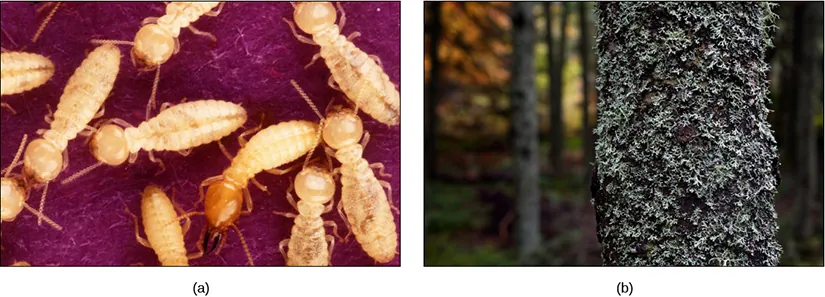
Photographs illustrating mutualism via (a) termites and their gut symbionts and (b) lichens on tree bark. These examples show how nutritional mutualisms persist when partners exchange limiting resources—such as digestion services or photosynthate—for shelter and access to nutrients. Source
Protection mutualisms
One species offers defence (stings, aggression, chemical deterrents); the other provides food or habitat.
Reproductive mutualisms
Animals gain food while plants gain pollination or seed dispersal.
Mutualism can be:
Obligate: at least one partner cannot survive or reproduce well without the other.
Facultative: both partners benefit, but either can live independently under some conditions.
Commensalism (+/0)
Commensalism: A symbiotic relationship in which one species benefits and the other is neither helped nor harmed in a meaningful way.
Commensalism is often about habitat and movement, not direct resource transfer.
Phoresy (transport): one organism gains dispersal by riding another.
Inquilinism (housing): one species gains shelter on or in another (for example, living on bark, shells, or external surfaces).
Feeding opportunities: one species uses leftovers or disturbed food sources without measurably affecting the “host” species.
Because “no effect” is difficult to prove, commensalism can shift to mutualism or parasitism if environmental conditions change (for example, if the commensal begins damaging tissue or providing defence).
Parasitism (+/-)
Parasitism: A symbiotic relationship in which one species benefits while the other is harmed.
In parasitism, the parasite gains energy or resources from the host, reducing host fitness. Unlike predators, parasites typically do not kill the host quickly, because the host is the parasite’s habitat and food source.
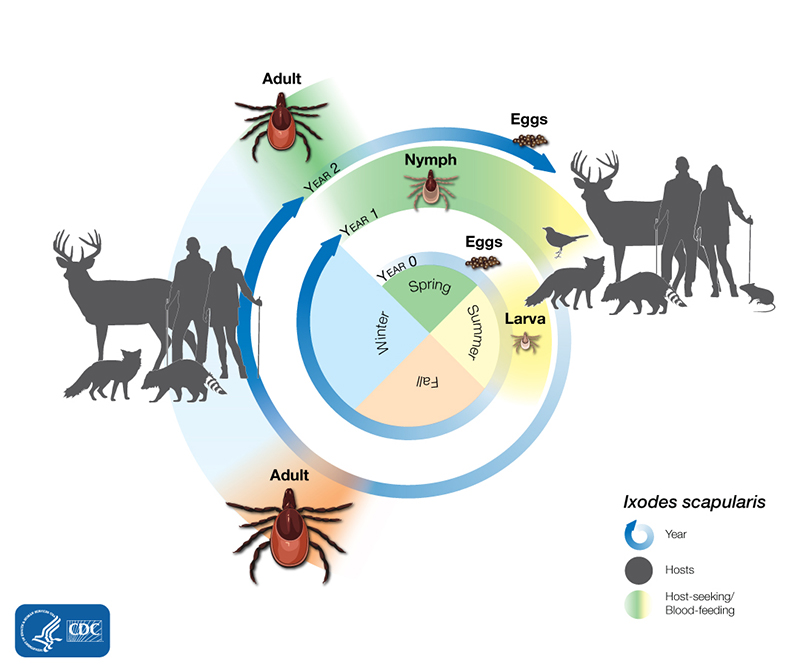
Labeled life-cycle diagram of the blacklegged tick (Ixodes scapularis), showing transitions among egg, larva, nymph, and adult stages across seasons. By connecting life stages to host-seeking and blood-feeding, it illustrates how parasitism can be prolonged and tightly linked to host availability over time. Source
Common parasite strategies include:
Ectoparasites (external): feed on skin, blood, or secretions; may increase host energy loss or introduce disease.
Endoparasites (internal): live in tissues or organs; may steal nutrients, disrupt function, or trigger immune costs.
Pathogens: disease-causing organisms; often treated as parasitic when they benefit by reproducing in the host.
Host–parasite interactions can drive coevolution:
Hosts evolve resistance (immune responses, barriers, behaviours like grooming).
Parasites evolve evasion (rapid reproduction, antigen changes, hiding within tissues).
What maintains symbiotic relationships over time
Long-term close interactions persist when benefits reliably exceed costs for at least one partner and when partners repeatedly encounter each other.
Specificity
Some symbioses are highly specific (one host species), while others are generalist (many possible partners).
Dependency and stability
Obligate relationships can be vulnerable to partner loss; facultative relationships may be more resilient across changing conditions.
Context dependence
The same pairing may change category depending on stress, resource levels, or population density (for example, a normally harmless commensal becoming harmful when it overgrows).
Practice Questions
Define symbiosis and name the three main types. (2 marks)
Correct definition: long-term, close interaction between two species (1)
Names any two of: mutualism, commensalism, parasitism (1)
A tick feeds on the blood of a deer for several days, while bacteria in a herbivore’s gut help digest cellulose and receive nutrients.
(a) Classify each interaction type.
(b) For each, state one benefit and one cost/impact for the relevant species. (6 marks)
Tick–deer classified as parasitism (1)
Correct benefit to tick (e.g., gains nutrients/energy from blood) (1)
Correct harm to deer (e.g., blood loss, disease risk, reduced fitness) (1)
Gut bacteria–herbivore classified as mutualism (1)
Correct benefit to herbivore (e.g., improved digestion/energy from cellulose breakdown) (1)
Correct benefit to bacteria (e.g., habitat and steady nutrient supply) (1)
FAQ
If conditions change, the balance of costs and benefits can flip.
Resource scarcity can increase competition between partners.
Overgrowth of one partner can cause tissue damage or nutrient drain.
A pathogen specifically causes disease, often via toxins or rapid replication.
A parasite is broader: it benefits from the host and harms it, sometimes without obvious “disease” symptoms.
Showing “no effect” requires measuring subtle fitness changes.
Small impacts (stress, infection risk, altered behaviour) may exist but be difficult to detect.
Obligate mutualisms arise when partners lose independent capabilities over evolutionary time.
Specialisation can increase efficiency but reduces flexibility if the partner disappears.
Hosts may tolerate parasites to limit damage rather than fully resist them.
Tissue repair and anti-inflammatory control
Behaviours reducing exposure (avoiding vectors, grooming)
