

AP Syllabus focus:
‘In predator–prey interactions, predators consume other organisms (their prey) as a source of energy and matter.’
Predator–prey relationships are a core species interaction that shapes population sizes, organism behavior, and energy transfer through ecosystems. They link survival, reproduction, and resource availability for both predators and prey.
Core idea: energy and matter transfer
In predator–prey interactions, one organism obtains energy and matter (biomass and nutrients) by consuming another. This interaction affects individual fitness and can scale up to influence population dynamics.
Key terms
Predation: an interaction in which a predator kills and consumes a prey organism, transferring energy and matter from prey tissues to predator tissues.
Predation differs from simply “eating” because it typically involves capture, killing, and consumption, with strong selective pressure on both organisms.
How predator–prey interactions shape populations
Predator–prey relationships are often density-dependent, meaning their effects strengthen as population density changes.
Top-down control and limitation
Predators can limit prey populations by increasing prey mortality, especially when prey are abundant and easy to find.
High prey density can increase predator hunting success (more encounters).
Low prey density can reduce predator success, sometimes allowing prey populations to rebound.
Predators may also reduce prey reproduction indirectly by changing prey behavior (less feeding, more hiding).
Predator responses to prey availability
Predator populations commonly track prey availability through two linked responses:
Functional response: change in the rate of prey consumption per predator as prey density changes (often increasing, then leveling off due to handling time).
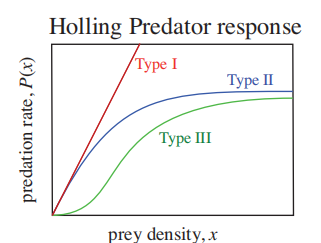
Comparison of Holling functional response curves (Types I, II, and III) showing how per-capita predation rate changes with prey density. The Type II curve rises rapidly at low prey density and then saturates, reflecting a ceiling on consumption as handling time and other constraints dominate at high prey availability. Source
Numerical response: change in predator population size (or local abundance) as prey becomes more available, via improved survival, reproduction, or immigration.
Adaptations and coevolution
Predator–prey interactions drive coevolution, where each species selects for traits in the other over generations.
Predator strategies
Predators evolve traits that improve prey capture and consumption:
Sensory adaptations (acute vision, smell, echolocation)
Speed and strength for pursuit or ambush
Camouflage and stealth
Cooperative hunting in some species, increasing capture success
Prey defenses
Prey evolve traits that reduce the chance of being eaten:
Avoidance behaviors (vigilance, flocking/schooling, alarm calls)
Structural defenses (shells, spines)
Chemical defenses (toxins, irritants)
Warning coloration (aposematism) and mimicry
Predator satiation strategies (e.g., synchronized emergence so predators cannot consume all individuals)
Population cycles and stability
Some predator–prey systems exhibit oscillations:
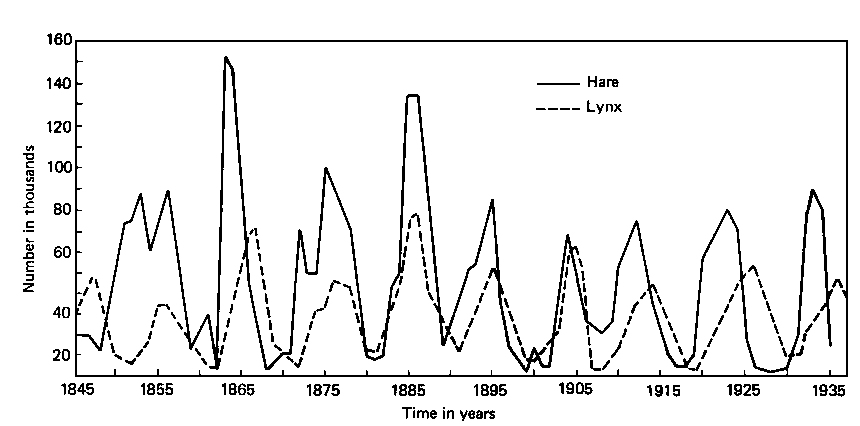
Time-series of snowshoe hare (solid) and Canada lynx (dashed) abundances derived from Hudson Bay Company pelt records. The repeating peaks and troughs, with lynx peaks generally lagging behind hare peaks, illustrate how predator population growth often follows prey increases and then feeds back to suppress prey abundance. Source
Prey populations may increase when resources and conditions are favorable.
Predator populations may increase after prey become abundant (more energy and matter available for predator growth and reproduction).
As predators increase, prey mortality rises, reducing prey abundance.
Reduced prey then limits predators, causing predator decline, which may allow prey recovery.
Stability depends on factors such as prey refuges, habitat complexity, and predator diet breadth.
Why prey are rarely eliminated
Complete prey elimination is uncommon because:
Prey may have refuges (physical hiding places or low-density areas where predators hunt inefficiently).
Predators often switch to alternative prey when a preferred prey becomes scarce.
Predators face constraints such as territory size, competition with other predators, and energetic limits.
Human impacts on predator–prey relationships
Human actions can shift predation intensity and outcomes by changing encounter rates and survival.
Habitat fragmentation can increase edge habitats, sometimes boosting predator access to prey.
Overharvesting predators can release prey from predation pressure, increasing prey populations.
Introducing non-native predators can cause steep prey declines when prey lack effective defenses.
Supplemental food (garbage, livestock carcasses) can raise predator survival and increase pressure on wild prey.
Practice Questions
Describe what happens in a predator–prey interaction and state why it is important for energy and matter flow. (2 marks)
Predators consume prey organisms (1)
This transfers energy and matter/biomass (nutrients) from prey to predator (1)
Explain how changes in prey abundance can affect predator abundance over time. Include at least two mechanisms in your answer. (6 marks)
More prey increases predator feeding success/encounter rate (functional response) (1)
Increased food intake raises predator survival and/or reproduction (1)
Predator numbers can rise via reproduction or immigration (numerical response) (1)
Higher predator abundance increases prey mortality, reducing prey abundance (1)
Reduced prey limits predator food supply, causing predator decline (1)
Reference to stabilising factors such as prey refuges or prey switching that can prevent extinction (1)
FAQ
Common approaches include direct observation, camera traps, and analysis of scat/stomach contents.
“Sentinel prey” experiments (artificial nests or model prey) can estimate relative risk
GPS collars can link predator movements to kill sites
Type II: consumption rises quickly then plateaus due to handling time.
Type III: consumption is low at low prey density (refuges, learning, prey switching), then accelerates before plateauing, often stabilising prey populations.
When predators shift to more abundant prey, rarer prey experience reduced hunting pressure.
This negative feedback can reduce extreme oscillations and lower the chance of a prey population crashing to very low levels.
Native prey may be “predator-naïve,” lacking effective recognition or avoidance behaviours.
Invasive predators may also hunt differently (new times/places) or reach higher densities due to fewer natural controls in the introduced range.
Urban light, noise, and food subsidies can alter hunting and vigilance.
Artificial lighting can increase nocturnal hunting success for some predators
Human refuse can boost predator survival, increasing pressure on nearby prey populations
