

AP Syllabus focus:
‘Biodiversity in an ecosystem includes three levels: genetic diversity, species diversity, and habitat diversity.’
Biodiversity is described at multiple biological scales. Understanding genetic, species, and habitat diversity helps explain ecosystem resilience, conservation priorities, and how environmental change can alter the living world.
Biodiversity as a multi-level concept
Biodiversity: The variety of life in an area, measured at different levels of biological organisation, including genes, species, and habitats.
In AP Environmental Science, biodiversity is commonly framed using three complementary levels, each capturing a different kind of “variety” found in nature. Looking at only one level can miss important patterns (for example, two sites can have the same number of species but very different genetic variation within those species).
Level 1: Genetic diversity
What it is and what it measures
Genetic diversity: The variety of genetic information (alleles) within a population or species.
Genetic diversity focuses on differences within a species, not between species.
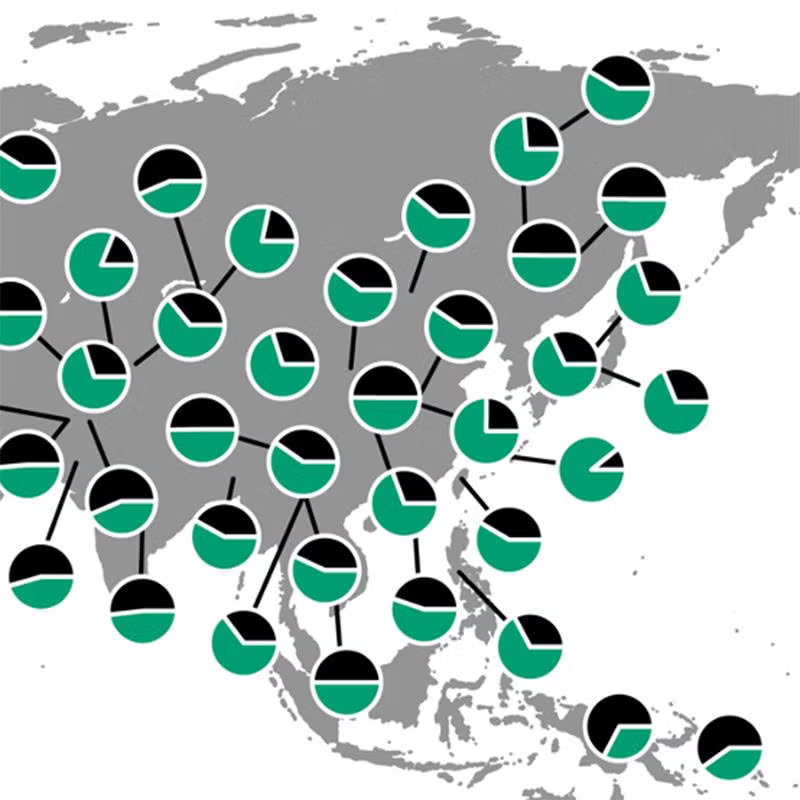
A map-based allele-frequency visualization uses pie charts to show how common alternative alleles are in different populations. Each pie summarizes genetic variation within a population, making spatial patterns of genetic diversity easy to compare. Such displays help connect the concept of alleles to real-world population differences across geography. Source
It includes variation among individuals in traits such as disease resistance, drought tolerance, growth rate, and reproductive timing.
Why it matters (conceptual emphasis)
Higher genetic variation increases the chance that some individuals can survive changing conditions.
Low genetic diversity can be associated with:
Reduced fertility or survival
Greater vulnerability to the same stressor affecting many individuals similarly
Less capacity for populations to maintain performance across variable environments
How to recognise it in context
Larger, well-connected populations often maintain more genetic diversity than small, isolated ones.
Genetic diversity can differ widely even when the same species is present in multiple locations.
Level 2: Species diversity
What it is and what it measures
Species diversity: The variety of species in a community, considering how many species are present and how individuals are distributed among those species.
Species diversity is about the community level: which species are present and the balance among them.
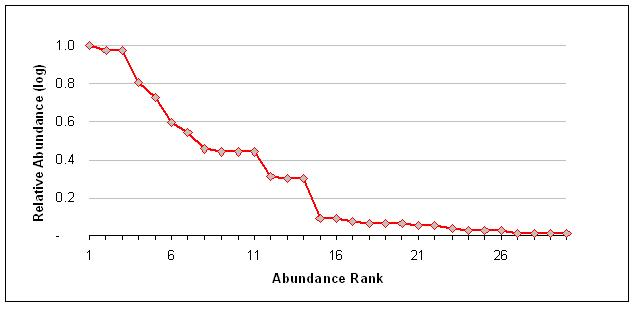
A rank–abundance (Whittaker) curve illustrates how individuals are distributed among species in a community. The length of the curve reflects species richness, while the steepness indicates evenness (steeper curves mean a few species dominate). This makes it a compact way to compare overall community diversity across sites. Source
A community dominated by one species with a few rare species is typically considered less diverse than one where individuals are more evenly spread across many species.
What species diversity captures
The breadth of ecological roles (for example, producers, predators, decomposers)
The potential for complex interactions (competition, predation, mutualism) that shape community structure
The “portfolio” of responses to environmental conditions (different species thrive under different conditions)
How it is discussed in APES contexts
Species diversity is often compared across habitats (for example, forest vs. grassland) or across disturbance gradients.
It is a central descriptor when evaluating conservation areas, restoration targets, and land-use impacts.
Level 3: Habitat diversity
What it is and what it measures
Habitat diversity: The variety of habitat types and physical environments within a landscape or region.
Habitat diversity focuses on the range of different places organisms can live (for example, wetlands, upland forests, riparian zones, dunes).
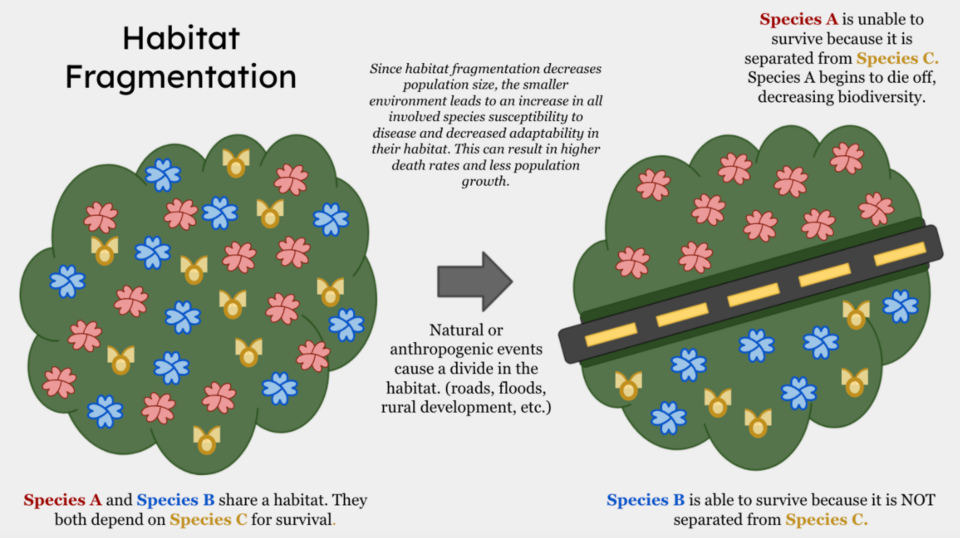
This diagram shows habitat fragmentation, where a once-continuous habitat becomes separated into smaller, isolated patches. It highlights how patch size, edge area, and connectivity can change as landscapes are subdivided. These spatial changes affect which species can persist and how easily organisms can move between habitats. Source
Because different species require different conditions, more habitat types generally create more ecological opportunities across a landscape.
Key components of habitat diversity
Structural variety (vertical and horizontal complexity, such as canopy layers or patchiness)
Abiotic variety (differences in soil type, moisture, salinity, temperature, and light)
Spatial arrangement of habitats
Large continuous habitat
Many small patches
Corridors connecting patches
Why habitat diversity is a distinct biodiversity level
Two regions could contain the same number of species today but differ in habitat diversity, affecting:
Future capacity to support additional species
Opportunities for migration within the landscape
The ability of populations to persist if local conditions shift
How the three levels relate (without being identical)
Genetic diversity occurs within a species and supports adaptability within populations.
Species diversity occurs among species in a community and reflects community composition and balance.
Habitat diversity occurs across physical environments and influences which species and populations can exist in a region.
Because these levels can change independently, environmental assessments and conservation plans often consider all three to describe “how biodiverse” an ecosystem is in a more complete way.
Practice Questions
State the three levels of biodiversity and briefly describe one of them. (2 marks)
1 mark: Names all three: genetic diversity, species diversity, habitat diversity.
1 mark: Correct brief description of any one level (e.g., genetic diversity = variation in genes/alleles within a population).
Explain how genetic diversity, species diversity, and habitat diversity represent different ways of measuring biodiversity, and describe one ecological implication for each level. (6 marks)
1 mark: Genetic diversity defined/identified as variation in alleles within a population/species.
1 mark: Species diversity defined/identified as variety of species in a community (may include evenness).
1 mark: Habitat diversity defined/identified as variety of habitat types/physical environments in a region.
1 mark: Ecological implication for genetic diversity (e.g., supports differential survival under environmental change).
1 mark: Ecological implication for species diversity (e.g., broader range of ecological roles/interactions within a community).
1 mark: Ecological implication for habitat diversity (e.g., more niche types/landscape options supporting more kinds of organisms).
FAQ
Common approaches include sampling specific genetic markers (e.g., microsatellites or SNP panels) and calculating metrics such as heterozygosity.
In field-oriented studies, visible trait variation can be noted, but it is less reliable because environment can influence traits.
Species richness counts how many species are present.
Species diversity also considers how evenly individuals are distributed among species, so two sites with equal richness can differ in diversity if one is dominated by a single species.
Yes. Small regions can contain sharp environmental gradients (e.g., shoreline-to-upland transitions) or fine-scale patchiness.
Examples include ecotones, complex topography, or mosaics created by natural features (rocks, streams) that generate multiple microhabitats.
If habitats are highly fragmented or too small, some species may not maintain viable populations.
Other limiting factors include harsh abiotic conditions, historical isolation, or barriers preventing colonisation of suitable habitats.
They may contain the same species, but one ecosystem’s populations could be small and isolated, reducing gene flow.
The other may be well-connected with larger population sizes, maintaining more alleles through mixing and reducing random loss of variation.

