

AP Syllabus focus:
‘Explain why nonmineral terrestrial resources (such as freshwater and trees for lumber) vary with climate, geography, latitude/altitude, nutrient availability, and soils.’
Nonmineral resources on land are unevenly distributed because physical conditions control water supply, plant growth, and ecosystem structure. Understanding these controls helps explain why some regions support forests, crops, or abundant freshwater while others do not.
What counts as a “resource” in terrestrial biomes?
Nonmineral terrestrial resources: Biologically or hydrologically based resources (e.g., freshwater, timber, forage, fertile soil) rather than mined geologic materials.
Resource availability is ultimately determined by how much biomass can be produced and how much liquid water is accessible over time.
Climate: the primary control on water and biomass
Precipitation patterns
Precipitation sets the baseline for surface water, soil moisture, and groundwater recharge.
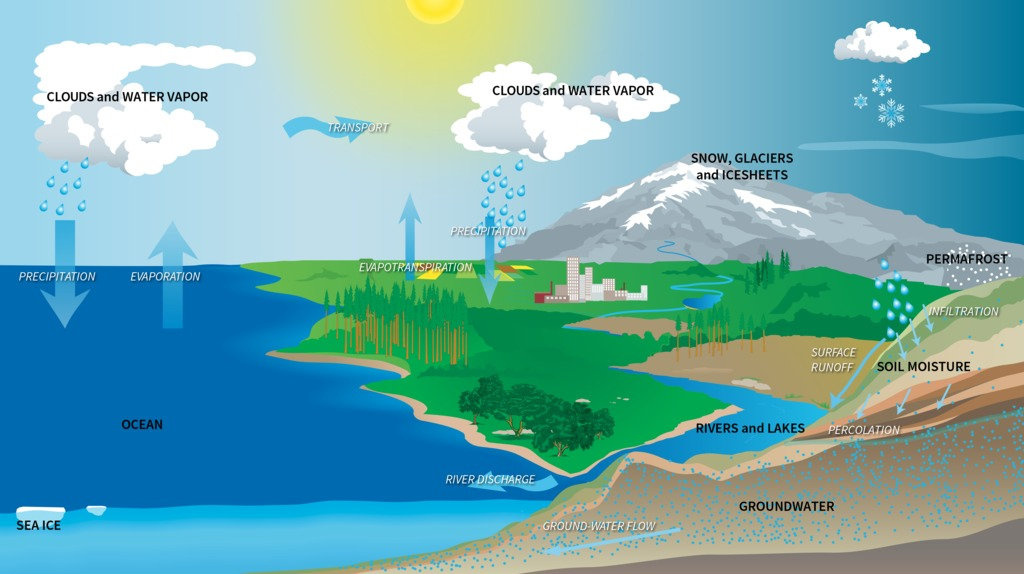
This diagram summarizes the major reservoirs (oceans, atmosphere, surface water, groundwater, snow/ice) and fluxes that move water between them, including precipitation, runoff, infiltration, and evapotranspiration. It reinforces that freshwater availability depends not just on how much rain falls, but on how much returns to the atmosphere versus how much infiltrates to recharge aquifers and sustain streams. Source
High, reliable rainfall increases streamflow, lake persistence, and aquifer recharge.
Low or highly seasonal rainfall limits freshwater and increases drought stress, reducing tree growth and timber yields.
Storm intensity matters: short, heavy rains often increase runoff and erosion instead of soaking into soils.
Temperature and evapotranspiration
Temperature influences evaporation and plant transpiration, controlling how much precipitation becomes usable water.
Warm conditions can reduce freshwater availability even where rainfall is moderate, because evapotranspiration is high.
Cold conditions can “lock up” water as snow/ice seasonally, limiting liquid water despite substantial precipitation.
Net effect on forests and lumber
Trees require sufficient water and a growing season long enough to accumulate woody biomass.
Wet + moderate temperatures generally favour high forest productivity and timber potential.
Dry climates favour grasses/shrubs; wood production is slower and more limited.
Geography: where a place sits reshapes local resource supply
Proximity to oceans and moisture sources
Coastal regions often have higher humidity and more frequent precipitation than interiors.
Onshore winds can deliver moisture, supporting greater freshwater availability and forest growth.
Continental interiors are commonly drier, lowering stream density and limiting timber.
Mountains, topography, and rain shadows
Topography controls where air rises and rains.
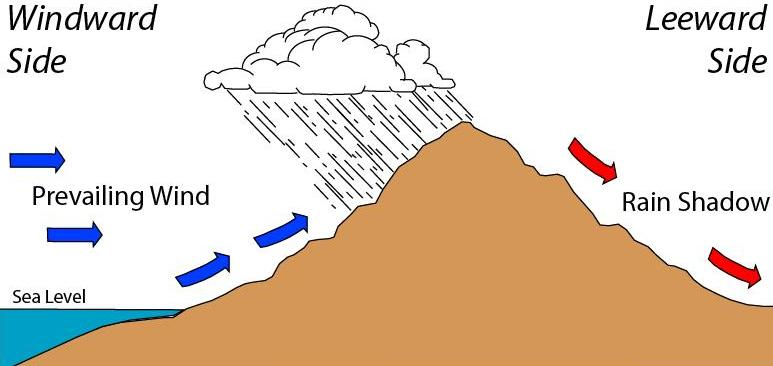
This rain-shadow diagram illustrates how moist air rises on windward mountain slopes, cools, and drops precipitation, producing wetter conditions that support streams and forests. It also shows how descending air on the leeward side warms and dries, creating arid conditions with reduced freshwater availability and limited woody vegetation. Source
Windward slopes: rising air cools, precipitation increases, supporting streams, forests, and deeper soils.
Leeward slopes (rain shadow): descending air warms and dries, reducing freshwater and woody vegetation.
Slope steepness affects infiltration and soil stability; steep terrain often increases runoff and erosion, lowering soil water storage and limiting agriculture/forest access.
Drainage networks and watershed shape
Even with similar rainfall, landscapes with dense drainage networks and permeable substrates can store and deliver freshwater differently than landscapes with rapid runoff or limited infiltration.
Latitude and altitude: solar energy gradients set growing conditions
Latitude (distance from the equator)
Latitude controls sun angle and seasonality, influencing temperature and growing season length.
Higher latitudes typically have shorter growing seasons, constraining tree growth rates and overall biomass.
Lower latitudes receive more consistent solar input, but water may still be limiting if precipitation is low or seasonal.
Altitude (elevation)
Temperature generally decreases with elevation, changing vegetation and water form.
Cooler temperatures can reduce evapotranspiration, sometimes increasing soil moisture.
High elevations can store water as snowpack, releasing freshwater seasonally downstream.
Tree lines occur where cold, wind, or shallow soils limit forests, reducing lumber resources above certain elevations.
Nutrient availability: productivity depends on more than water
Even in wet climates, plant growth can be limited by nutrient supply.
Low nutrient availability reduces primary productivity, lowering timber yields and slowing ecosystem recovery after disturbance.
Nutrient-rich conditions can support denser vegetation and greater biomass, provided water and temperature are suitable.
Key influences on nutrients include:
Parent material (what the soil formed from)
Weathering rates (often faster in warm, wet climates)
Leaching (heavy rain can wash nutrients downward/out of root zones)
Soils: the “operating system” for terrestrial resources
Soils determine how much water and nutrients are stored and how well roots can access them.
Texture: sandy soils drain quickly (lower water storage); clay-rich soils hold more water but may reduce aeration.
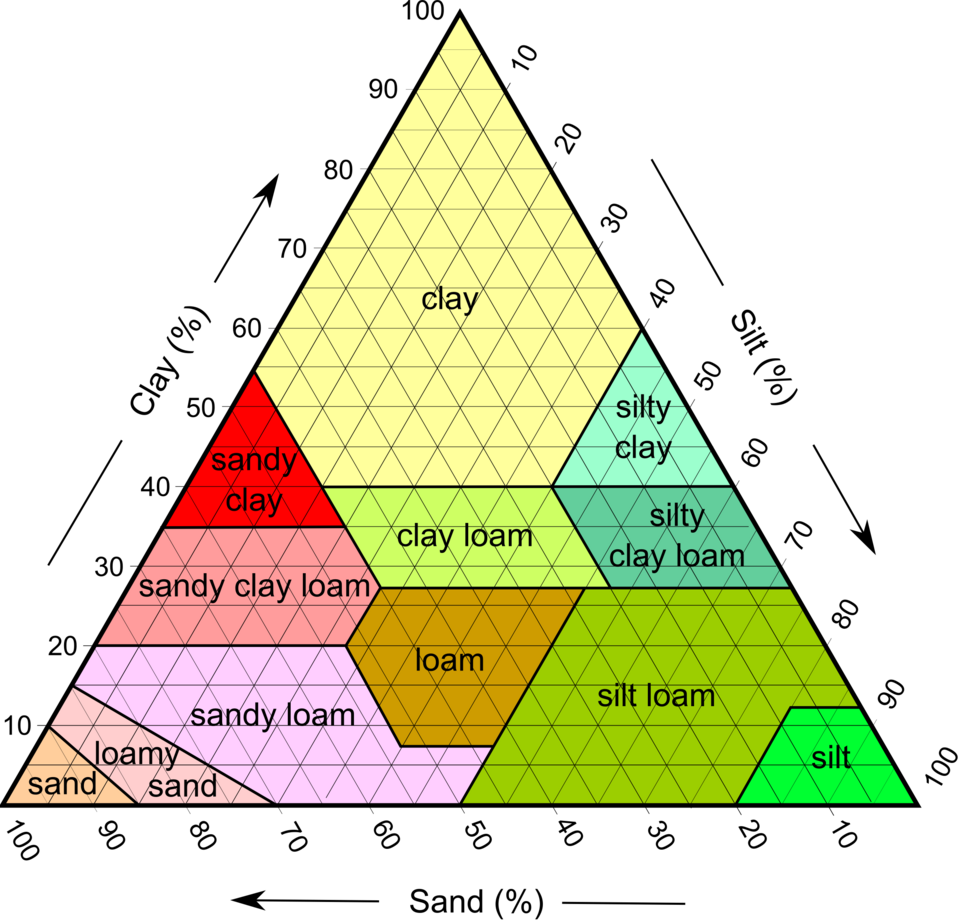
This soil texture triangle classifies soils based on the relative percentages of sand, silt, and clay, linking particle-size composition to a named soil texture class (e.g., loam, sandy loam, clay). Because texture controls pore size distribution, it strongly influences infiltration, drainage, and plant-available water—key factors shaping terrestrial biomass and resource potential. Source
Organic matter (humus) increases nutrient retention and water-holding capacity, supporting higher plant growth.
Soil depth controls rooting volume; shallow soils limit trees and reduce drought resilience.
pH affects nutrient solubility; extreme pH can reduce nutrient availability even when nutrients are present.
Erosion susceptibility reduces long-term fertility and can silt up waterways, affecting freshwater quality and storage.
Because soils integrate climate, topography, organisms, and time, they strongly mediate where freshwater is retained and where forests can develop enough to be harvested sustainably.
Practice Questions
State two factors that cause nonmineral terrestrial resources such as freshwater and timber to vary across land biomes. (2 marks)
Any two distinct factors named (1 mark each): climate, geography/topography, latitude, altitude, nutrient availability, soils.
Explain how climate and soils together can lead to high freshwater availability but low timber production in a terrestrial region. (6 marks)
Climate link to freshwater (up to 2 marks): e.g., high precipitation and/or low evapotranspiration increases runoff, recharge, and soil moisture.
Soil link limiting trees (up to 2 marks): e.g., shallow soils, poor drainage/aeration, low organic matter, unfavourable pH, or low nutrient retention restrict root growth and productivity.
Interaction (up to 2 marks): e.g., heavy rainfall can leach nutrients from certain soils; water may be present but nutrient-poor or waterlogged soils reduce tree growth and lumber yield.
FAQ
They steer storm tracks and where air rises or sinks.
Rising air cools and condenses, increasing rainfall; sinking air suppresses clouds, promoting aridity. Persistent wind directions also determine windward/leeward precipitation patterns near mountains.
Timing and intensity matter.
Rain falling in short intense storms may run off quickly rather than infiltrate.
Permeable ground can recharge aquifers; impermeable layers increase surface runoff.
Long dry seasons increase losses to evapotranspiration between rain events.
Regeneration depends on water storage, nutrient supply, and rooting conditions.
Key controls include soil depth, organic matter, texture (water-holding), pH, and compaction. Poor soils can slow regrowth enough to make timber use unsustainable.
High elevations can function as seasonal water towers.
Snowpack and glaciers store water and release it during warmer months, supporting river flow when lowland rainfall is limited. Warming can shift this timing, increasing winter flow but reducing summer availability.
Warm, wet conditions accelerate weathering but can also intensify leaching.
Frequent heavy rainfall can wash soluble nutrients below root zones, and highly weathered soils may have low capacity to retain nutrients, requiring tight nutrient recycling to sustain productivity.


