

AP Syllabus focus:
‘Describe how biome distribution has changed in the past and may shift again as global climate patterns change.’
Biomes are not fixed on Earth’s surface.
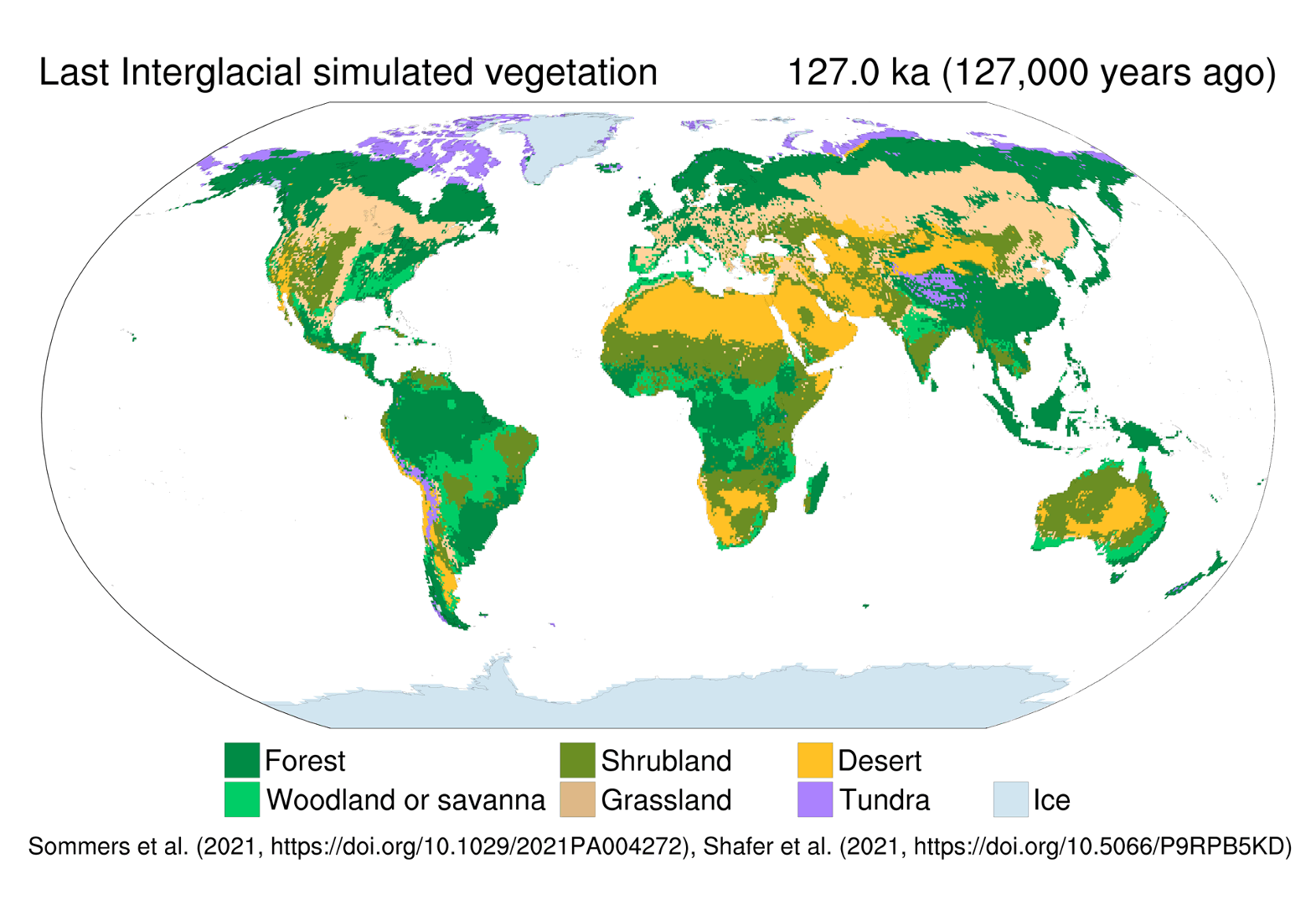
Animated global biome change during the Last Interglacial (127–119 thousand years ago). Colors represent aggregated biome classes (forest, grassland, desert, tundra, etc.) that shift as climate conditions change, illustrating moving biome boundaries rather than static zones. The animation also includes changes in the Greenland Ice Sheet, connecting cryosphere change to biome redistribution. Source
Over decades to millennia, changing temperature, precipitation, and disturbance patterns alter where plant communities can persist, causing biome boundaries to expand, contract, or relocate.
What it means for biomes to shift
Biome location reflects long-term climate conditions that determine which dominant vegetation types can survive. When climate patterns change, the “best-fit” regions for those vegetation types move, and biome maps change accordingly.
Biome shift: A long-term change in the geographic distribution of a biome (its location, area, or boundaries) driven primarily by changing climate conditions and associated ecosystem processes.
These shifts often appear first as changes along ecotones (transition zones) and at range limits (e.g., poleward edges or mountain treelines).
Evidence that biomes have changed in the past
Past biome redistribution is well established from multiple lines of evidence showing that climate has varied naturally through time.
Major drivers of historical change
Glacial–interglacial cycles: Colder, drier periods expanded ice sheets and tundra-like conditions while contracting forests; warmer periods allowed forests and grasslands to advance.
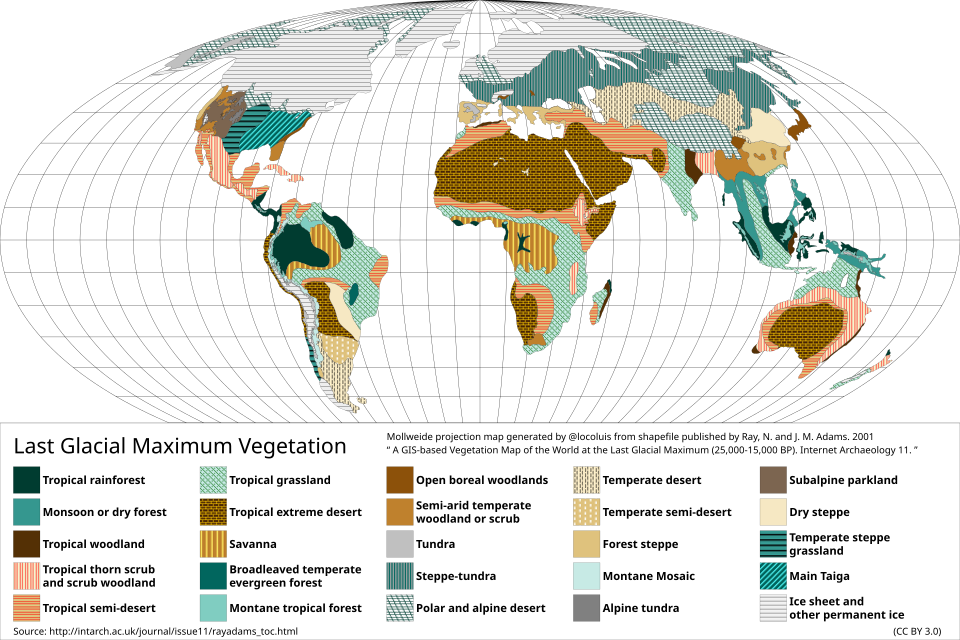
Reconstructed global vegetation at the Last Glacial Maximum (~18,000 years ago). The map shows how colder, drier glacial conditions reorganized major vegetation types (e.g., tundra/steppe expansion and forest contraction) relative to today. It provides a concrete example of large-scale biome redistribution driven by climate change over geologic time. Source
Regional precipitation shifts: Persistent changes in storm tracks and monsoon strength altered the balance between forest, shrubland, and grassland.
Sea level change: Shoreline movement changed the extent and position of coastal ecosystems, reshaping coastal biome patterns.
How we know
Pollen and plant macrofossils preserved in lake sediments and peat show which plant communities dominated different times and places.
Ice cores and other climate proxies indicate past temperature and atmospheric composition changes associated with reorganised biomes.
Tree rings (where available) reveal recent historical variability in moisture and temperature that can precede boundary movement.
Mechanisms: how climate change translates into a new biome pattern
Climate patterns change biomes through interacting ecological processes rather than instantaneous replacement.
Shifts in climatic suitability
Temperature increases generally push suitable conditions poleward and upslope.
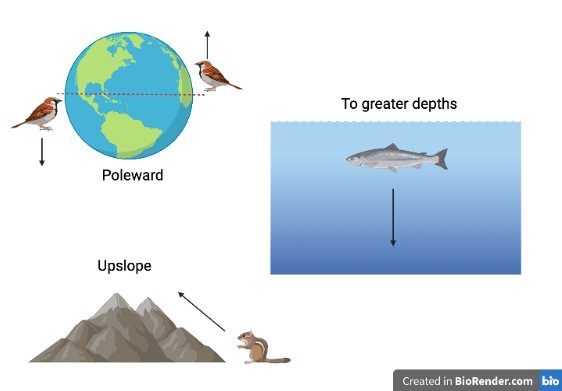
Conceptual diagram of expected climate-driven range shifts. The figure illustrates the prevailing hypothesis that warming pushes many species’ suitable habitat toward higher latitudes (poleward) and higher elevations (upslope). This provides a clean visual bridge from climatic change (temperature) to geographic redistribution of ecosystems and biomes. Source
Precipitation decreases and higher evaporative demand can favour drought-tolerant vegetation and increase the likelihood of desertification in vulnerable regions.
Changes in seasonality (timing of wet/dry seasons, snowmelt) can be as important as changes in annual averages.
Disturbance regime changes
Climate strongly influences disturbance, which can accelerate or redirect biome change:
Wildfire: Warmer, drier conditions can increase fire frequency and severity, favouring fire-adapted grasslands or shrublands over forests.
Insect outbreaks and disease: Milder winters and stressed vegetation can increase mortality, opening space for different plant communities.
Storms and droughts: Extreme events can cause rapid dieback that “resets” successional pathways.
Lags and constraints (why shifts can be slow or uneven)
Even if climate becomes suitable, biomes may not track the change smoothly.
Dispersal limits: Seeds and migrating species may not reach newly suitable areas quickly.
Soil development: Soil depth, nutrients, and organic matter may not match the needs of incoming vegetation for decades to centuries.
Fragmentation: Human land use can block movement corridors, creating isolated patches and preventing continuous biome migration.
Community interactions: Existing species can resist replacement; novel mixes of species can form instead of a clean biome swap.
Why biomes may shift again under modern climate change
Modern climate change is altering global and regional climate patterns on timescales that can outpace natural migration and adaptation for many species.
Expected directional trends
Poleward expansion of warmth-adapted vegetation zones and contraction of cold-adapted zones.
Upslope movement of montane biomes, with reduced area near mountain summits (“nowhere to go” effect).
Increased risk of dryland expansion where warming coincides with reduced precipitation or more intense drought.
Ecological and environmental consequences (tied to distribution change)
Carbon storage changes: Replacing forests with grasslands/shrublands (or vice versa) can alter biomass and soil carbon pools.
Albedo and feedbacks: Shifts from snow-covered systems to darker vegetation can increase heat absorption, reinforcing warming locally.
Biodiversity impacts: Species specialised to shrinking climates (cold, high-elevation) face higher extinction risk; invasive species may gain advantages in newly suitable regions.
Ecosystem services: Water regulation, habitat provision, and locally important resources can change as dominant vegetation reorganises.
Practice Questions
Explain how global climate patterns can cause a biome boundary to move over time. (2 marks)
Temperature and/or precipitation patterns change, altering which vegetation types can survive (1)
Species distributions/vegetation zones shift poleward and/or upslope, relocating the biome boundary (1)
Describe two mechanisms by which modern climate change may shift biome distribution, and explain one reason why biome shifts may lag behind climate change. (6 marks)
Mechanism 1 described (e.g., warming increases drought stress, favouring grassland/shrubland over forest; or poleward/upslope shift in climatic suitability) (2)
Mechanism 2 described (e.g., altered fire regime increases frequency/severity, preventing forest regrowth and promoting fire-adapted vegetation) (2)
One lag reason explained (e.g., dispersal limitation, soil constraints, habitat fragmentation, community resistance) (2)
FAQ
They combine proxies with dating methods.
Common tools include:
Fossil pollen assemblages from lake sediments/peat
Plant macrofossils and charcoal layers
Radiocarbon dating to place changes on a timeline
Climate velocity is how fast climate conditions move across the landscape.
High velocity makes tracking harder because plants must disperse quickly, and slow-moving species can be left behind even if suitable climate exists elsewhere.
Yes, when thresholds are crossed.
Examples of triggers include repeated extreme droughts, megafires, or widespread insect-driven tree mortality, which can rapidly convert forest to shrubland or grassland and prevent recovery.
As temperature bands move upslope, the area available often shrinks with elevation.
This can compress habitats into smaller zones, increasing competition and local extinction risk, especially near summits where further upslope movement is impossible.
Models link vegetation to climate variables and simulate where conditions become suitable.
Uncertainties include:
Future precipitation patterns at regional scales
Disturbance changes (fire, pests)
Human land use barriers and fragmented migration pathways

