

AP Syllabus focus:
‘Define a biome as a region with characteristic plant and animal communities that are adapted to the biome’s climate.’
Biomes are a core way scientists organise Earth’s life-supporting regions. Understanding what defines a biome helps you predict which organisms can survive in an area and why similar climates produce similar communities.
What a Biome Is
Biome: a large geographic region defined by its climate and its characteristic plant and animal communities that show adaptations suited to that climate.
A biome is bigger than a single habitat and often spans many local ecosystems. The unifying feature is that the dominant vegetation and associated animals recur across the region because they are shaped by the same broad climate constraints.
Key Features That Define a Biome
Climate is the primary driver
Climate sets the limits on biological structure because organisms must balance energy and water needs.
Temperature patterns (average temperature, extremes, and seasonality) influence:
length of the growing season
rates of metabolism and decomposition
risks such as freezing or overheating
Precipitation patterns (amount, timing, and variability) influence:
plant water availability
drought stress and fire likelihood
whether trees, shrubs, or grasses can dominate
Because climate is regional, a biome is also regional: areas far apart can share similar communities if they share similar climate conditions.
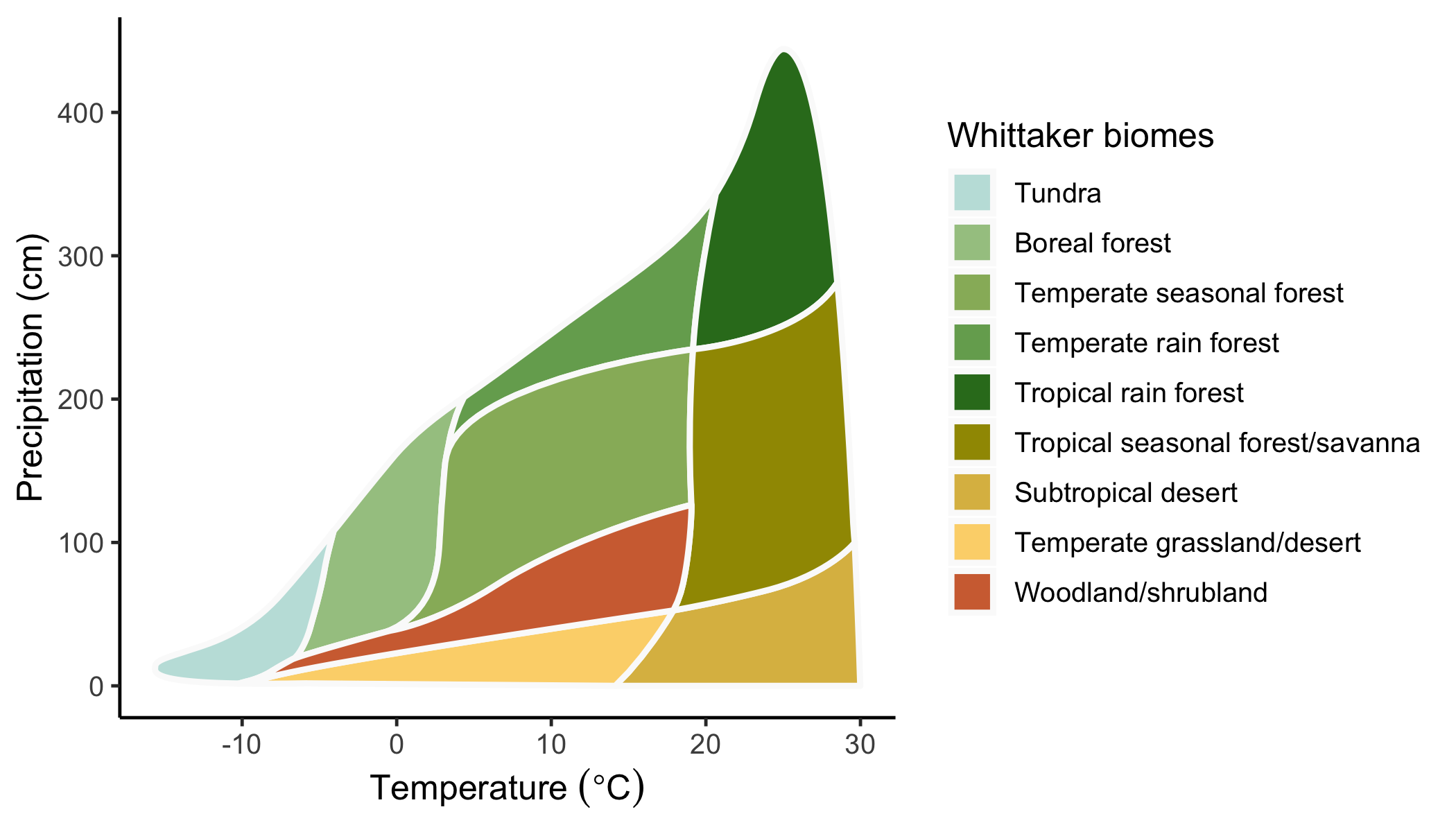
This Whittaker biome diagram plots major terrestrial biomes in “climate space,” with mean annual temperature and mean annual precipitation as the two axes. The labeled regions show how broad climate constraints predict which biome types (e.g., desert, tundra, temperate forest, tropical rainforest) are most likely to occur. It reinforces that temperature and water availability jointly filter which plant communities can dominate. Source
Characteristic communities
“Characteristic” means the community has recognisable, repeated biological traits rather than a single identical species list everywhere.
Plants are especially important in defining biomes because they:
form the physical structure of habitats (canopy, ground cover)
set food resources and microclimates for animals
reflect climate strongly (plants cannot easily move to escape conditions)
Animals are characteristic when they consistently match the vegetation and climate through:
feeding roles (herbivores, predators, decomposers)
behaviour (migration, nocturnal activity, burrowing)
physiology (water conservation, insulation)
Adaptations: How Organisms “Fit” a Biome
Adaptations are heritable traits that increase survival and reproduction under local climate pressures. In a biome context, the most important idea is that climate filters species: only those with suitable traits persist.
Common climate-linked adaptation themes include:
Water-related adaptations
reduced water loss (waxy coatings, smaller leaves, efficient kidneys)
water storage or opportunistic life cycles tied to rainfall
Temperature-related adaptations
insulation, dormancy, seasonal coat changes
heat avoidance through shade use, burrows, or activity timing
Seasonality responses
timed reproduction to favourable seasons
leaf drop or slowed growth during stressful periods
These adaptations explain why biomes have predictable community patterns: the climate creates repeated challenges, and similar solutions evolve or are selected.
What Biomes Are Used For (and what they are not)
Biomes are a classification tool that helps environmental scientists:
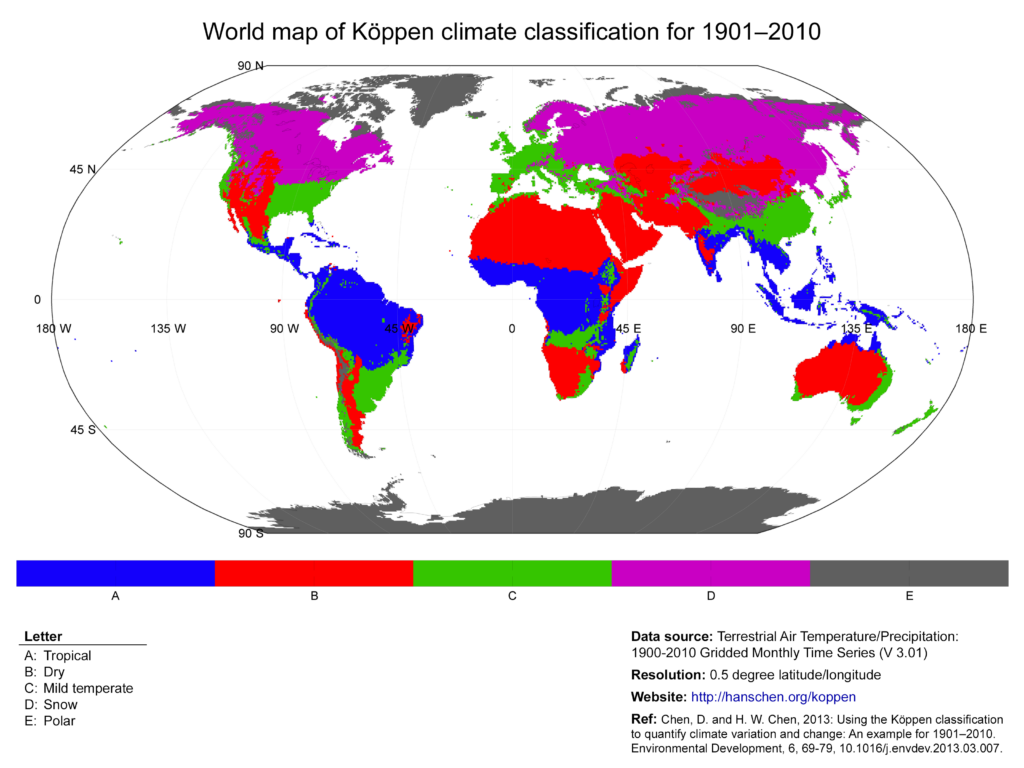
This map shows the global distribution of the major Köppen climate groups (A–E), which summarize regional patterns of temperature and precipitation. Because biome patterns track climate patterns, the map helps explain why similar biomes can appear on different continents at similar latitudes or in similar climate zones. It also highlights that these ecological regions ignore political borders and instead follow climate boundaries. Source
compare regions using a shared climate–community framework
anticipate likely ecosystem structure (for example, overall vegetation density)
communicate broad ecological patterns at continental to global scales
A biome is not defined by political borders, and it is not a single food web or one uniform ecosystem. Real landscapes include transitions and local variation, but the biome concept remains useful because climate still sets the dominant biological template.
Practice Questions
Define a biome and state the main factor that determines biome type. (2 marks)
Correct definition: region with characteristic plant and animal communities adapted to climate (1)
Identifies climate as the main determining factor (1)
Explain how climate influences the characteristic plant and animal communities found in a biome. (5 marks)
Links temperature to biological limits (e.g., growing season, metabolism, survival) (1)
Links precipitation to water availability and vegetation structure (1)
Explains that plants largely determine biome structure and habitat (1)
Describes at least one plant adaptation to climate (e.g., water-loss reduction or dormancy) (1)
Describes at least one animal adaptation to climate (e.g., migration, insulation, water conservation) (1)
FAQ
A biome is a large-scale classification based on climate and characteristic communities across a region.
An ecosystem is a specific place, including its organisms and physical environment, with measurable interactions and energy/matter flows.
Often they do not. Boundaries are commonly gradual transition zones (ecotones).
In ecotones, species from neighbouring biomes can overlap, and community structure can shift over short distances.
Plants are stationary and strongly constrained by temperature and rainfall, so they reflect climate clearly.
Vegetation also creates habitat structure, influencing which animal communities can persist.
Yes. Similar climates can select for similar functional traits (e.g., drought tolerance), even if species are unrelated.
This produces “look-alike” community structure without identical species.
Many systems use long-term climate averages and seasonality (for example, climate classification schemes) combined with observed dominant vegetation.
Remote sensing can help estimate vegetation structure and productivity to support biome mapping.
