

AP Syllabus focus:
‘Describe freshwater biomes—streams, rivers, ponds, and lakes—and explain why they are vital sources of drinking water.’
Freshwater biomes include flowing and standing inland waters that support distinct communities shaped by water movement, temperature, and dissolved oxygen. Because humans can treat and distribute them relatively easily, they are central to reliable drinking water supplies.
What counts as a freshwater biome?
Freshwater biome: An inland aquatic ecosystem with low salinity (generally less than 1 ppt), including streams, rivers, ponds, and lakes, organised by physical conditions and biological communities.
Freshwater biomes occupy a small fraction of Earth’s water but are disproportionately important to people and biodiversity. Their characteristics are driven by flow rate, depth, light availability, temperature, dissolved oxygen (DO), and nutrient inputs from surrounding land.
Streams and rivers (lotic systems)
Core features
Streams and rivers are flowing waters that generally move from higher elevation headwaters to lower elevation floodplains and deltas.
Flow creates a gradient in habitat conditions:
Headwaters: colder, faster, higher DO, often shaded; fewer producers if light is limited.
Mid-reaches: wider channel, more light; more algae and aquatic plants where nutrients and light allow.
Lower reaches: slower, warmer, more sediment and turbidity; DO can be lower, and floodplains can be extensive.
Why flow matters
Flow transports oxygen, nutrients, and organisms, and it continuously reshapes habitat (riffles, runs, pools).
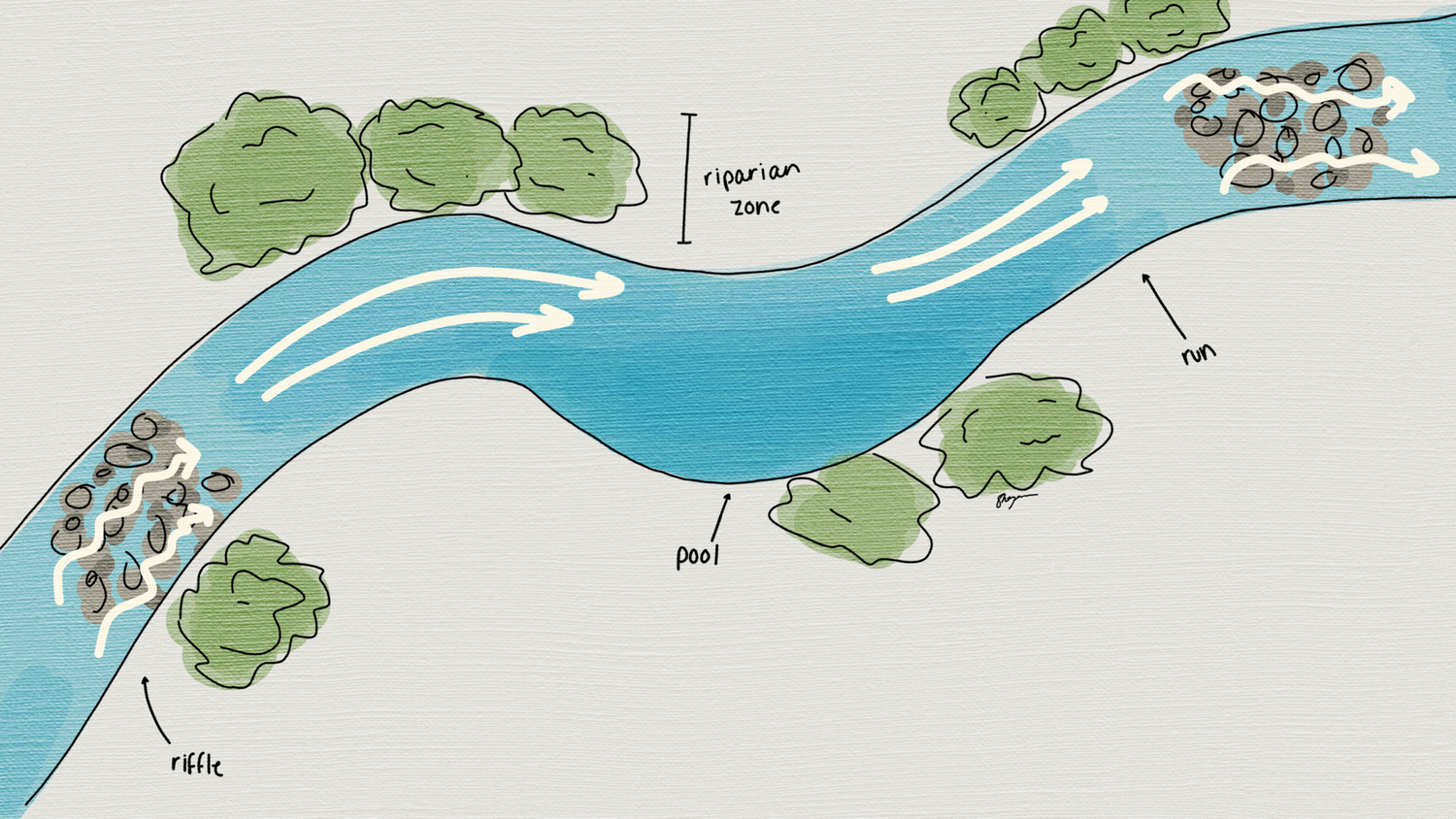
Labeled stream-channel schematic showing the repeating riffle–run–pool sequence created by flowing water. The diagram helps explain why shallow, turbulent riffles tend to be higher in dissolved oxygen while deeper pools slow flow and accumulate finer sediments and organic matter. Source
Many organisms are adapted to current (streamlined bodies, attachment structures), and food sources often include leaf litter and fine organic particles carried downstream.
Ponds and lakes (lentic systems)
Core features
Ponds and lakes are standing waters where depth strongly controls temperature and light.
Key habitat zones commonly include:
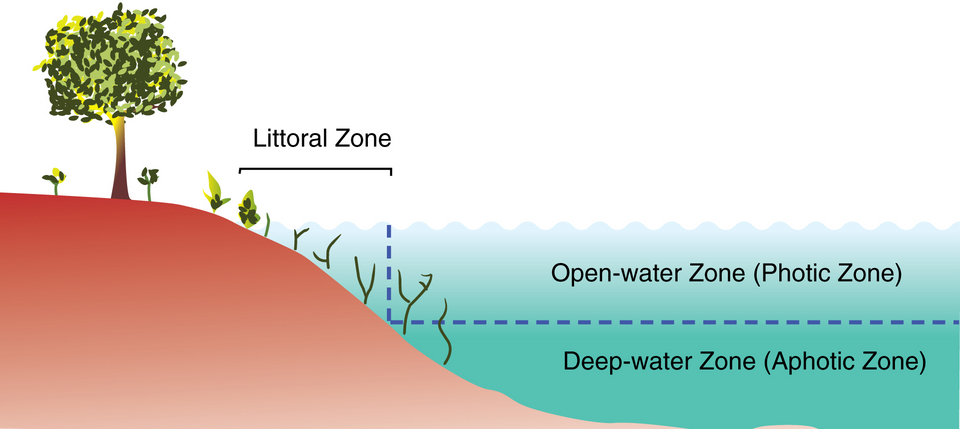
Diagram of the primary ecological zones in a lake, labeling the littoral (near-shore), limnetic/open-water (photic), and profundal/deep-water (aphotic) regions. Use it to connect depth and light availability to where photosynthesis is most likely and where decomposition and low-oxygen conditions are more common. Source
Littoral zone: near-shore, shallow, well-lit; high plant growth and biodiversity.
Limnetic zone: open water where photosynthesis occurs if light penetrates.
Profundal/benthic areas: deeper or bottom habitats; lower light, decomposition, and potential oxygen depletion in deep water.
Physical and chemical patterns
Light penetration decreases with depth and turbidity, limiting where photosynthesis can occur.
Thermal layering can separate warm surface water from cold deep water, affecting oxygen distribution and which species can thrive.
Watersheds link freshwater to land
Watershed (drainage basin): The land area that collects precipitation and channels it—via surface runoff and groundwater—into a particular stream, river, pond, or lake.
Because freshwater biomes integrate inputs from their watersheds, land use strongly influences water quantity and quality. For AP Environmental Science, this explains why protecting drinking water often requires managing the surrounding landscape, not just the waterbody itself.
Why freshwater biomes are vital sources of drinking water
Direct human dependence
Accessible supply: Freshwater in rivers, lakes, and connected groundwater can be withdrawn, treated, and delivered for municipal use.
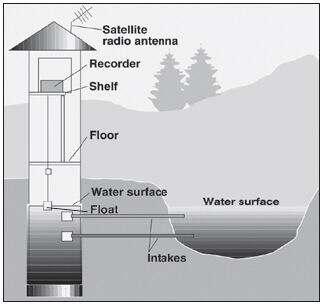
Diagram of a USGS streamgage installation showing how river stage (gage height) is measured (e.g., via a stilling well) and recorded/transmitted. Stream stage data are a core input for estimating discharge, which is essential for managing reliable withdrawals and understanding changing river conditions. Source
Storage and reliability: Lakes and reservoirs provide natural/engineered storage, helping buffer seasonal variation in rainfall and streamflow.
Recharge connections: Many rivers and lakes exchange water with aquifers, supporting wells used for drinking water.
Ecosystem services that support potable water
Natural filtration: Wetland margins, vegetated shorelines, and streambeds can reduce sediment and some contaminants before water reaches intake points.
Dilution and transport: Flowing water can disperse pollutants, though this does not eliminate risk and depends on discharge and pollutant loading.
Public health foundation: Stable, treatable freshwater sources reduce reliance on unsafe supplies and support sanitation systems that protect drinking water.
Practice Questions
Define a freshwater biome and name two examples. (2 marks)
Correct definition referencing inland, low-salinity aquatic ecosystem (1)
Any two correct examples: stream, river, pond, lake (1)
Explain how streams/rivers differ from ponds/lakes, and describe two reasons freshwater biomes are vital sources of drinking water. (6 marks)
One correct difference related to flow (lotic vs lentic) (1)
One additional correct difference (e.g., oxygen patterns, habitat zonation, sediment/turbidity, depth/light effects) (1)
Reason 1: accessibility/withdrawal and treatment for human supply (1)
Development of reason 1 (e.g., proximity to populations, distribution systems, intakes) (1)
Reason 2: storage/reliability and/or connections to aquifer recharge (1)
Development of reason 2 (e.g., buffering seasonal rainfall, sustaining wells/baseflow) (1)
FAQ
Autumn and spring mixing can redistribute nutrients, metals, and low-oxygen deep water into surface layers.
This may change taste/odour compounds and increase treatment needs for filtration and disinfection.
Gaining streams receive groundwater (baseflow), supporting flow during dry periods.
Losing streams leak water to the aquifer, potentially reducing surface supply but contributing to groundwater resources.
They make up most stream length and strongly influence downstream conditions.
Small changes in land use can rapidly alter sediment, temperature, and contaminant delivery to larger rivers and reservoirs.
Vegetated strips can:
trap sediments
take up some nutrients
shade streams, moderating temperature
They also stabilise banks, reducing erosion and turbidity.
Reservoirs often have fluctuating water levels and altered flow patterns.
These changes can increase shoreline erosion, resuspend sediments, and shift oxygen conditions near intakes depending on depth and season.

