

AP Syllabus focus:
‘Explain how nonmineral marine resources (such as different fish) vary with salinity, depth, turbidity, nutrient availability, and temperature.’
Marine organisms are not evenly distributed. Physical and chemical conditions create predictable gradients that control where populations can survive, feed, and reproduce, shaping the availability of living marine resources.
What “marine resource distribution” means
Nonmineral marine resources include living organisms harvested or valued by humans (for example, different fish species). Their distribution reflects where environmental conditions match species’ tolerance ranges for key abiotic factors and where food is available.
Major factors controlling distribution
Salinity
Salinity affects osmoregulation (maintaining water and ion balance). Many marine fish are adapted to relatively stable ocean salinity, while fewer can tolerate rapid changes.
Open ocean conditions are fairly constant, favoring species with narrow salinity tolerances.
Coastal zones and estuaries experience variable salinity from freshwater inputs, favoring euryhaline species (broad salinity tolerance).
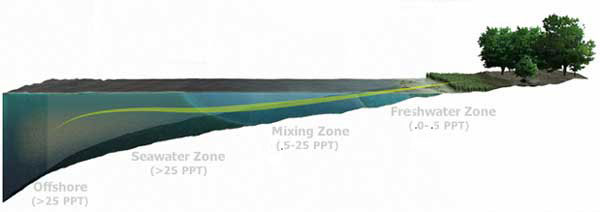
Estuary cross-section illustrating distinct salinity zones from river freshwater to offshore seawater, with an intermediate mixing zone. This spatial gradient helps explain why community composition shifts along an estuary: organisms must match their osmoregulatory tolerances to local salinity conditions. Source
Salinity changes can shift:
spawning success (eggs/larvae are often less tolerant than adults)
community composition as stress excludes sensitive species
Depth
Depth structures distribution by changing multiple conditions simultaneously.
Increasing depth typically brings:
less light for photosynthetic food webs
lower temperatures (until deep-water masses stabilise)
higher pressure
often different oxygen and nutrient patterns
Many fish partition habitat by depth to reduce competition and match prey availability.
Depth-related ocean zones (surface vs deeper waters) often support distinct fisheries because productivity is concentrated where energy enters food webs (near the surface).
Turbidity
Turbidity influences light penetration and visibility, changing feeding efficiency and habitat suitability.
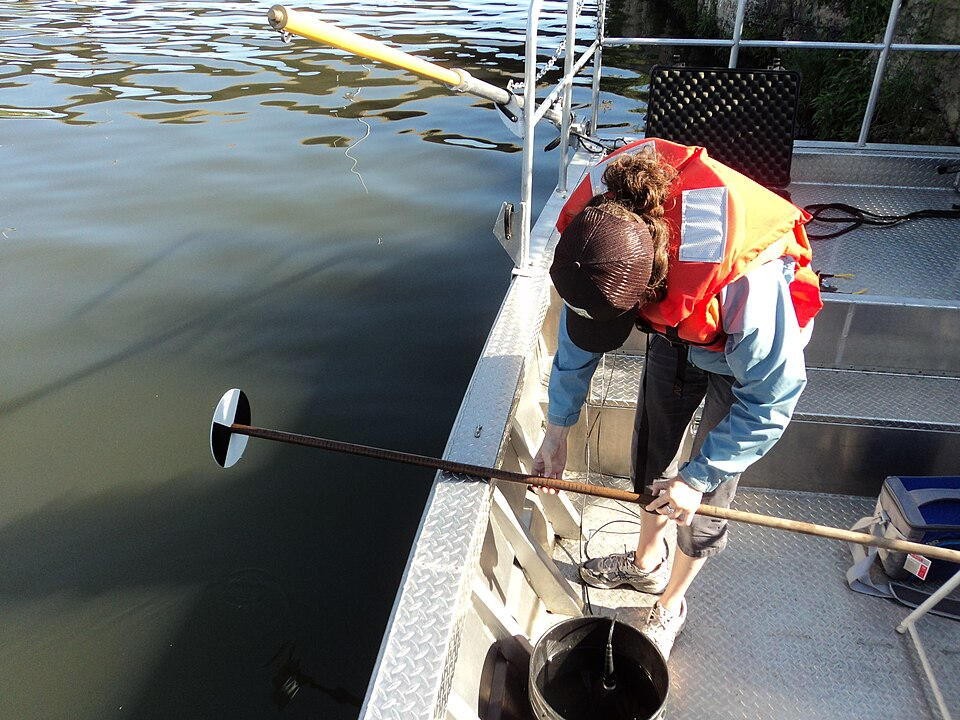
Field photo showing turbidity being assessed with a Secchi disk, a simple instrument used to estimate water clarity based on visibility. Because turbidity is defined by suspended particles reducing light transmission, Secchi depth provides an intuitive proxy for how far light can penetrate and support visual feeding and photosynthesis. Source
Turbidity: the cloudiness of water caused by suspended particles (such as silt, plankton, or organic matter) that reduce light penetration.
High turbidity can:
reduce photosynthesis by limiting light, indirectly lowering food supply in some systems
interfere with visual predators but benefit species that rely on other senses
clog or irritate gills in sensitive organisms
Turbidity is often higher near coasts, river mouths, and after storms, helping explain why nearshore species differ from offshore species.
Nutrient availability
Nutrients (especially nitrogen and phosphorus compounds in usable forms) control primary productivity, which sets the food base for higher trophic levels, including fish.
Nutrient-rich areas often occur where:
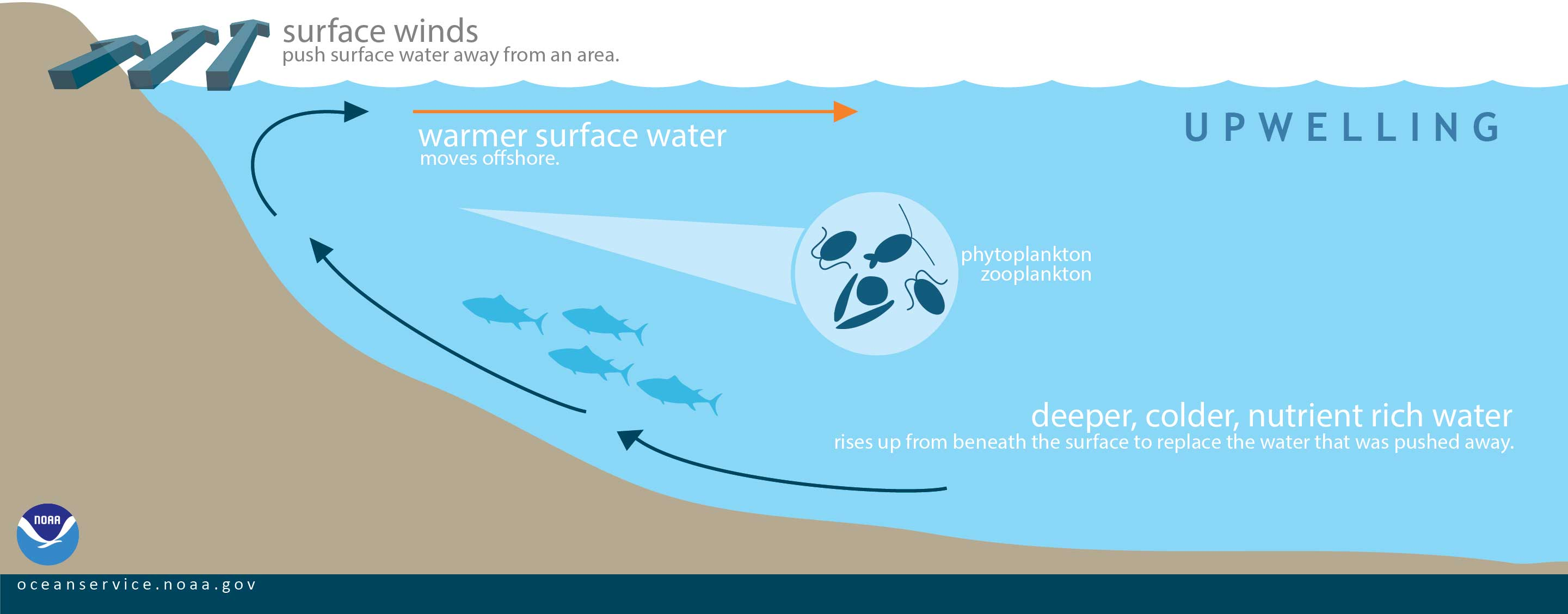
Coastal upwelling diagram showing wind-driven offshore transport of surface water and the rise of deeper, colder, nutrient-rich water into the sunlit zone. The figure also links this nutrient injection to increased plankton (primary productivity) and higher fish abundance, illustrating why upwelling regions often support major fisheries. Source
rivers deliver nutrients to coasts
currents and mixing bring deeper water upward
seafloor sediments release nutrients in shallow areas
Low-nutrient areas (many open-ocean regions) tend to have lower biomass and different species assemblages than nutrient-enriched coastal or upwelling regions.
Nutrient supply affects:
abundance of plankton (food for small fish)
strength and location of productive fishing grounds
Temperature
Temperature controls metabolic rates, growth, reproduction timing, and oxygen demand.
Most marine species have an optimal temperature range; outside it, energy is diverted from growth to stress response.
Warmer water generally speeds metabolism but can raise food requirements and increase stress if food is limited.
Temperature also affects dissolved oxygen (warmer water holds less oxygen), which can constrain fish in warm, stratified waters.
Seasonal and long-term temperature shifts can cause:
changes in migration routes
range expansions or contractions of commercially important species
How the factors work together
These factors rarely act alone; they combine to determine where resources concentrate.
Stratification can separate warm, low-nutrient surface water from colder, nutrient-rich deeper water, affecting both nutrients and temperature with depth.
Coastal areas often show strong gradients over short distances (salinity and turbidity from runoff, nutrients from rivers), creating patchy but productive habitats.
Productive resource “hotspots” form where conditions align: suitable temperature ranges, tolerable salinity, manageable turbidity, and high nutrient-supported food webs.
Practice Questions
Identify two abiotic factors that can cause different fish species to be found in different parts of the ocean. (2 marks)
Any two from: salinity, depth, turbidity, nutrient availability, temperature. (1 mark each)
A river-fed coastal area is compared with nearby open ocean waters. Explain how salinity, turbidity, and nutrient availability could each influence which fish species are more common in the coastal area than offshore. (6 marks)
Coastal waters typically have more variable/lower salinity due to freshwater input.
Species with broad salinity tolerance are more likely to persist near the river mouth.
Coastal waters often have higher turbidity from suspended sediments/particles.
Higher turbidity can reduce visibility/light penetration, favouring some species and disadvantaging others.
River inputs can increase nutrient availability in coastal waters.
More nutrients can raise primary productivity/food availability, supporting higher fish abundance and different community composition than nutrient-poor offshore waters.
FAQ
Salinity is commonly measured with conductivity sensors (CTDs) and reported in practical salinity units.
Turbidity is measured using optical instruments (for example, nephelometers) reported as NTU.
Temperature is measured with calibrated thermistors; CTDs often record all three simultaneously.
Brackish areas can reduce the number of fully marine predators that tolerate low/variable salinity.
Turbidity can provide visual cover, reducing predation risk on juveniles.
High nutrient inputs can increase food supply, improving growth and survival.
Mixing redistributes nutrients already present at depth into sunlit surface waters where producers can use them.
This can be driven by wind, tides, or current interactions with coastlines and seafloor features.
The result is often a short-lived but intense rise in local productivity.
No. Highly mobile species may shift ranges to track preferred temperatures.
Less mobile species may rely on behavioural adjustments (changing depth or timing of activity) or acclimation, but these have limits.
Early life stages are often less tolerant, so recruitment can drop even if adults remain.
Beneficial effects include reduced predation pressure and, in some systems, more plankton growth if particles carry nutrients.
Harmful effects include reduced light for photosynthesis, impaired feeding for visual hunters, and physiological stress (for example, gill irritation).
Net impact depends on species traits and local nutrient/light conditions.

.jpg)