

AP Syllabus focus:
‘Define the carbon cycle as the movement of carbon-containing atoms and molecules between sources and sinks.’
Carbon moves continually through Earth’s systems, linking living organisms to the atmosphere, oceans, and geosphere. Understanding sources and sinks clarifies why atmospheric changes over time and how ecosystems and Earth processes regulate carbon.
Core idea: carbon moves between sources and sinks
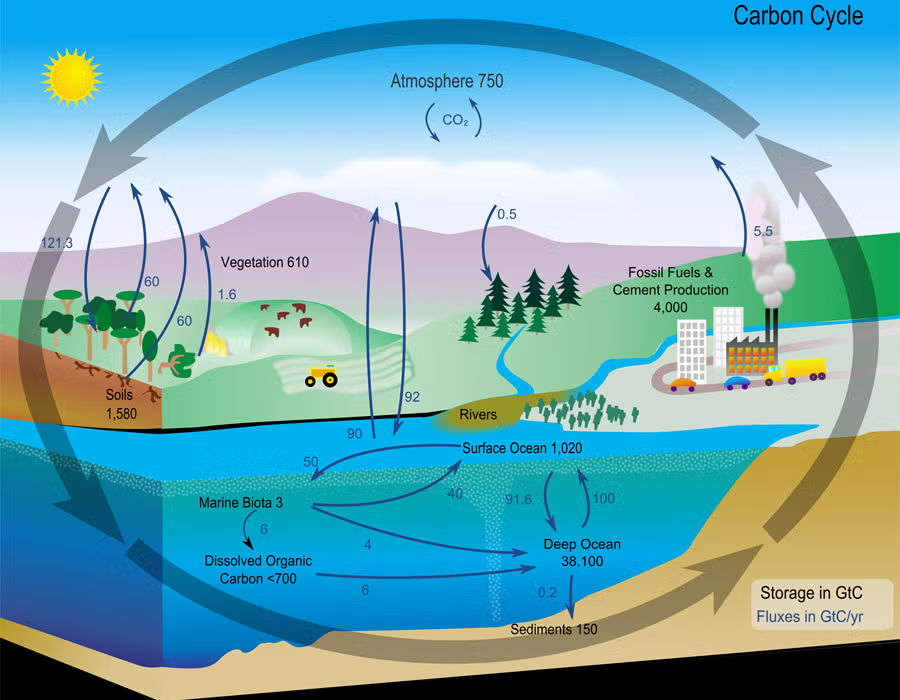
This diagram summarizes major carbon reservoirs (atmosphere, vegetation, soils, surface ocean, deep ocean, sediments, and fossil fuels) and the fluxes connecting them. Arrow directions and labels help distinguish processes that commonly act as sources (e.g., respiration, fossil-fuel combustion) versus sinks (e.g., photosynthesis, ocean uptake) for atmospheric on a given time scale. Source
Carbon cycle: The movement of carbon-containing atoms and molecules through Earth’s systems via transfers among sources and sinks.
Carbon is conserved as it moves; it changes form (for example, from to organic carbon) and location (for example, from air to water).
Carbon forms students should recognise
Inorganic carbon: atmospheric , dissolved inorganic carbon in water (including bicarbonate/carbonate forms)
Organic carbon: carbon in biomass (carbohydrates, lipids, proteins) and detritus (dead organic matter)
Mineral carbon: carbon stored in carbonate minerals (for example, limestone)
Sources, sinks, and fluxes
Source: A process or location that releases more carbon to a system than it absorbs over a stated time period.
A “source” depends on the system boundary (local lake vs global atmosphere) and the time scale (daily vs decades).
Sink: A process or location that removes more carbon from a system than it releases over a stated time period.
A sink reduces carbon in the defined system (often the atmosphere) by storing it elsewhere or converting it into another pool.
Flux: the movement that connects them
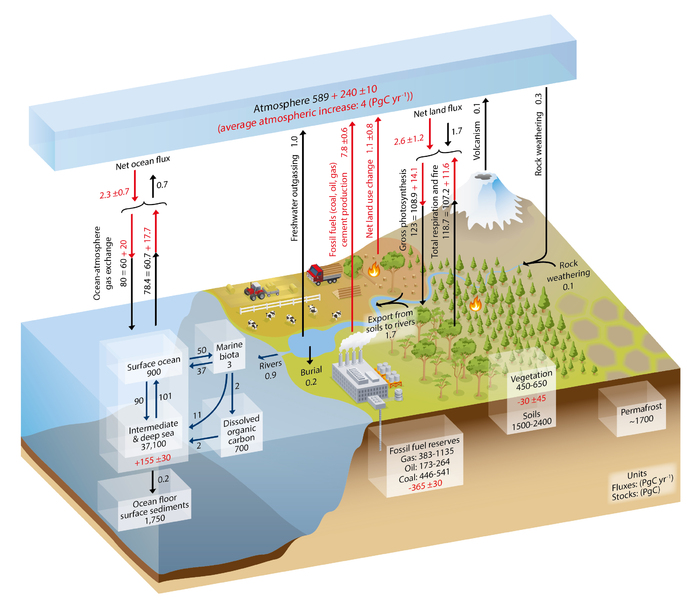
This schematic quantifies major carbon stocks and fluxes, separating natural exchanges from human-caused additions and highlighting net land and net ocean uptake. It supports the definition of carbon flux as a rate and helps students see that a reservoir can exchange carbon both ways while still being a net sink or net source for atmospheric . Source
Fluxes are the transfers of carbon between pools (for example, air–sea exchange of ).
The net effect determines whether something acts as a source or sink.
Carbon flux: The rate of carbon transfer between pools (often described per unit time and sometimes per unit area).
Common carbon sources (conceptual examples)
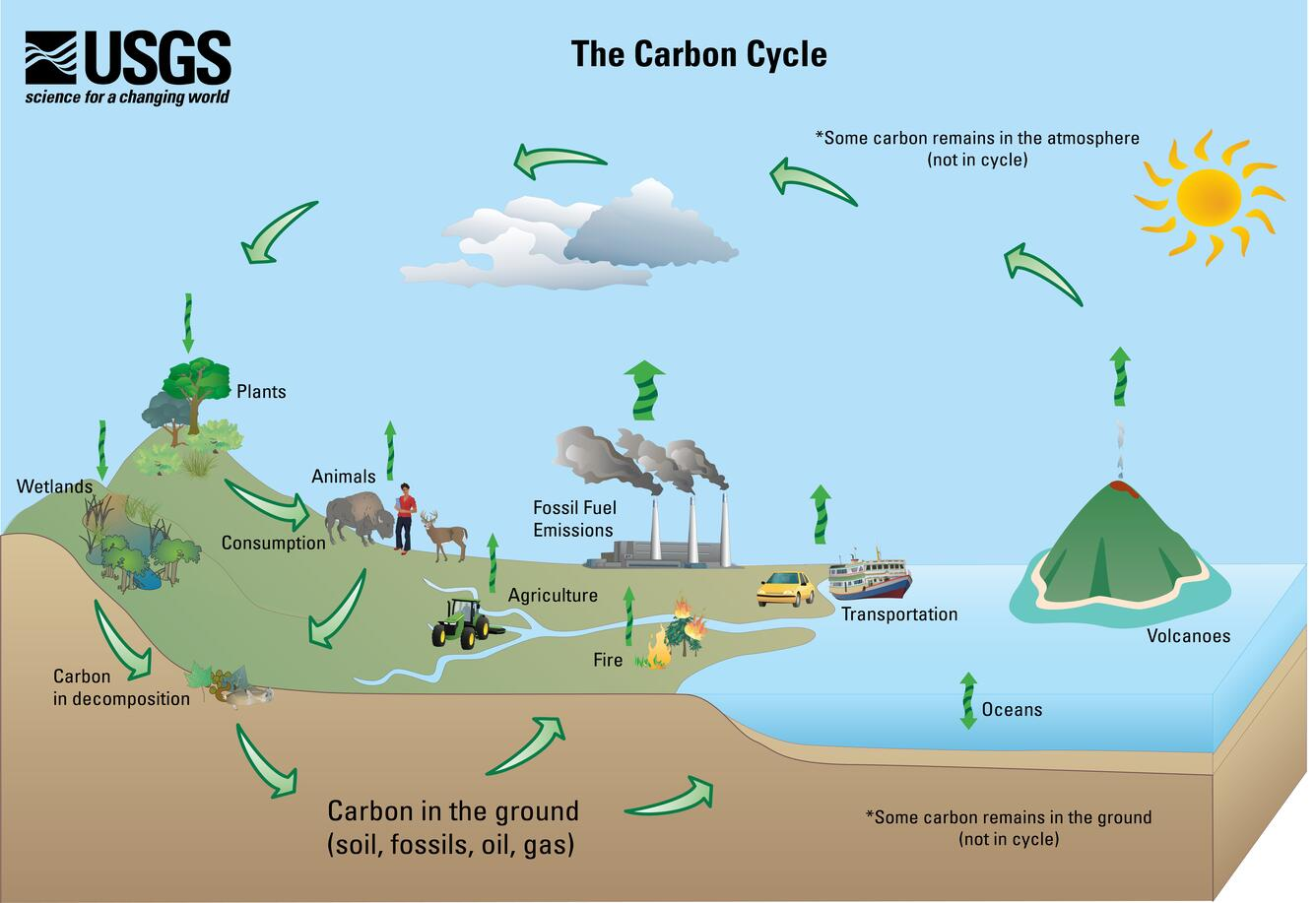
This USGS figure provides an overview of carbon movement among the atmosphere, biosphere, hydrosphere, and geosphere, with arrows representing transfers such as decomposition, combustion, and ocean–atmosphere exchange. It is especially useful for visually connecting the notes’ list of biological sources (respiration/decomposition) and Earth-system sources (volcanoes, outgassing) to the idea of context-dependent sources and sinks. Source
Whether these are sources is judged relative to a particular system (commonly the atmosphere as the reference pool).
Biological and ecosystem sources
Cellular respiration by plants, animals, and microbes releases to air or water.
Decomposition of dead organic matter releases carbon gases (primarily in oxygen-rich conditions).
Physical and Earth-system sources
Outgassing of from oceans to the atmosphere when conditions favour release (for example, warmer surface waters).
Geologic emissions (for example, volcanic activity) can add to the atmosphere.
Common carbon sinks (conceptual examples)
Sinks remove carbon from a target pool by transferring it into storage or into another chemical form.
Biological and ecosystem sinks
Photosynthetic uptake removes from air or water and stores it as organic carbon in biomass.
Net ecosystem uptake can occur when carbon stored in growing biomass and soils exceeds carbon released by respiration and decomposition.
Physical and Earth-system sinks
Ocean absorption of atmospheric (air-to-sea transfer), storing carbon in dissolved forms.
Carbonate formation and burial (long-term removal from active cycling) stores carbon in sediments and rocks.
Why “sources and sinks” are context-dependent
Scale matters: A forest may be a sink regionally while the global land biosphere’s net sink strength varies year to year.
Time matters: Seasonal plant growth can create a temporary atmospheric sink, even if annual net uptake is small.
Disturbance matters: Events like drought or insect outbreaks can shift an ecosystem from sink to source by reducing uptake and/or increasing releases.
What AP Environmental Science students should be able to do
Use the terms carbon cycle, source, sink, and flux accurately.
Classify a process or place as a source or sink only after stating the system (often atmospheric ) and time period.
Explain qualitatively that atmospheric carbon changes when sources and sinks are imbalanced, even if total carbon is conserved.
Practice Questions
Define (i) a carbon source and (ii) a carbon sink, in the context of the carbon cycle. (2 marks)
1 mark: Source defined as net release of carbon to the specified system over a stated time period.
1 mark: Sink defined as net removal of carbon from the specified system over a stated time period.
A coastal ecosystem is monitored for one year. During spring and summer it removes from the atmosphere, but during autumn and winter it releases overall. Explain how the same ecosystem can act as both a sink and a source, and state what additional information is needed to decide its net annual role. (6 marks)
1 mark: Recognises sink/source status depends on net balance over a defined time period.
1 mark: Explains seasonal variation in uptake vs release (e.g., higher photosynthetic uptake in growing season).
1 mark: Notes seasonal variation in release processes (e.g., respiration/decomposition dominating when uptake is lower).
1 mark: States need to define the system boundary/reference pool (e.g., atmospheric over the ecosystem).
1 mark: States need quantitative net carbon flux/integrated balance over the full year (total removed vs total released).
1 mark: Mentions that “net annual sink” occurs only if annual uptake exceeds annual release (or vice versa for source).
FAQ
They combine approaches such as eddy-covariance flux towers (net air–land exchange) and carbon inventories (biomass/soil changes).
Uncertainty is reduced by repeated measurements across seasons.
A reservoir (pool) is where carbon is stored at a moment in time.
A sink is defined by net direction: it is a process/location that removes more carbon than it emits over a chosen time period.
Yes. Air–sea $CO_2$ exchange can reverse direction.
Temperature, mixing, and surface-water chemistry can shift net flow into (sink) or out of (source) the ocean.
Seasonal swings reflect changing net global (or hemispheric) balance between biological uptake and biological release.
The pattern’s strength depends on latitude and land vegetation coverage.
The same process can be a sink for the atmosphere but a source for the ocean (or vice versa), depending on what you define as “the system.”
Always specify the reference pool and the time window before labelling source or sink.
