

AP Syllabus focus:
‘Explain how carbon cycles between photosynthesis and cellular respiration in living organisms.’
Photosynthesis and cellular respiration are complementary biological processes that move carbon between the atmosphere, organisms, and ecosystems.
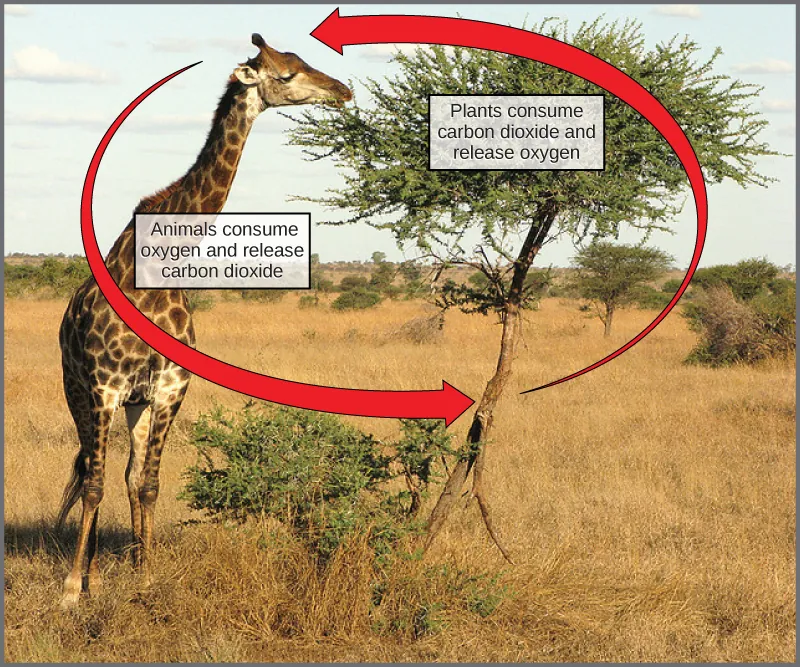
A labeled overview showing that photosynthesis and cellular respiration use each other’s products: photosynthesis takes in and releases , while respiration takes in and releases . This makes the carbon flow intuitive—carbon is fixed into organic matter in producers and returned to the abiotic environment as through respiration. Source
Together, they explain how carbon is stored in biomass, released as CO, and continually recycled through food webs.
The core carbon-cycle idea in living systems
Carbon moves through organic molecules
Carbon cycling in organisms is largely the back-and-forth conversion between inorganic carbon (mainly CO) and organic carbon (carbon-containing biomolecules such as sugars).
Photosynthesis removes CO from air (or water) and converts it into organic molecules in producers.
Cellular respiration breaks organic molecules back down, returning CO to air (or water) while releasing usable energy for life processes.
Photosynthesis: carbon fixation into biomass
What photosynthesis does to carbon
Photosynthesis: A process (mainly in plants, algae, and some bacteria) that uses light energy to convert CO and HO into energy-rich organic molecules, storing carbon in biomass.
Carbon enters living systems when autotrophs (producers) build sugars that can later become cellulose, starch, lipids, and proteins (indirectly, via nutrient assimilation). This is why photosynthesis is a major biological pathway for carbon storage in ecosystems.
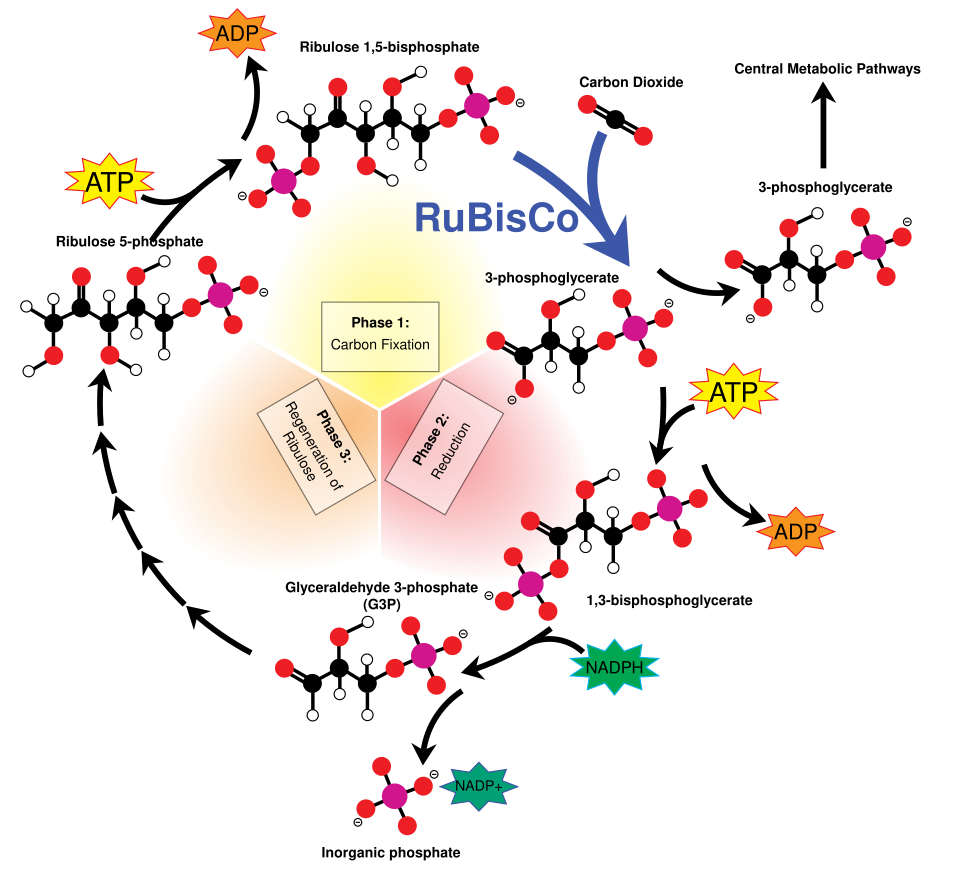
An overview of the Calvin cycle (light-independent reactions), showing how is incorporated into organic molecules and ultimately used to build sugars. This diagram emphasizes the concept of carbon fixation—transforming inorganic carbon into organic carbon that can become plant biomass. Source
Key points for AP Environmental Science:
CO is the carbon source for the sugars produced.
The carbon fixed into plant tissue can:
stay in the producer as biomass,
move to consumers through feeding,
or enter detrital pathways when organisms die or produce waste.
= carbon dioxide (inorganic carbon source)
= water (reactant supplying electrons and hydrogen)
= glucose (representative organic carbon product)
= oxygen (byproduct released)
Cellular respiration: carbon returned to CO
How respiration complements photosynthesis
Cellular respiration: A process in producers, consumers, and decomposers that converts organic molecules into ATP (usable energy), releasing CO and HO as products.
Respiration is essentially the reverse carbon-direction of photosynthesis: it oxidises organic carbon (such as glucose) and releases CO, returning carbon to the abiotic environment.
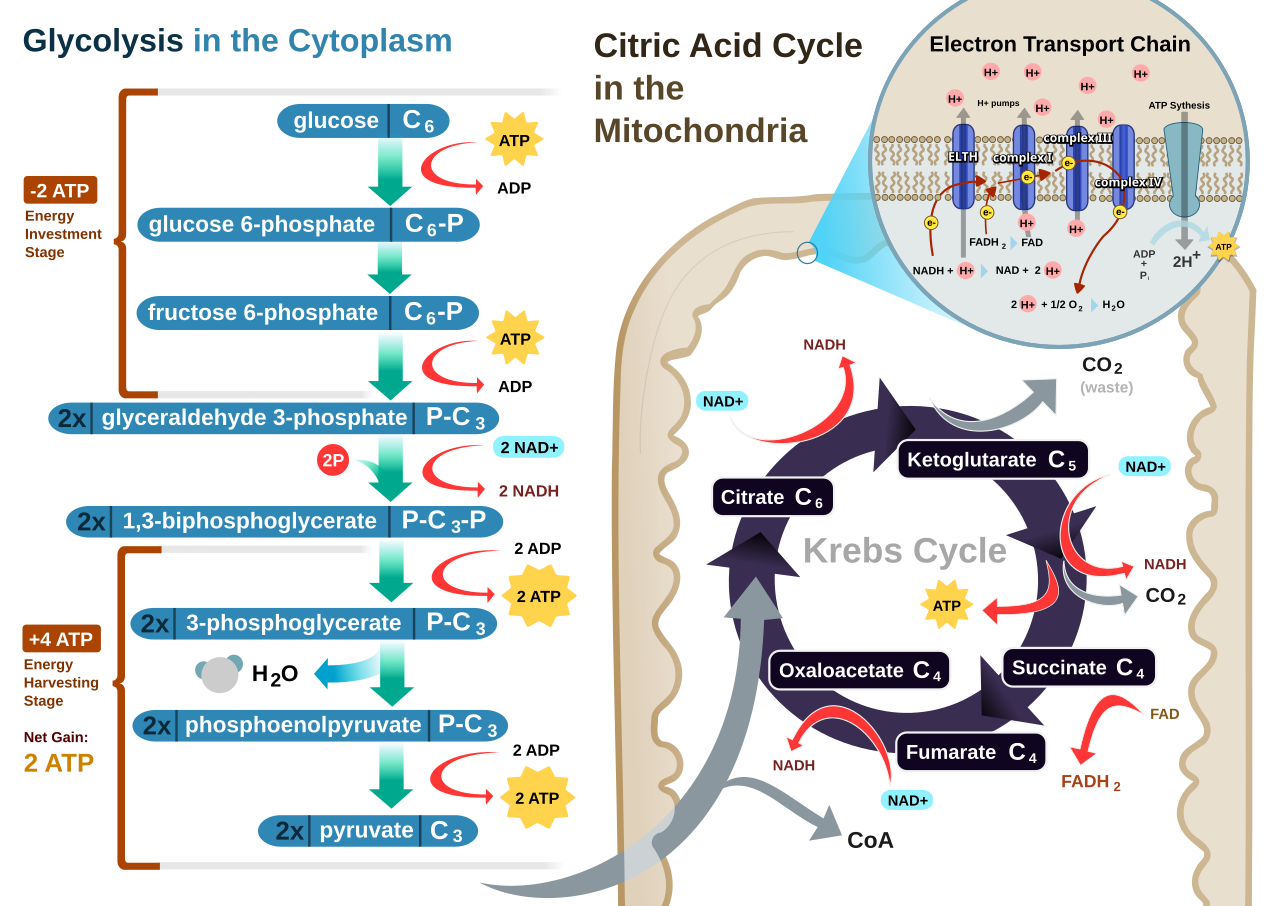
A structured diagram of aerobic cellular respiration showing the main stages (glycolysis, citric acid cycle/Krebs cycle, and the electron transport chain). It highlights where is released and where ATP is generated, linking the breakdown of organic carbon to energy capture and carbon return to the environment. Source
Importantly, both plants and animals respire; plants photosynthesise and respire, often at different rates depending on light and conditions.
Occurs continuously in living cells (day and night).
Transfers carbon from biomass to atmospheric or dissolved CO.
The released CO becomes available again for photosynthesis, closing the biological loop.
= organic carbon fuel (representative sugar)
= oxidant enabling high energy yield
= carbon dioxide returned to air/water
= water produced
= usable chemical energy captured as ATP, with some lost as heat
Carbon cycling through organisms and food webs
Coupling across trophic roles
The photosynthesis–respiration cycle connects major organism groups:
Producers: take in CO via photosynthesis; also release CO via respiration.
Consumers: obtain organic carbon by feeding; release CO via respiration.
Decomposers/detritivores: break down dead biomass and wastes; respire and release CO.
What changes the balance (without leaving the subtopic)
Whether an ecosystem is a net carbon sink or source over a time period depends on the relative rates of:
Photosynthetic carbon uptake (carbon stored into organic matter)
Respiratory carbon release (carbon returned as CO)
This balance shifts with factors that alter organism activity (for example, light availability affects photosynthesis; organism metabolic demand affects respiration), directly influencing how carbon cycles between living organisms and the atmosphere or water.
Practice Questions
State how photosynthesis and cellular respiration move carbon between organisms and the atmosphere. (2 marks)
Photosynthesis removes/takes in CO and converts it into organic molecules/biomass. (1)
Cellular respiration breaks down organic molecules and releases CO back to the atmosphere/water. (1)
Explain how carbon fixed by producers can cycle through an ecosystem and return to the atmosphere, referring to photosynthesis and cellular respiration. (6 marks)
Producers fix carbon by taking in CO during photosynthesis and making organic molecules (e.g. glucose/biomass). (1)
Carbon in producer biomass can be transferred to consumers through feeding. (1)
Producers respire and release some carbon back as CO. (1)
Consumers respire and release CO during breakdown of organic molecules. (1)
Dead organisms and waste contain organic carbon that enters decomposer pathways. (1)
Decomposers respire, returning carbon to the atmosphere/water as CO. (1)
FAQ
No. Plants both photosynthesise and respire.
In light, photosynthesis may exceed respiration, so net CO$_2$ uptake occurs. In darkness, photosynthesis stops but respiration continues, causing net CO$_2$ release.
Glucose carbon can be rearranged into other organic molecules.
Linked into polysaccharides (e.g. cellulose/starch)
Converted into lipids (long-term energy storage)
Used to build amino acids (with nitrogen input), then proteins
In aerobic respiration, O$_2$ acts as the final electron acceptor, allowing efficient energy extraction from organic carbon.
Without O$_2$, cells rely on anaerobic pathways that yield less ATP and do not fully oxidise carbon in the same way.
Aquatic producers often use dissolved inorganic carbon rather than atmospheric CO$_2$ directly.
Depending on pH and chemistry, carbon may be taken up as dissolved CO$_2$ or bicarbonate, but it is still incorporated into organic matter via photosynthesis.
Carbon fixation refers to incorporating inorganic carbon into organic molecules.
In many producers, enzymes (such as RuBisCO) attach CO$_2$ to an existing carbon compound, initiating pathways that ultimately generate sugars and other carbon-based biomolecules.


