

AP Syllabus focus:
‘Explain nitrogen fixation as converting atmospheric nitrogen into plant-available nitrogen (primarily ammonia) that can be built into plant tissue.’
Nitrogen is abundant in the atmosphere but mostly unusable to organisms. This page explains how nitrogen fixation creates plant-available nitrogen (mainly ammonia) and how plants take it up to build proteins, DNA, and other biomolecules.
Why Atmospheric Nitrogen Must Be “Fixed”
Most atmospheric nitrogen is , a molecule with a strong triple bond that most organisms cannot break.
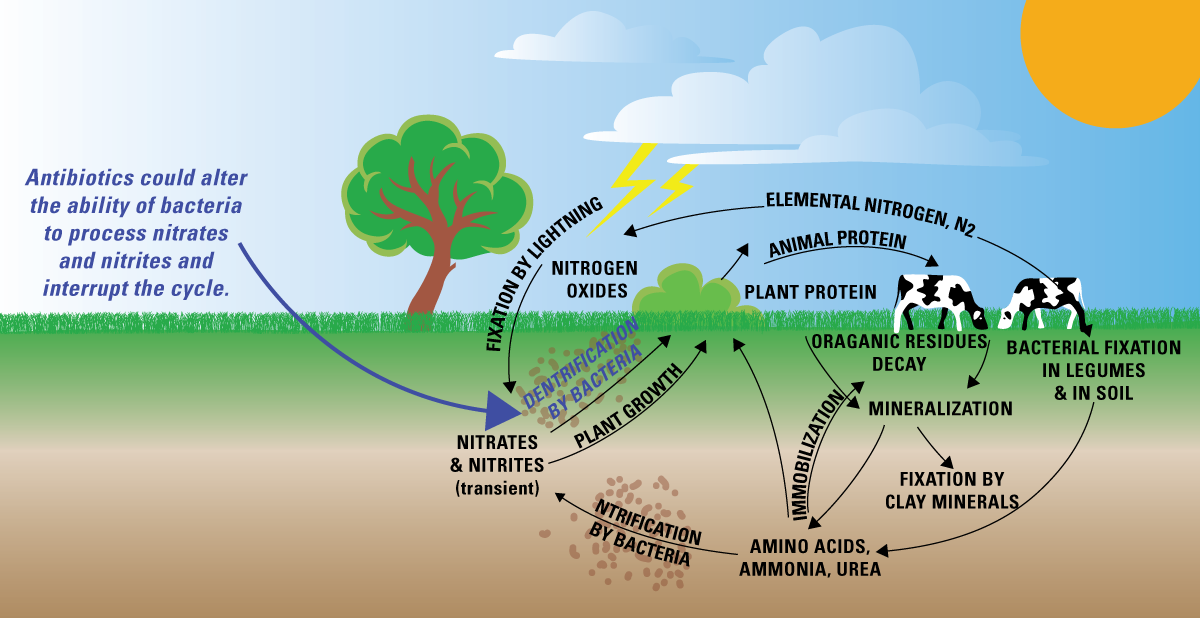
USGS nitrogen-cycle diagram summarizing the major transformations that move nitrogen between the atmosphere, soils/waters, and living organisms. It provides a big-picture map showing where nitrogen fixation introduces reactive nitrogen and how microbial processes convert it into forms plants can absorb and eventually return to the atmosphere. Source
Ecosystems therefore depend on processes that convert into reactive forms plants can assimilate.
Nitrogen Fixation (Core Idea)
Nitrogen fixation: conversion of atmospheric into plant-available nitrogen, primarily ammonia () or its ionic form ammonium ().
Fixed nitrogen is “biologically available” because it can be incorporated into organic molecules after additional steps in soils and plants.
How Nitrogen Fixation Happens
Nitrogen fixation occurs through a few key pathways, all of which increase the supply of plant-available nitrogen in an ecosystem.
Biological Fixation (Most Important in Ecosystems)
Specialised nitrogen-fixing microbes use enzymes (notably nitrogenase) to reduce to ammonia.
Symbiotic fixation
Microbes live in close association with plant roots (often in nodules)
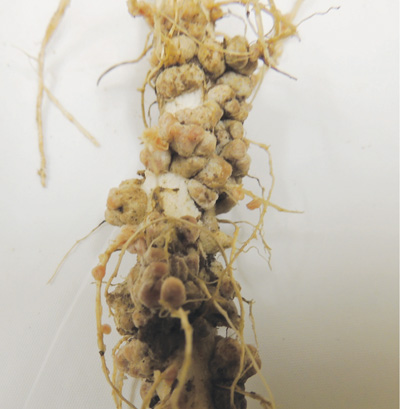
Photograph of a legume root system with visible nodules—specialized structures that house nitrogen-fixing bacteria. This image reinforces the symbiosis concept: the plant provides carbohydrates/energy, while microbes convert atmospheric into plant-usable nitrogen compounds. Source
Plant supplies sugars/energy; microbe supplies fixed nitrogen
Free-living fixation
Some soil and aquatic microbes fix nitrogen without a host plant
Conditions that influence biological fixation include:
Oxygen levels (nitrogenase is oxygen-sensitive)
Soil moisture and temperature
Availability of energy sources (organic matter) for microbes
Atmospheric Fixation (Minor but Widespread)
High-energy events (e.g., lightning) can convert into nitrogen oxides that dissolve in rain and enter soils. This contributes some reactive nitrogen, but typically far less than biological fixation.
Industrial Fixation (Human-Caused Input)
Although not an ecosystem process, industrial fixation produces ammonia-based fertilisers that add large amounts of reactive nitrogen to agricultural soils, directly affecting plant uptake dynamics.
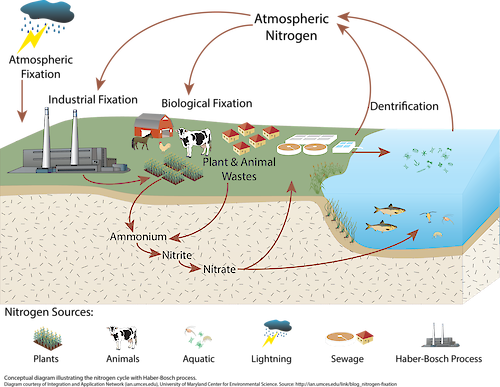
Conceptual nitrogen-cycle diagram that integrates natural fixation with the Haber–Bosch industrial pathway. It highlights how fixed nitrogen moves among atmospheric, soil/water, and biological reservoirs and how human fertiliser inputs increase reactive nitrogen available for plant uptake and downstream processes (e.g., runoff). Source
“Plant-Available Nitrogen”: What Plants Actually Absorb
Plants do not use gas directly; they primarily absorb inorganic nitrogen through roots as:
Ammonium ()
Nitrate () (often abundant after microbial conversion of ammonium)
Ammonia produced by fixation in soils quickly becomes in water, which can either be taken up by plants or transformed by microbes into . Regardless of form, the key syllabus point is that fixation creates nitrogen that can be built into plant tissue.
Plant Uptake and Assimilation into Tissue
Root uptake is followed by biochemical assimilation inside the plant, turning inorganic nitrogen into organic molecules.
Uptake (Root-Level)
Nitrogen enters roots dissolved in soil water
Uptake rate depends on:
Root surface area and growth
Soil pH and aeration (influences which nitrogen forms dominate)
Competition with microbes for the same nitrogen pool
Assimilation (Building Plant Biomass)
Inside plants, absorbed nitrogen is used to make:
Amino acids → proteins (enzymes, structural proteins)
Nucleic acids (DNA/RNA)
Chlorophyll (nitrogen-rich pigment essential for photosynthesis)
Nitrogen availability therefore strongly influences plant growth and primary production because it controls how quickly plants can build new tissues.
Ecological Significance of Fixation + Uptake
Nitrogen fixation sets the “new” input of reactive nitrogen into many natural systems.
Plant uptake transfers fixed nitrogen from soils into biomass, making it available to herbivores and higher trophic levels through feeding.
When fixation is limited, plant growth can be constrained due to insufficient nitrogen for proteins and chlorophyll production.
Practice Questions
Describe nitrogen fixation and name the main plant-available nitrogen product. (2 marks)
Converts atmospheric into biologically/plant-available nitrogen (1)
Produces primarily ammonia () / ammonium () (1)
Explain how nitrogen fixation supports the incorporation of nitrogen into plant tissue. (5 marks)
Atmospheric is largely unusable to most organisms (1)
Fixation converts into reactive nitrogen, mainly / (1)
Plants take up inorganic nitrogen via roots (accept and/or ) (1)
Absorbed nitrogen is assimilated into amino acids/proteins (1)
Nitrogen is also incorporated into DNA/RNA and/or chlorophyll, enabling growth/tissue formation (1)
FAQ
No. Some are symbiotic and form nodules with particular plants, but many are free-living in soils or water.
Free-living fixers can still contribute meaningful nitrogen inputs, especially where symbiotic hosts are scarce.
The enzyme nitrogenase is inhibited by oxygen.
Some symbioses manage this by regulating oxygen near the fixation site (e.g., creating low-oxygen microenvironments) while still supporting respiration.
Ammonia in soils commonly converts to ammonium and can be further microbially transformed into nitrate.
Nitrate is mobile in soil water and is often abundant where soils are well-aerated, making it a frequent uptake form.
Plants can downregulate transporter activity and adjust root growth patterns when nitrogen is plentiful.
They may also shift allocation (less root growth, more shoot growth) depending on which resource is limiting overall growth.
Common approaches include:
Using isotopic tracers such as $^{15}N_2$ to track incorporation into biomass
Measuring changes in nitrogen content of organisms/soils over time under controlled conditions
Each method has limitations related to scale, disturbance, and spatial variability.
