

AP Syllabus focus:
‘Explain net primary productivity as energy stored by photosynthesizers after subtracting energy lost to respiration.’
Net primary productivity (NPP) is a core measure of how much new biological material an ecosystem builds. It links photosynthesis, organismal respiration, and the energy available to support consumers and ecosystem services.
Core idea: energy stored after respiration
Photosynthesizers capture solar energy and convert it into chemical energy stored in organic molecules. However, they also use some of that captured energy to power their own metabolism. Net primary productivity (NPP) is what remains as new plant (or algal) biomass after those metabolic costs are paid.
Key terms you must know
Net primary productivity (NPP)
Net primary productivity (NPP): the rate at which photosynthesizers store energy as new biomass after subtracting energy used in respiration, per unit area per unit time.
NPP is the most direct indicator of how much “extra” biological material is produced and potentially available to the rest of the food web.
Gross primary productivity (GPP)
Gross primary productivity (GPP): the total rate at which photosynthesizers capture energy by photosynthesis in a given area.
GPP is the “gross income” of energy capture; NPP is the “take-home” amount stored in tissues.
Autotrophic respiration (R)
Autotrophic respiration (R): energy used by photosynthesizers to fuel cellular processes (maintenance, growth processes, transport), which reduces energy retained as biomass.
Respiration does not destroy energy, but it converts stored chemical energy into forms less available for building new biomass (including heat released during transformations).
The NPP relationship (required)
NPP is defined by subtracting respiration losses from total photosynthetic capture.
= energy stored as new photosynthesizer biomass per unit area per unit time
= total energy captured by photosynthesis per unit area per unit time
= energy used in autotrophic respiration per unit area per unit time
This equation directly matches the syllabus wording: NPP is energy stored by photosynthesizers after subtracting energy lost to respiration.
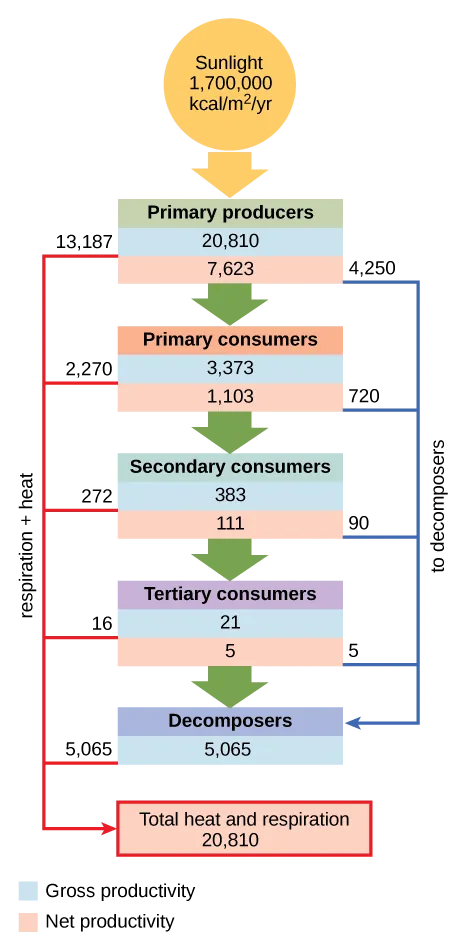
This compartment (energy-flow) diagram quantifies how much energy primary producers capture as gross primary productivity and how much is lost as respiration/heat before the remainder becomes net productivity available to consumers. The arrows make the “take-home” idea of NPP visible: only the fraction not used in metabolism is stored as new biomass that can support higher trophic levels. Source
What NPP represents biologically
NPP corresponds to the net accumulation of organic matter in producers. In practical ecological terms, higher NPP generally means:
More plant growth (more leaves, stems, roots) or more algal growth
Greater potential food supply for herbivores and detritivores
More carbon retained in living tissues (at least temporarily)
NPP is a rate, not a standing quantity. A forest can have high biomass but moderate NPP if growth is slow; a grassland can have lower biomass but relatively high NPP during rapid growth periods.
Factors that change NPP (through GPP and/or R)
NPP can decrease either because GPP falls or because respiration rises, even if GPP stays similar. Key controls include:
Light availability: affects photosynthesis and therefore GPP
Water availability: drought stress lowers photosynthesis and may raise metabolic costs
Temperature: can increase photosynthetic rates up to an optimum, but often increases respiration strongly
Nutrient availability: limits the ability to build new tissues even when light is sufficient
Producer type and physiology: fast-growing species often allocate energy differently than slow-growing, long-lived species
A useful way to think about it is:
Conditions that raise GPP tend to raise NPP (if respiration does not rise equally)
Conditions that raise R can lower NPP even if photosynthesis remains high
Why NPP matters in environmental science
NPP is foundational for evaluating ecosystem function because it sets an upper limit on how much energy is available to higher trophic levels. Ecologists use NPP to connect producer growth to:
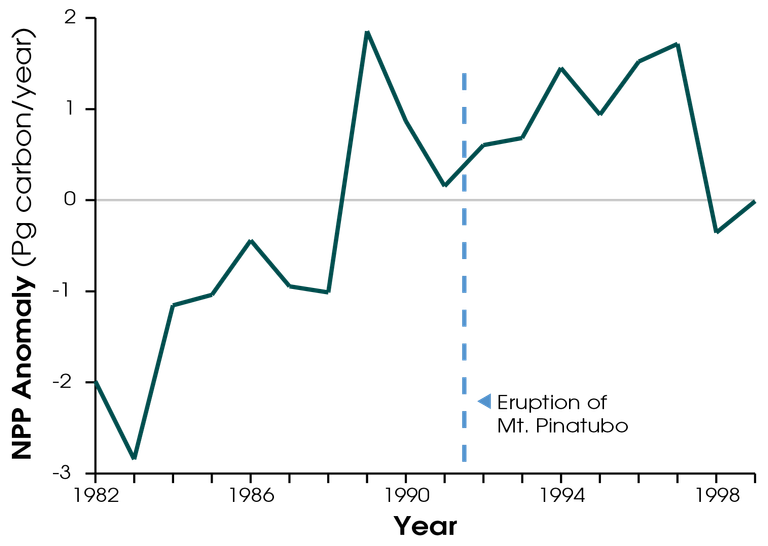
This NASA Earth Observatory figure summarizes how global terrestrial net primary productivity varies over time, highlighting that NPP is dynamic rather than fixed. It’s a useful visual reminder that changes in climate conditions (for example, those associated with El Niño or volcanic aerosols) can shift the balance between photosynthesis and respiration and therefore alter NPP. Source
Potential supportable consumer biomass
Carbon storage potential in living biomass (short- to medium-term)
Ecosystem responses to environmental change (for example, warming that increases respiration)
NPP is also a practical indicator of how human actions that alter growing conditions can change ecosystem productivity, by shifting the balance between photosynthesis and respiration.
Practice Questions
Define net primary productivity (NPP) and state its relationship to gross primary productivity (GPP) and respiration. (2 marks)
Correct definition of NPP as energy/biomass stored by producers after respiratory losses (1)
Correct relationship: (1)
An ecosystem experiences a warmer growing season. Describe how warming could increase, decrease, or not change NPP, using the roles of GPP and autotrophic respiration in your explanation. (6 marks)
States that NPP depends on both GPP and respiration (1)
Explains that warming may increase GPP up to an optimum (1)
Explains that warming often increases respiration rates (1)
Links higher respiration to reduced NPP if GPP does not rise as much (1)
Identifies that NPP could increase if GPP rises more than respiration (1)
Identifies that NPP could decrease if respiration rises more than GPP, or GPP declines due to stress (1)
FAQ
They combine field measurements with remote sensing.
Satellites estimate vegetation activity (for example, greenness indices) and absorbed light
Models convert absorbed light into production using climate and vegetation parameters
Field plots calibrate and validate the model outputs
No. NPP is a production rate, while carbon storage depends on how long biomass persists.
Carbon can be rapidly returned to the atmosphere through plant death, decomposition, fire, or harvest, even if NPP is high.
They may differ in autotrophic respiration.
Higher maintenance costs (for example, from heat stress or high tissue turnover) increase $R$, reducing NPP even when photosynthesis remains comparable.
NPP includes all new biomass, but it may be “hidden” belowground.
Ecosystems allocating more to roots can have substantial NPP with less visible aboveground growth, affecting how productivity is perceived from surface observations.
Uncertainty often comes from incomplete sampling and separating processes.
Estimating belowground production is difficult
Distinguishing new growth from stored reserves can be challenging
Spatial variability means small plots may not represent the whole ecosystem
