

AP Syllabus focus:
‘Explain how limited light penetration in water affects photosynthesis and how aquatic producers have adaptations to photosynthesize with less visible light.’
Aquatic photosynthesis is constrained by how quickly light weakens with depth. Understanding light penetration explains why most primary production occurs near the surface and how producers persist under dim, spectrally shifted conditions.
Light penetration in water: what controls it?
Water filters sunlight more strongly than air, so both light intensity and light quality (wavelength) change rapidly with depth.
Key processes that reduce underwater light
Absorption: water molecules and dissolved substances take up light energy (converted to heat).
Scattering: suspended particles and water molecules redirect light, lowering straight-line transmission.
Reflection at the surface: waves and low sun angles reduce light entry.
Light availability also varies with:
Turbidity (sediment, plankton, detritus): higher turbidity = shallower photosynthetic zone.
Water colour / dissolved organic matter (often from wetlands or leaf litter): preferentially absorbs shorter wavelengths, dimming deeper water.
Season and latitude: day length, sun angle, and ice/snow cover alter light input.
Mixing and stratification: turbulence can move producers in and out of high-light surface layers.
Depth patterns and consequences for photosynthesis
As depth increases, photosynthesis rate declines because fewer photons reach producers, eventually falling below the rate needed to balance respiration.
Photic zone: the upper layer of a water body that receives enough light to support photosynthesis.
Within the photic zone, the upper euphotic portion supports the highest net photosynthesis; below it, light becomes too weak for most producers to maintain positive carbon gain.
Light changes with depth (intensity and colour)
Longer wavelengths are removed first:
Red and orange light are absorbed quickly near the surface.
Blue-green light penetrates deeper, so deeper habitats are dominated by blue-green wavelengths.
This spectral shift matters because photosynthetic organisms must capture what remains. Clear ocean water can have a deeper photic zone than a turbid lake, even if surface sunlight is similar.
= Light intensity at depth (e.g., W/m or % of surface light)
= Light intensity just below the surface (same units as )
= Light attenuation coefficient (m), larger in turbid/productive water
= Depth (m)
A higher (from algae blooms or sediment runoff) causes light to drop off faster, shrinking the depth range where photosynthesis is possible.
Why limited light penetration reshapes aquatic ecosystems
Limited light concentrates most aquatic primary production near the surface, with common ecological outcomes:
Vertical zoning of producers: attached algae and aquatic plants are restricted to shallow margins in many lakes.
Lower productivity at depth: deeper water relies more on sinking organic matter (“marine/lake snow”) rather than local photosynthesis.
Sensitivity to turbidity increases: small increases in suspended particles can sharply reduce underwater light and plant growth.
Competition for light: dense phytoplankton can self-shade, reducing photosynthesis below the surface even when nutrients are abundant.
Adaptations that allow photosynthesis with less visible light
Aquatic producers (phytoplankton, algae, cyanobacteria, and aquatic plants) persist by improving light capture, tolerating low light, or positioning themselves where light is available.
Pigments and light harvesting
Producers use accessory pigments to absorb wavelengths that chlorophyll a alone captures poorly, especially as the spectrum shifts with depth.
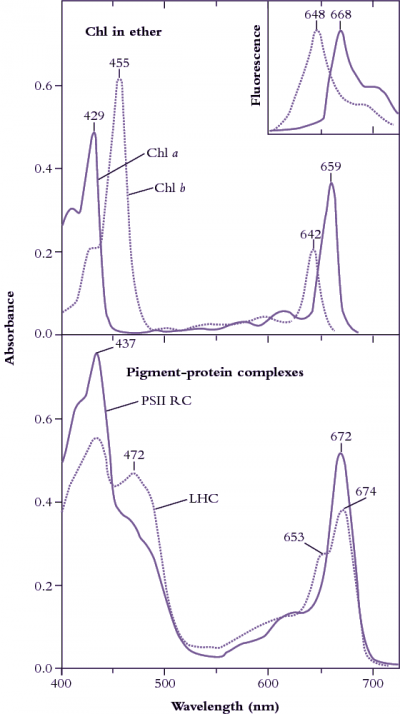
These absorption spectra compare chlorophyll a and chlorophyll b, showing strong absorption in blue and red wavelengths but much weaker absorption in the green-yellow range. The differing peak positions illustrate how adding accessory pigments expands the range of wavelengths that can drive photosynthesis when the underwater light field is spectrally filtered. Source
Chlorophyll b/c: broaden absorption beyond chlorophyll a.
Carotenoids: absorb blue-green light and protect against excess light.
Phycobilins (common in cyanobacteria and red algae): capture green/blue light that penetrates deeper than red.
Structural and physiological strategies
Larger light-harvesting antennae (more pigment per cell) to increase photon capture.
Lower light compensation requirements (maintain photosynthesis under dim conditions).
Thin tissues and high surface-area structures (many algae) to reduce self-shading and speed diffusion.
Behavioural and positional adaptations
Buoyancy regulation (e.g., gas vesicles in some cyanobacteria) to remain in well-lit surface waters.
Vertical migration: some plankton move upward for light and downward for nutrients, balancing both constraints.
Floating leaves and elongated stems (many aquatic plants) to place photosynthetic tissue near the surface.
These adaptations directly address the core challenge: underwater photosynthesis must function with less total visible light and with a narrower set of penetrating wavelengths.
Practice Questions
State two ways that increased turbidity can reduce photosynthesis in aquatic producers. (2 marks)
Any two of:
Reduces light intensity at depth by increasing scattering/absorption (1)
Makes the photic/euphotic zone shallower (1)
Increases self-shading by suspended particles/algae, reducing light to deeper producers (1)
Explain how limited light penetration affects where most aquatic photosynthesis occurs, and describe adaptations that enable aquatic producers to photosynthesise with less visible light. (6 marks)
Photosynthesis decreases with depth as light intensity attenuates; most production near surface/photic zone (1)
Deeper water receives less visible light and a shifted spectrum (red absorbed first; blue-green penetrates deeper) (1)
Consequence such as shallow distribution of aquatic plants/attached algae or reduced productivity at depth (1)
Accessory pigments broaden wavelength absorption (e.g., carotenoids, phycobilins, chlorophyll b/c) (1)
Buoyancy/positioning strategies (gas vesicles, floating leaves, elongated stems, or migration) keep tissues in brighter water (1)
Physiological/structural low-light strategies (larger antennae, lower light requirements, thin/high-SA tissues) (1)
FAQ
Common methods include a Secchi disc (depth at which it disappears) and underwater light sensors (PAR meters) that log irradiance versus depth.
Secchi depth is quick but indirect; PAR profiles directly quantify the light available for photosynthesis.
Even with low turbidity, light intensity declines exponentially, so deep layers may still fall below what producers need.
Also, deep layers can be cold and nutrient-limited for certain producers, constraining growth even when some light remains.
Yes. “Tea-coloured” water rich in humic substances can absorb specific wavelengths, favouring producers with pigments tuned to the remaining spectrum.
This can shift communities toward cyanobacteria or certain algae adapted to altered light quality.
Photoinhibition is reduced photosynthetic performance under excessively intense light, often compounded by UV damage.
Some producers avoid it via protective pigments, repair mechanisms, or moving/mixing away from the brightest surface layer.
Ice and snow can reflect and absorb incoming radiation, greatly reducing PAR under the surface.
Producers may rely on brief seasonal windows, adjust pigment composition, or persist as resting stages until light returns.
