

AP Syllabus focus:
‘Island biogeography examines how organisms are distributed on islands and how island community structure develops through ecological relationships.’
Island biogeography explains patterns of biodiversity on islands by linking geography to ecology. It focuses on why some islands have more species than others and how communities assemble, persist, and change over time.
What island biogeography studies
Core idea: distribution and community assembly
Island biogeography investigates where organisms live on islands and why those patterns occur, emphasizing how island community structure emerges through ongoing ecological processes and interactions. “Islands” can be literal oceanic islands or any isolated habitat patch that functions like one.
Island biogeography: The study of how island size, isolation, and ecological dynamics shape the number and types of species found on islands and how island communities form and change.
A central focus is explaining differences among islands in:
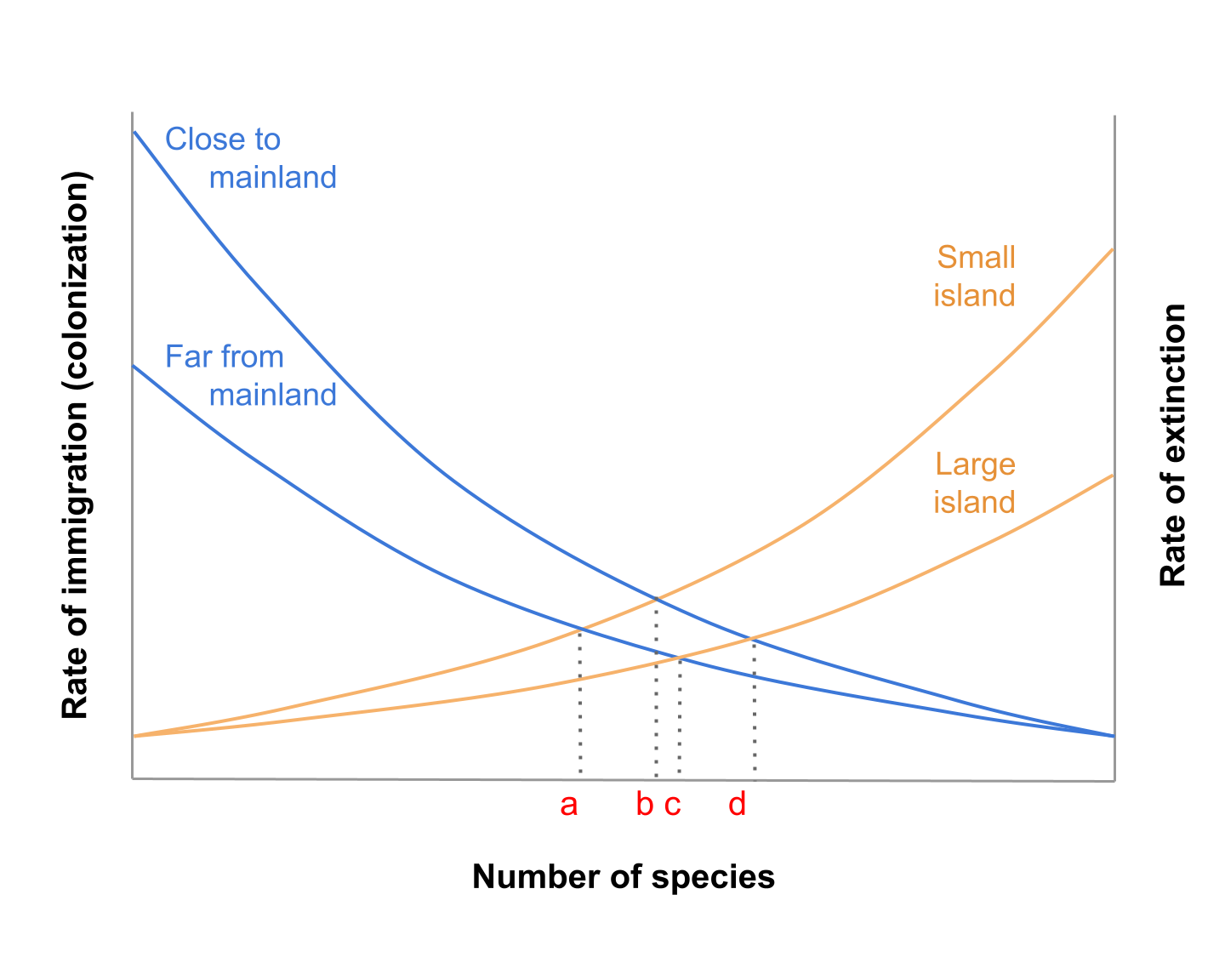
Classic equilibrium theory diagram for island biogeography: immigration (colonization) decreases as species accumulate, while extinction increases as communities become more crowded and competitive. The intersection of the two curves represents the predicted equilibrium species richness, where immigration and extinction rates are equal even though species turnover can continue. Source
Species presence/absence (which species occur)
Species richness (how many species occur)
Community composition (which kinds of organisms dominate)
Turnover (how community membership changes through time)
What counts as an “island” in APES contexts
Island biogeography often applies to true islands, but the same logic is used for habitat fragments surrounded by unsuitable conditions.
Biogeographic island: Any isolated area of suitable habitat surrounded by unfavourable habitat that limits movement of organisms (e.g., mountaintops, lakes, forest fragments).
Examples (conceptual, not case studies):
Forest patches isolated by agriculture or urban development
Alpine “sky islands” separated by warmer lowlands
Ponds separated by dry land for aquatic species
Key ecological relationships shaping island communities
Isolation, movement, and connectivity
Island biogeography examines how isolation influences the ability of organisms to reach and maintain populations on an island.
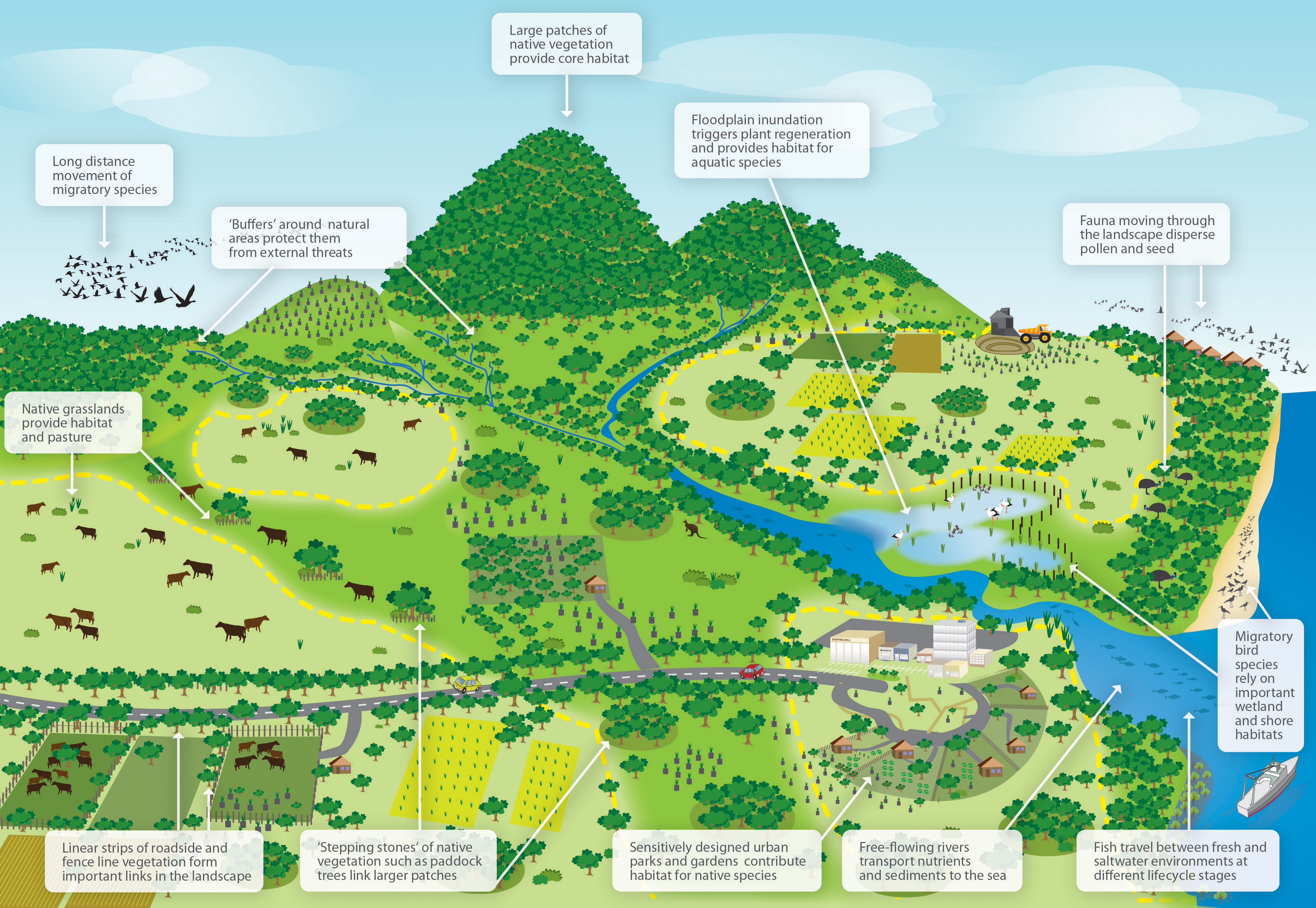
Landscape-connectivity diagram illustrating how habitat patches can function as “biogeographic islands” connected by corridors, stepping-stone patches, and linear vegetation strips. The figure emphasizes that connectivity reduces effective isolation, increasing movement among patches and supporting recolonization and gene flow. Source
Key ecological relationships include:
Dispersal ability (flying vs non-flying organisms)
Distance and barriers (water, roads, development)
Connectivity/corridors that reduce effective isolation
These relationships help determine which species can become part of the island community in the first place, and how often populations are replenished.
Local persistence: interactions that structure communities
Beyond arrival and presence, island biogeography studies how ecological relationships shape community structure once organisms are present. Important relationships include:
Competition (overlapping niches can limit coexistence)
Predation and herbivory (top-down control of populations)
Mutualism (pollination, seed dispersal, symbioses)
Resource partitioning (reducing direct competition by using different resources)
Community structure: The composition and relative abundance of species in a community, shaped by interactions such as competition, predation, and mutualism.
Because islands are relatively bounded and isolated, they can make these interactions easier to observe and model, highlighting how relationships influence which species dominate and which remain rare.
Major patterns island biogeography seeks to explain
Why island size matters
Island biogeography investigates how island area relates to biodiversity patterns. Larger islands often support:
More habitat types (greater environmental variety)
Larger populations (lower chance of local extinction)
More ecological roles (more niches and interactions)
Smaller islands tend to have smaller populations that are more vulnerable to random events, which can change community structure quickly.
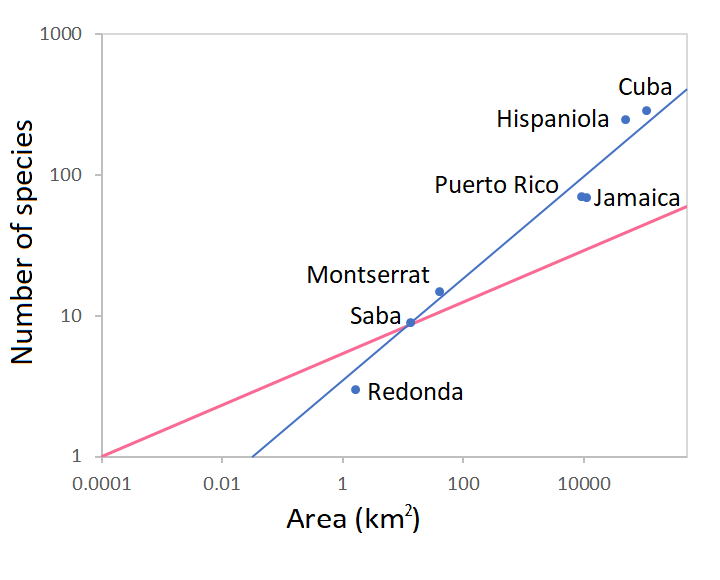
Species–area relationship plot showing that species richness generally increases with island area, illustrated with labeled West Indies islands (e.g., Cuba, Hispaniola, Jamaica). Trend lines summarize how the slope of the relationship can differ across datasets, but the overarching pattern remains that larger areas tend to support more species. Source
Why isolation matters
More isolated islands tend to have fewer species because fewer organisms can reach them. Isolation can also shape communities by favouring:
Species with high dispersal capacity
Species that can tolerate small, fluctuating populations
Community networks that depend less on frequent replenishment from outside sources
These patterns connect directly to the syllabus emphasis on distribution and community development through ecological relationships.
Practice Questions
Define island biogeography and state one type of ecological relationship it studies that helps shape island community structure. (2 marks)
1 mark: Correct definition linking species distribution on islands to factors such as size/isolation and community formation/change.
1 mark: One valid ecological relationship stated (e.g., competition, predation, mutualism, herbivory).
Explain how island biogeography investigates differences in community structure between a small, isolated island and a large, less isolated island. In your answer, refer to dispersal and ecological relationships. (6 marks)
1 mark: States that isolation affects dispersal/arrival of organisms (more isolated = fewer arrivals).
1 mark: States that size affects persistence (larger = larger populations/lower extinction risk).
1 mark: Links larger area to greater habitat variety/niche availability.
1 mark: Explains that limited arrivals on isolated islands can alter composition (e.g., biased towards strong dispersers).
1 mark: Mentions an ecological relationship (competition/predation/mutualism) affecting relative abundances.
1 mark: Connects these factors to observed differences in community composition/relative abundance (community structure).
FAQ
Isolation is measured using distance to source habitats, but also “effective isolation,” such as prevailing winds/currents and barriers to movement.
Common metrics include:
Nearest-neighbour distance
Distance to mainland/source pool
Connectivity indices from GIS landscape maps
Fragment “island-like” behaviour increases when the surrounding matrix is hostile and dispersal between patches is rare.
Key drivers:
Edge effects that reduce interior habitat quality
Low permeability of the matrix (roads, fields, urban areas)
Limited corridor availability
Endemism is treated as a distribution pattern: isolated islands can have species found nowhere else, which changes community composition compared with mainland communities.
This is often analysed by comparing:
Proportion of endemic species
Similarity indices between island and source regions
Simplified species pools can produce missing trophic levels or weakened interactions (e.g., fewer predators), which shifts relative abundances and stability.
Researchers look for:
Trophic cascades
Changes in functional roles
Altered interaction strengths
They compare whether suitable conditions exist versus whether species can reach the island.
Approaches include:
Habitat suitability modelling
Comparing communities across equal-quality islands at different distances
Tracking movement with tagging or genetic assignment tests
