

AP Syllabus focus:
‘Because island resources like food and territory are limited, many island species evolve as specialists rather than generalists.’
Islands constrain organisms with finite space, fewer habitat types, and limited food webs. These constraints shape niches, favouring species that exploit particular resources efficiently, often at the cost of flexibility when conditions change.
Limited resources on islands
Island ecosystems typically have:
Restricted territory: less total area for foraging, nesting, and breeding
Finite resource supply: fewer prey items, plant hosts, freshwater sources, or nesting sites
Simpler communities: fewer competitors and predators in some systems, but also fewer alternative resources
When resources are limited, individuals that use a specific resource especially well can outcompete others for that resource. Over many generations, this can shift populations toward narrower ecological roles.
Key terms: specialists and generalists
Specialist species: A species with a narrow niche that relies on a limited set of resources or environmental conditions (e.g., one food type or a specific nesting habitat).
A specialist may be highly efficient at obtaining one kind of food, using one microhabitat, or tolerating a narrow climate range, which can be advantageous where options are few and competition is intense for the “best” resource.
Generalist species: A species with a broad niche that uses a wide variety of resources and can tolerate a wider range of conditions.
A generalist gains flexibility by switching foods or habitats, but may be less efficient than a specialist at exploiting any single resource under strong competition.
Why limited island resources can favour specialisation
Specialisation is often favoured on islands because:
Efficiency matters when choices are few: a specialist can extract more energy or nutrients per unit effort from a scarce resource.
Niche partitioning reduces direct competition: when several species coexist, selection can favour individuals that use different resources or use the same resource in different ways (different sizes, times, or locations).
Stable, predictable resources can reward narrow niches: if a key food source or habitat feature persists over time, specialising on it can increase fitness.
Small territories intensify competition: limited space can increase overlap among individuals; specialising can reduce overlap by focusing activity in a particular microhabitat.
Mechanisms that produce specialist traits
Over generations, specialist populations may evolve:
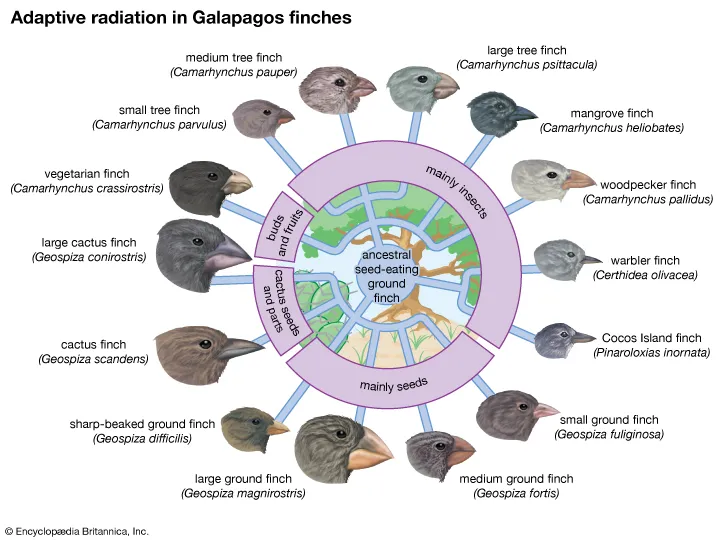
Adaptive radiation in island finches (beak form fits diet). This illustration compares beak shapes across multiple Galápagos finch species descended from a common ancestor, highlighting how different morphologies are associated with different feeding niches. It reinforces the idea that selection on islands can favor specialist traits when resources are limited and competitors partition food types. Source
Morphological traits: body size, beak/teeth shape, limb structure suited to one feeding strategy
Physiological traits: tolerance to low water availability, salt spray, or nutrient-poor diets
Behavioural traits: narrow foraging times, specific nesting preferences, tight habitat selection
These adaptations can increase success in a constrained setting, aligning with the syllabus focus that limited food and territory often push island species toward specialist strategies.
Trade-offs: benefits and vulnerabilities
Specialisation is not “better” overall; it is a trade-off.
Advantages of being a specialist on islands
Higher performance on a key resource (faster feeding, better digestion, better access)
Reduced competition if few species share that exact resource
Lower energy costs when behaviour is optimised for a narrow task
Costs of specialisation under limited resources
Lower resilience to change: if the specialised resource declines, alternatives may be unusable.
Higher extinction risk from resource variability: drought, storms, disease, or habitat alteration can remove the very resource the species depends on.
Small populations amplify risk: limited territory can cap population size, making specialists more sensitive to random events and reduced genetic variation.
Generalists in island settings
Generalists can persist on islands, especially when:
Resources fluctuate seasonally or unpredictably
Human activity creates novel, mixed habitats or food sources
The community is disturbed, making flexibility more valuable than efficiency
However, where food and space are consistently tight, the competitive edge of efficient specialists can shape community structure toward narrower niches.
Practice Questions
Explain why limited food and territory on islands can favour specialist species over generalist species. (2 marks)
Identifies that island resources (food/space) are limited (1)
Explains that specialising increases efficiency/competitive ability for a particular resource under scarcity (1)
Describe two advantages and two disadvantages of specialist strategies for island species, linking each to limited island resources. (5 marks)
Advantage 1 linked to limited resources (e.g., higher feeding efficiency on scarce food) (1)
Advantage 2 linked to limited resources (e.g., reduced competition via niche partitioning in small areas) (1)
Disadvantage 1 linked to limited resources (e.g., dependence on one resource increases risk if it declines) (1)
Disadvantage 2 linked to limited resources (e.g., small territory limits population size, increasing vulnerability) (1)
Clear linkage to the idea that islands have limited food/territory shaping these outcomes (1)
FAQ
Specialisation can involve diet, but also nesting sites, microhabitats, activity time, or tolerance to salt, wind, or drought.
Examples include:
Microhabitat specialists (e.g., cliff nesters)
Behavioural specialists (e.g., nocturnal foragers)
Key drivers include resource predictability, disturbance frequency, and how many distinct resource types exist.
If resources are stable and few, specialisation is favoured; if variable or frequently disrupted, flexibility can be favoured.
Small areas increase overlap among individuals, raising competition. Selection can then favour individuals using slightly different resources or microhabitats, gradually narrowing niches within the population.
Yes. A species may be specialised overall, while individuals differ in the exact resource used.
This variation can:
Reduce competition within the species
Provide some buffer if the main resource declines
Common approaches include:
Diet breadth from observations or scat/stomach contents
Stable isotope analysis to infer trophic resource use
Habitat-use mapping (home range and microhabitat occupancy)
