

AP Syllabus focus:
‘Invasive species, often generalists, may outcompete specialist island species, threatening specialists’ long-term survival.’
Islands are biodiversity hotspots but are especially vulnerable to ecological disruption. This page explains how invasive species change island communities through competition, why specialists are at risk, and what factors determine invasion success.
Core idea: competition favors invasive generalists on islands
Key terms for AP Environmental Science
Invasive species: A non-native organism that spreads rapidly and causes ecological and/or economic harm in the new environment.
Many island natives evolve as specialists (narrow diets, specific habitat needs), while many invaders are generalists (broad diets, flexible habitat use). When resources and space are limited, competition can shift strongly toward generalists.
Why island specialists are vulnerable
Island specialists are often disadvantaged because they tend to have:
Narrow ecological niches (dependence on particular foods, nesting sites, or microclimates)
Small population sizes (less buffer against rapid declines)
Low reproductive rates (slower recovery after losses)
Reduced anti-predator/competitor defenses (limited evolutionary history with similar competitors)
How invasive species outcompete natives
Competition mechanisms that matter on islands
Competition is strongest when invaders and natives overlap in resource use (food, shelter, breeding sites). Outcomes commonly include:
Exploitative competition: invaders consume resources faster or more efficiently, leaving too little for native species.
Interference competition: invaders directly prevent access to resources (aggression, territorial displacement, crowding out nesting sites).
Competitive exclusion: if two species have nearly identical niches and resources are limiting, one may be driven locally extinct.
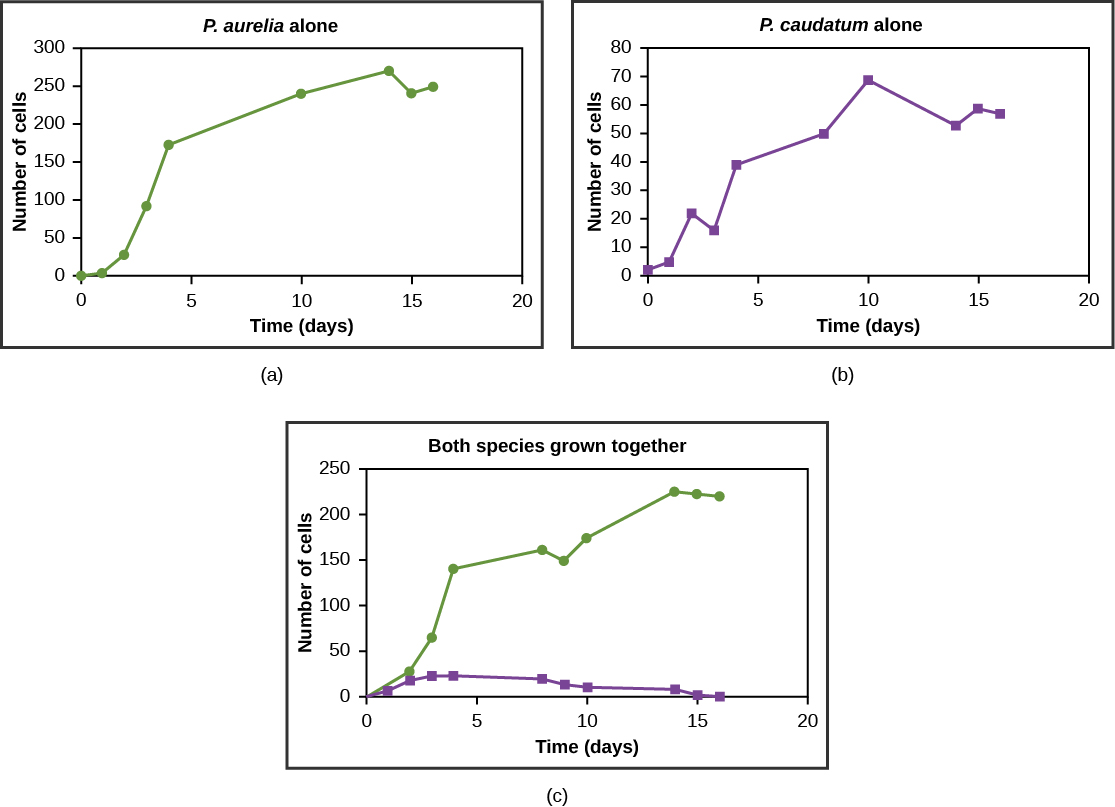
These time-series plots from Gause’s Paramecium experiments show that two species can each persist alone, yet one species can be driven to local extinction when both compete for the same limiting resource. The figure concretely illustrates “competitive exclusion” as a population outcome of sustained niche overlap under limiting resources. Source
Traits that make invasive generalists strong competitors
Generalist invaders often succeed because they can:
Use multiple food sources and switch diets seasonally
Tolerate a wide range of conditions (temperature, salinity, moisture, disturbance)
Reproduce quickly (short generation times can rapidly increase population size)
Disperse effectively (human transport, hitchhiking, strong mobility)
Thrive in human-altered habitats (ports, roads, farms) that act as invasion “launch points”
Community-level impacts on island biodiversity
What “outcompete” looks like in real ecosystems
Competition-driven impacts are often observed as:
Declines in native specialist abundance before complete disappearance
Range contraction of natives into marginal habitats where invaders perform poorly
Reduced species richness when endemic specialists are lost
Simplified communities dominated by a few widespread generalists
Indirect effects that intensify competition
Even when competition is the main interaction, invaders can indirectly worsen outcomes by:
Altering resource availability (e.g., consuming key food items that structure the food web)
Changing habitat structure (e.g., trampling or burrowing that reduces nesting cover)
Triggering trophic cascades when the loss of a native competitor changes predator–prey dynamics
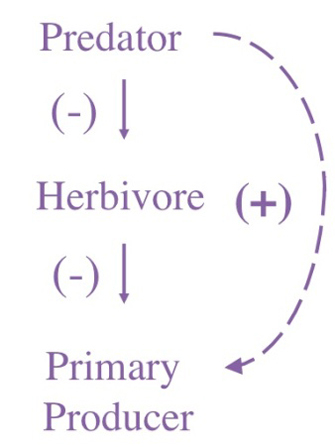
This schematic depicts a three-level trophic cascade: predators suppress herbivores (−), herbivores suppress primary producers (−), and the net indirect effect of predators on producers is positive (+). It is a compact way to visualize how adding or removing a top consumer can restructure lower trophic levels even without direct contact between predators and plants. Source
Why islands are invasion-prone
Ecological and geographic reasons
Island ecosystems often have:
High endemism (unique species found nowhere else), so losses are irreversible globally
Fewer competitors historically, leaving open niche space that invaders can exploit
Small total area, so displacement has immediate population consequences
High edge effects (coasts, fragmented habitats) where disturbance-tolerant invaders thrive
Human pathways that increase introductions
Common introduction routes include:
Shipping and cargo (stowaways, contaminated goods)
Tourism and travel (seeds, insects, small vertebrates)
Intentional releases (pets, ornamental species, pest control attempts)
Food and agriculture imports (accidental transport of eggs/larvae/seeds)
Managing invasive competition on islands
Prevention is usually most effective
Because eradication is difficult once an invader spreads, island management emphasises:
Biosecurity (inspections, quarantine, cleaning equipment, restricted imports)
Early detection and rapid response (EDRR) to remove populations before establishment
Public education to reduce intentional releases and transport
Control approaches and trade-offs
When invaders are established, strategies include:
Mechanical removal (traps, hand-pulling plants): targeted but labour-intensive
Chemical control (pesticides/herbicides): effective but risk non-target impacts
Biological control (introduced natural enemies): can be long-lasting but requires strict risk assessment to avoid additional invasions
Habitat restoration to support native specialists (replanting, protecting nesting sites), reducing the competitive advantage of invaders
Practice Questions
Explain why invasive species are often able to outcompete specialist island species. (2 marks)
States that many invasive species are generalists with broad resource use/tolerance (1).
Explains that specialists have narrow niches/limited resources on islands, so they are displaced when resources become limiting (1).
Describe two mechanisms by which an invasive generalist could reduce the long-term survival of a native island specialist, and suggest one management strategy that directly addresses competition. (5 marks)
Mechanism 1 described (e.g., exploitative competition: invader uses shared food/nesting sites more efficiently, reducing availability for the specialist) (1).
Links mechanism 1 to population decline/local extinction risk of the specialist (1).
Mechanism 2 described (e.g., interference competition: aggressive displacement/territorial exclusion at breeding sites) (1).
Links mechanism 2 to reduced reproduction/survival of the specialist (1).
Management strategy that targets competition (e.g., early eradication/removal of invader, biosecurity to prevent introduction, or protecting key specialist habitat to reduce overlap) with a brief justification (1).
FAQ
They quantify niche breadth using field observations and diet/habitat data.
Common measures include:
Diversity of food items in gut contents or stable isotope signatures
Range of habitats used across seasons
Performance (growth/reproduction) across different environmental conditions
Strong selection can occur in small, novel environments.
Rapid change is more likely when:
Generation times are short
There is high initial genetic variation or multiple introductions
New conditions favour traits like boldness, dispersal, or broader diet
It is when one invasive species facilitates others, accelerating impacts.
Examples of facilitation include:
One invader altering habitat to suit another
One invader providing new food resources
Mutual reduction of native resistance, making further invasions easier
They combine evidence from multiple sources.
Typical approaches:
Before–after monitoring where the invader spreads
Removal experiments (native recovery after control)
Resource overlap studies showing direct competition
Ruling out other drivers (disease, habitat change) with targeted surveys
Islands can be logistically contained.
Advantages include:
Clear geographic boundaries limiting reinvasion
Smaller area to search and treat
Fewer connected habitats
Biosecurity at ports can maintain eradication success over time
