

AP Syllabus focus:
‘Ecological tolerance is the range of environmental conditions an organism can withstand before injury or death occurs.’
Ecological tolerance explains why organisms live where they do and why they disappear when conditions shift. It frames environmental limits as measurable ranges, connecting physiology and habitat conditions to survival, growth, and reproduction.
Core idea: what ecological tolerance means
Ecological tolerance describes how well an organism can function across a span of environmental conditions (for example, chemical, physical, or biological conditions).
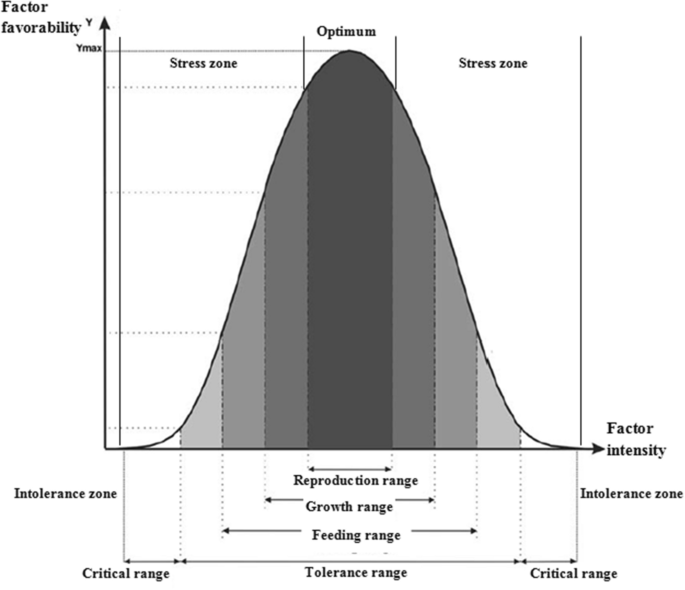
Shelford’s tolerance law curve illustrates how a species’ performance (often shown as abundance or “favorability”) varies across an environmental gradient. The central peak represents the optimum conditions, flanked by zones of physiological stress where survival may occur but fitness declines, and ending in zones of intolerance where populations cannot persist. The labeled boundaries visually reinforce the idea that ecological limits are ranges, not single threshold values. Source
It is commonly visualised as a “tolerance curve,” where performance changes as conditions move away from a preferred level.
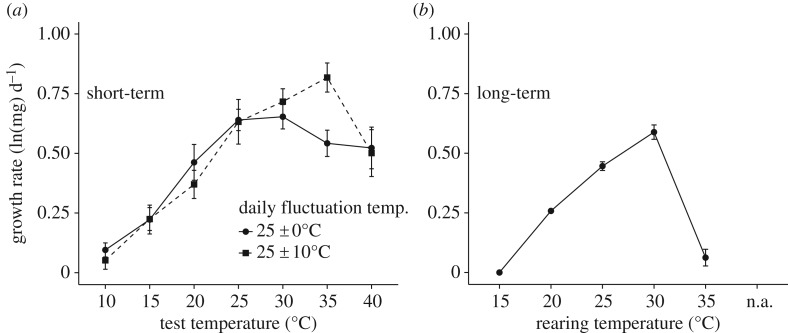
This figure shows an empirical thermal performance curve: organism growth rate changes with temperature and peaks at an intermediate optimum. As temperature shifts away from that optimum, performance declines, illustrating how organisms can remain alive but function less effectively under physiological stress. Using real data emphasizes that “tolerance curves” are measurable relationships, not just conceptual sketches. Source
A key AP-level implication is that an organism’s distribution is often constrained not by where it could survive briefly, but by where it can maintain populations over time.
Ecological tolerance: The range of environmental conditions an organism can withstand before injury or death occurs.
Components of a tolerance range
Within any tolerance range, organisms typically have different performance zones. These zones help explain patterns such as patchy distributions, seasonal die-offs, and why some species are restricted to narrow habitats.
Optimum and performance
Optimum range is where an organism performs best (highest survival, growth, and reproductive success). Conditions near the optimum support stable populations because individuals can allocate energy efficiently to maintenance and reproduction rather than stress responses.
Optimum range: The set of conditions within an organism’s tolerance range where it functions best (maximised survival, growth, and reproduction).
Zones of physiological stress
As conditions move away from the optimum, organisms may still survive but experience physiological stress. Stress can reduce fitness even if immediate death does not occur.
Common outcomes in the stress zone include:
Reduced growth rate and smaller body size
Lower reproductive output or failed development
Increased susceptibility to disease or predation
Behavioural shifts (reduced activity, seeking shelter) that can reduce feeding
Limits and zones of intolerance
At the edges of the tolerance range are tolerance limits, beyond which injury occurs and survival drops sharply; past these limits is the zone of intolerance, where death occurs and populations cannot persist.
Tolerance limits: The upper and lower boundary conditions beyond which an organism is injured or dies.
Why tolerance matters in environmental science
Ecological tolerance is a practical tool for predicting ecological responses to environmental change. It links environmental conditions to population presence/absence without requiring full knowledge of every species interaction.
Key uses of the concept include:
Explaining species distributions: organisms are absent where conditions exceed tolerance limits, even if food or space is available.
Interpreting habitat quality: a location can be “habitable” but still poor-quality if conditions place organisms in chronic stress.
Understanding population vulnerability: populations living near tolerance limits have less buffer against additional change.
Tolerance is not “all-or-nothing”
A frequent misconception is that being “within tolerance” means a species is unaffected. In reality, conditions in the stress zone can:
Lower long-term population growth (even if individuals survive)
Reduce resilience to short-term extremes (heat waves, low oxygen episodes)
Increase the likelihood of local extirpation when conditions fluctuate
Multiple conditions act together
In nature, organisms experience several environmental conditions simultaneously. A species may tolerate a given condition at one level only if other conditions are favourable. This is why tolerance should be understood as a real-world constraint, not a single-number threshold.
Practical interpretation:
When one condition pushes individuals into stress, they often become less tolerant of additional stressors.
Short exposures to extremes may be survivable, while long exposures at the same level may cause injury or death.
Practice Questions
Define ecological tolerance and state what occurs when environmental conditions exceed an organism’s tolerance limits. (2 marks)
Ecological tolerance is the range of environmental conditions an organism can withstand (1).
Beyond tolerance limits, injury and/or death occurs and the organism cannot persist (1).
A species shows highest reproductive success at intermediate values of an abiotic condition, reduced growth at slightly higher or lower values, and death at extreme high and low values. Explain, using ecological tolerance terms, how this pattern affects where the species can form stable populations. (6 marks)
Identifies the intermediate values as the optimum range (1).
Explains that fitness (e.g., reproduction) is maximised near the optimum (1).
Describes adjacent values as zones of physiological stress (1).
Explains that survival may occur in stress zones but reduced growth/reproduction lowers population stability (1).
Identifies extremes as zones of intolerance beyond tolerance limits (1).
Links intolerance/stress to distribution: stable populations most likely where conditions remain near the optimum and not beyond limits (1).
FAQ
They run controlled exposures across a gradient of a single condition while holding other conditions constant. Endpoints may include survival, injury, growth rate, or reproductive output.
Field validation often compares lab-derived limits with where the organism is actually found.
Life stages have different physiology and resource needs. Early stages may have narrower tolerances because they have limited energy reserves and less ability to regulate internal conditions.
A tolerance limit is where injury/death occurs. A regulatory limit is where the organism can no longer maintain stable internal conditions without major performance costs, even if it still survives.
Yes. Acclimation can adjust physiology within an individual’s lifetime (e.g., producing stress proteins or changing membrane composition). This can shift performance within the tolerance range but does not change genes.
Tolerance is often duration-dependent: a brief extreme may be survivable, while prolonged exposure at the same level causes cumulative damage. This is why chronic stress can reduce populations even when acute mortality is rare.
