

AP Syllabus focus:
‘Ecological tolerance can be described for individuals and for entire species, depending on variation within populations.’
Ecological tolerance describes survival under environmental conditions, but it can be framed at two scales. Understanding the difference between individual-level and species-level tolerance improves predictions about population persistence, range shifts, and management decisions.
Individual vs Species-Level Ecological Tolerance
Ecological tolerance: The range of environmental conditions an organism can withstand before injury or death occurs.
An individual’s tolerance is the specific set of conditions that one organism can endure. A species’ tolerance is a broader description summarising tolerance across many individuals, reflecting variation within the population.
Individual-Level Tolerance (Within One Organism)
Individual tolerance is shaped by traits and circumstances unique to that organism, so two members of the same species can respond differently to the same environmental stressor.
Key sources of individual variation include:
Genetic differences (different alleles affecting physiology, enzymes, membrane structure, etc.)
Life stage and size (eggs/larvae/juveniles often have narrower tolerances than adults)
Health and condition (disease, parasites, injury, nutritional status)
Acclimation (physiological adjustment) to recent conditions (for example, altered metabolism or water balance after gradual change)
Behavioral buffering (microhabitat choice, posture, activity timing) that reduces exposure without changing physiology
Individual tolerance is often described using thresholds:
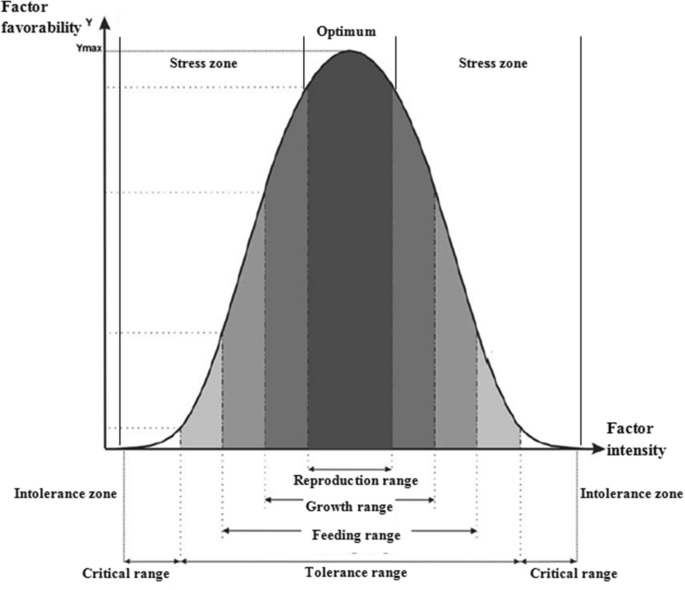
Shelford’s law of tolerance is commonly illustrated as a bell-shaped curve relating an environmental factor’s intensity to organism performance or abundance. The figure highlights lower and upper tolerance limits, the optimal range where performance is highest, and the flanking stress/intolerance zones where survival and reproduction decline or fail. Source
Lower tolerance limit: conditions below which function fails (leading to injury/death)
Upper tolerance limit: conditions above which function fails
Optimal range: conditions where growth, reproduction, and performance are highest
Zones of physiological stress: conditions where survival may occur but with reduced growth or reproduction
Tolerance range: The span between an organism’s lower and upper tolerance limits for a given environmental factor.
Species-Level Tolerance (Across a Population)
Species-level tolerance aggregates many individuals, so it depends on variation within populations. Because not all individuals share the same limits, a species can appear tolerant even if many individuals are stressed or failing.
How species-level tolerance is constructed:
Based on distributions of individual limits (not a single value)
Influenced by population structure (proportion of juveniles vs adults, for example)
Can differ among subpopulations living in different local conditions (spatial variation)
Important implications:
A species may persist under a condition because some individuals survive, even if average performance declines.
Species-level “limits” may shift over time if the population’s composition changes (for example, if more tolerant individuals survive and reproduce).
A species-level tolerance statement is only as accurate as the sampling of individuals and the endpoints measured (survival vs reproduction).
Why the Distinction Matters for Environmental Science
Environmental decisions often use species-level tolerance to set guidelines, but real ecosystems respond through individuals.
Situations where scale changes interpretation:
Environmental stress assessments: Individuals can experience sublethal stress (reduced reproduction) even when the species is still present, so presence/absence alone can underestimate impact.
Range boundaries and habitat suitability: A species’ geographic distribution reflects where enough individuals can survive and reproduce; edge populations may exist near tolerance limits with higher mortality.
Conservation planning: Small or isolated populations may have less within-population variation, making species-level tolerance estimates from elsewhere misleading for local management.
Population resilience: When conditions change, persistence may depend on whether there are individuals with traits that fall within the new conditions’ tolerance window.
Interpreting Tolerance Carefully
When reading or using tolerance information, clarify:
Are the limits based on individuals or a population average?
What response was measured: survival, growth, or reproduction?
Were organisms exposed to abrupt change (testing acute tolerance) or gradual change (allowing acclimation)?
Does the dataset represent the local population’s age structure and genetic diversity?
Practice Questions
Explain the difference between individual-level ecological tolerance and species-level ecological tolerance. (2 marks)
Individual-level tolerance refers to the range of conditions a single organism can withstand before injury/death. (1)
Species-level tolerance summarises tolerance across many individuals and depends on variation within the population. (1)
A pollutant is introduced into a river. Surveys show the species is still present downstream, but its numbers fall and fewer juveniles are observed. Using individual vs species-level tolerance, explain how the species can persist while the population declines. (5 marks)
Species presence can be maintained if some individuals have higher tolerance and survive exposure. (1)
Variation within the population means individual tolerance limits differ; less tolerant individuals die or fail to reproduce. (1)
Sublethal effects can reduce growth or reproduction even when survival occurs, lowering recruitment. (1)
Juveniles may have narrower tolerance than adults, leading to fewer juveniles observed downstream. (1)
Population decline can occur despite persistence because overall reproduction/survival rates drop below replacement for many individuals. (1)
FAQ
Acclimatisation involves reversible physiological changes within an organism’s lifetime (e.g., altered enzyme activity or water balance).
It can shift an individual’s effective tolerance range, but it does not directly alter allele frequencies in the population.
Laboratory tests often control one factor at a time and may use abrupt exposures.
In the field, multiple stressors interact, organisms can behaviourally avoid extremes, and food availability or competition can change outcomes.
If sampling over-represents healthy adults, tolerance may look broader than it is for the whole population.
Including different life stages, seasons, and microhabitats usually produces a more realistic species-level tolerance distribution.
Lethal endpoints focus on survival (death vs no death).
Sublethal endpoints track performance (e.g., reduced reproduction), which can drive population decline even when most individuals survive.
Yes. Local populations can differ in genetic composition and past exposure history, producing different distributions of individual tolerances.
These differences may persist even with the same species name, especially when gene flow is limited.
