

AP Syllabus focus:
‘Natural disruptions can cause environmental consequences that, for a given event, may be as great as or greater than human-made disruptions.’
Natural events such as storms, fires, floods, and droughts regularly reshape ecosystems. Understanding how these natural disruptions alter populations, habitats, and ecosystem processes helps explain both short-term damage and longer-term ecological change.
What counts as a natural disruption?
Natural disruptions (also called disturbances) are events that change environmental conditions and resource availability, altering how ecosystems function.
Disturbance (natural disruption): A naturally occurring event (e.g., hurricane, wildfire, flood, drought, volcanic eruption) that causes a measurable change in an ecosystem’s structure and/or function.
A key AP idea is that natural disruptions can be as ecologically consequential as human-caused disruptions for a given event, even if their causes differ.
Types of natural disruptions and their immediate effects
Physical disturbances
These directly damage organisms and habitat structure.
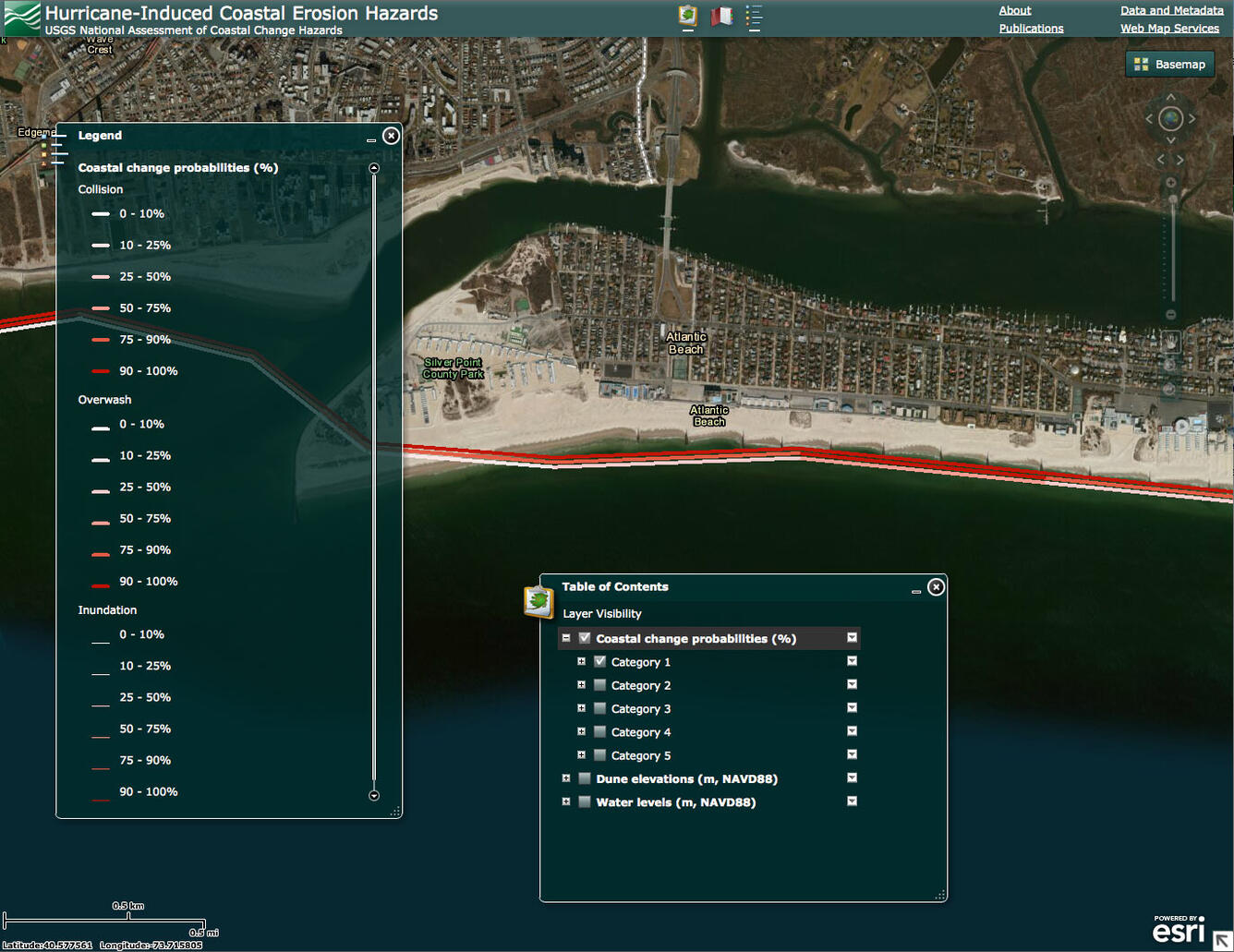
USGS coastal-change hazard map illustrating how a hurricane can produce different coastal outcomes (dune collision, overwash, and inundation) along the same shoreline. The color-coded probability bands show that disturbance impacts are spatially heterogeneous, creating adjacent patches of severe versus limited habitat alteration. Source
Hurricanes/typhoons: windthrow, salt spray injury, storm surge, coastal erosion
Floods: scouring of streambeds, sediment deposition, displacement of organisms
Wildfires (lightning-caused): biomass loss, canopy opening, ash deposition
Volcanic eruptions/landslides: burial by ash or debris, habitat removal, altered topography
Immediate ecological consequences often include:
Direct mortality (plants, animals, soil organisms)
Habitat fragmentation at small scales (patches of intact vs damaged areas)
Changes in light, temperature, and moisture due to canopy loss
Reduced primary productivity when photosynthetic tissue is removed
Climatic and biological disturbances
These shift conditions or interactions rather than physically removing habitat.
Droughts/heat waves: water stress, reduced growth and reproduction, increased fire risk
Cold snaps/frost events: tissue damage in temperature-sensitive species
Disease outbreaks and insect irruptions: rapid population declines, altered food webs
How disruptions change ecosystem structure
Population and community impacts
Natural disruptions can reorganise which species are present and how abundant they are by:
Removing sensitive life stages first (seedlings, juveniles, nesting adults)
Favoring species with disturbance-tolerant traits (resprouting, rapid reproduction, mobility)
Causing local population bottlenecks when survivors are few (which can affect future adaptation)
Altering predator–prey dynamics if one trophic level is hit harder than another
Habitat complexity and niches
After major damage to vegetation or reefs, ecosystems often experience:
Fewer microhabitats (loss of leaf litter layers, dead wood, coral branches)
Simplified structure that can reduce shelter and breeding sites
Greater exposure to wind and sun, changing evaporation rates and soil moisture
How disruptions change ecosystem function
Energy flow and productivity
Disruptions can sharply reduce energy capture and transfer by:
Lowering gross primary productivity when photosynthetic biomass is lost
Reducing food availability for herbivores and then predators
Temporarily increasing detritus (dead organic matter), shifting energy flow toward decomposers
Nutrient cycling and water quality
Natural disruptions can accelerate or redirect nutrient movement.
Fires can volatilize nutrients (notably nitrogen), leave mineral-rich ash, and reduce ground cover
Floods can mobilize nutrients and sediments, increasing turbidity and lowering light in aquatic systems
Storm runoff can deliver pulses of organic matter that raise microbial respiration and reduce dissolved oxygen
These changes can create cascading effects such as fish kills (low oxygen), algal blooms (nutrient pulses), or altered soil fertility (ash enrichment vs erosion losses), depending on local conditions.
Why impacts can rival human-made disruptions
The syllabus emphasises that, event-for-event, natural disruptions may produce consequences comparable to human-caused ones. Key reasons include:
Magnitude: a single hurricane can topple vast forest areas; a severe wildfire can remove most aboveground biomass across a region
Speed: abrupt change can outpace the ability of organisms to move or adjust behaviorally
System-wide reach: disruptions can simultaneously affect soil, water, vegetation, and wildlife, producing multi-trophic impacts
Feedbacks: initial damage can trigger secondary effects (erosion after vegetation loss, increased runoff, reduced habitat quality)
Ecological responses that determine severity
Severity depends on both the event and the ecosystem’s ability to absorb change and reorganize.
Ecological resilience: The capacity of an ecosystem to withstand a disturbance and recover key structures and functions over time.
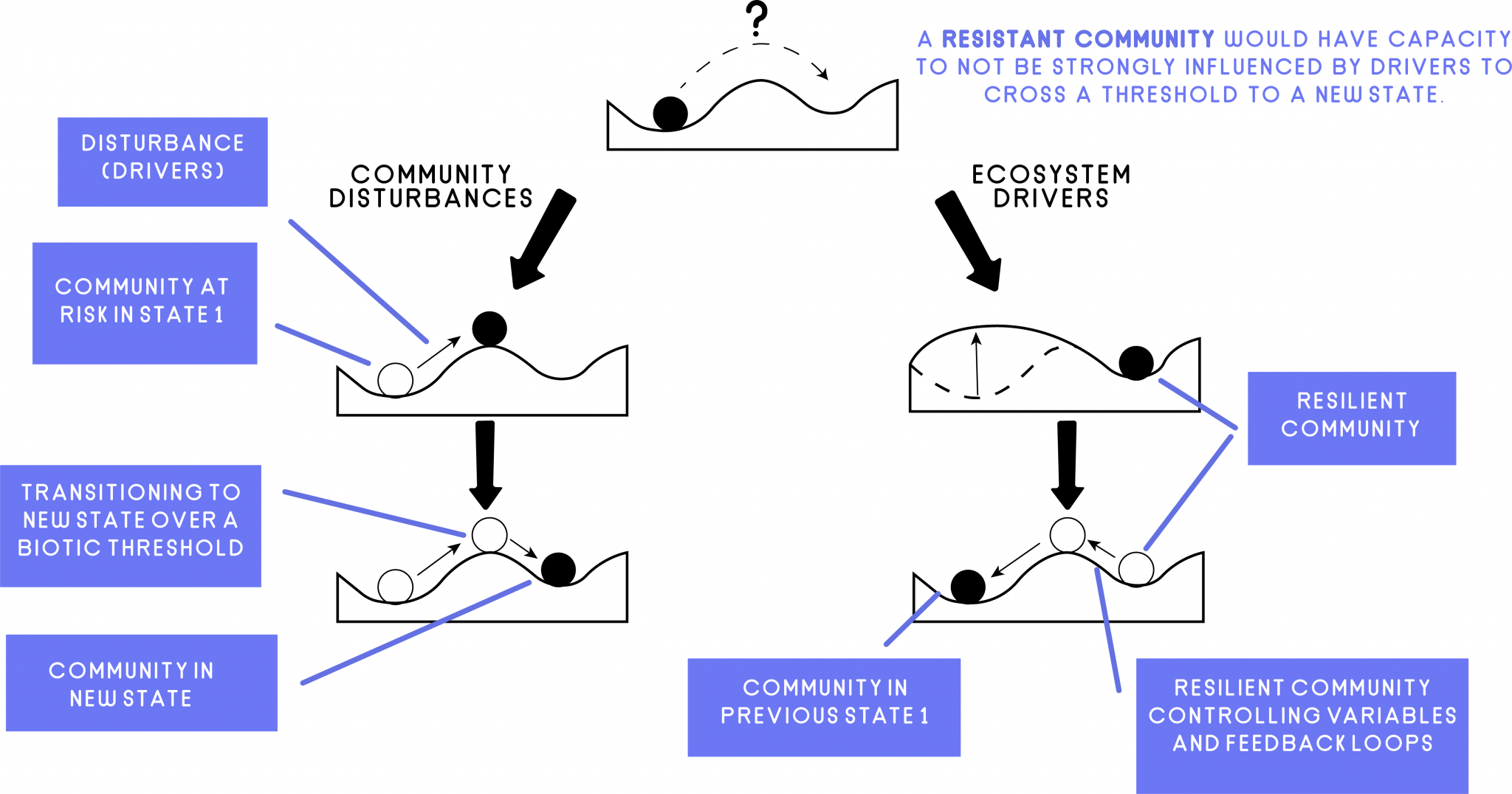
Ball-and-cup (stability landscape) diagram showing how disturbances can push an ecosystem state (the “ball”) within or across basins of attraction (the “cups”). Deeper basins represent higher resilience because larger perturbations are needed to force a threshold transition into a different stable state. Source
A resilient ecosystem is not “unchanged”; it may recover function while shifting species composition.
Factors that shape outcomes
Disturbance intensity and extent: how strong and how widespread the event is
Pre-disturbance condition: prior stress (water scarcity, nutrient limitation) can amplify impacts
Refugia and survivors: undamaged patches and surviving individuals speed recolonization
Connectivity: nearby source populations enable repopulation after local losses
Resource pulses: post-disturbance nutrients or light can temporarily boost growth of certain species, reshaping competition
Practice Questions
State two environmental consequences of a natural disruption on an ecosystem. (2 marks)
1 mark for each valid consequence stated (e.g., increased erosion/sediment run-off, reduced primary productivity, direct mortality, altered water quality/turbidity, nutrient pulse, habitat structure loss).
Explain how a single natural disruption event can cause ecosystem consequences that may be as great as or greater than a human-made disruption. (6 marks)
1 mark: links to magnitude/scale of a single event (large area affected).
1 mark: rapid onset causing high mortality or habitat loss.
1 mark: explains change to ecosystem structure (e.g., community composition, habitat complexity).
1 mark: explains change to ecosystem function (e.g., productivity/energy flow, nutrient cycling).
1 mark: includes cascading or secondary effects (e.g., erosion after vegetation loss, oxygen depletion after organic matter pulse).
1 mark: clear comparative statement that the ecological impact can rival human-caused disruption for that event (not just that both exist).
FAQ
Intensity describes the physical strength of the event (e.g., wind speed, peak discharge, fireline intensity).
Severity measures ecological change caused (e.g., % canopy loss, soil organic matter loss, mortality rates), often using before–after plots or remote sensing indices.
Common indicators include:
Canopy cover loss and treefall rates
Bank erosion and suspended sediment concentration
Nutrient concentrations (nitrate/phosphate) and turbidity
Dissolved oxygen and temperature changes
Population counts of key taxa (fish, amphibians, birds)
Differences often come from baseline water storage and access:
Soil texture and depth (water-holding capacity)
Groundwater availability and rooting depth
Prior drought history (physiological acclimation)
Local microclimates and shading
Species traits (stomatal control, dormancy, migration)
In fire-adapted systems, periodic burning can:
Reduce fuel loads, lowering the chance of extremely severe fires
Recycle nutrients into readily available mineral forms
Maintain open habitats needed by certain plants and wildlife
Trigger germination in some species (serotinous cones, smoke cues)
This depends strongly on fire frequency and season.
A compound disturbance occurs when events interact (e.g., drought followed by wildfire, hurricane followed by disease).
Interactions can amplify impacts by reducing recovery capacity, increasing mortality, or accelerating erosion and nutrient losses, making outcomes harder to predict from single-event effects alone.
