AP Syllabus focus:
'Northern Renaissance art emphasized human-centered naturalism and treated ordinary individuals and daily life as worthy subjects.'
In Northern Europe, artists developed a strikingly detailed visual language that made the visible world meaningful. Their paintings valued observation, texture, and the experiences of ordinary people as serious artistic subjects.
Core Characteristics of Northern Art
In the Northern Renaissance, especially in the Low Countries, German lands, and France, painters aimed to represent the world with extraordinary fidelity. Rather than idealizing the body in a classical way, they often emphasized careful observation of faces, clothing, interiors, weather, and landscape. This naturalism made people and objects seem tangible and immediate.
Observation of the Visible World
Artists studied how things actually looked.

Albrecht Dürer’s Young Hare (1502) exemplifies Northern Renaissance observation through painstaking rendering of fur, highlights, and shadow. The work treats a single, ordinary creature as worthy of sustained attention, reinforcing the era’s emphasis on empirical looking and tangible reality. Source
They paid attention to:
wrinkles, aging skin, and individualized faces
folds in cloth, fur, glass, and metal surfaces
light reflected in windows, mirrors, and polished objects
landscapes, towns, and rooms rendered with convincing depth
This focus on observable detail gave paintings a strong sense of lived reality. Viewers were meant to feel that the scene belonged to the same world they inhabited. Northern artists often treated the visible world as worthy of close scrutiny, making art a record of human presence in ordinary settings.
Oil Painting and Precision
Northern painters became especially associated with oil paint, which dried slowly and allowed artists to build up thin layers of color. This technique supported:
subtle shading
rich color saturation
minute surface detail
luminous effects in skin, jewels, and fabric
Because of this, Northern art often appears intensely realistic.
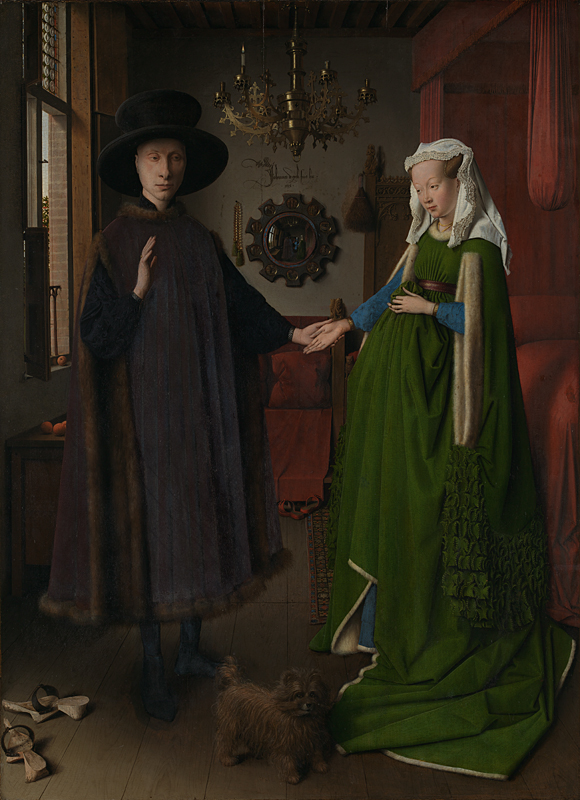
Jan van Eyck’s Arnolfini Portrait (1434) demonstrates how oil paint enabled Northern artists to build luminous layers and capture minute surface detail. The scene’s domestic interior—complete with mirror reflections, textiles, and household objects—links close observation to symbolic meaning, showing ordinary material life as intellectually significant. Source
The medium helped artists capture not just bodies but also the textures of daily material life. A fur collar, a brass candlestick, or a wooden chair could be painted with such care that objects themselves seemed important. This was a major part of Northern art’s emphasis on human-centered naturalism.
Ordinary Individuals as Important Subjects
The Northern Renaissance expanded who could appear in serious art. Alongside religious figures and rulers, artists painted merchants, spouses, children, donors, and townspeople with remarkable individuality. Portraits did not simply record status; they also suggested personality, self-control, piety, or prosperity.
Portraits and Domestic Interiors
Many works placed individuals in detailed indoor settings filled with familiar objects. Domestic spaces, furniture, books, clothing, and household goods communicated social identity. These paintings showed that private life could be artistically significant.
Ordinary objects were rarely random. A candle, a dog, a pair of shoes, fruit, or a mirror could carry symbolic meaning while still looking like part of everyday experience. Northern artists therefore joined close observation with layered interpretation. The result was art that felt both realistic and intellectually demanding.
Portraiture also reflected the growing visibility of urban and commercial groups. Wealthy townspeople wanted images that displayed both success and personal identity. As a result, Northern art often treated the individual person as worthy of sustained attention, even when the sitter was not a monarch or noble hero.
Scenes of Work, Community, and Common Life
Northern artists also treated everyday activity as worthy of representation. Markets, meals, weddings, festivals, peasant labor, and changing seasons all became subjects for major works.
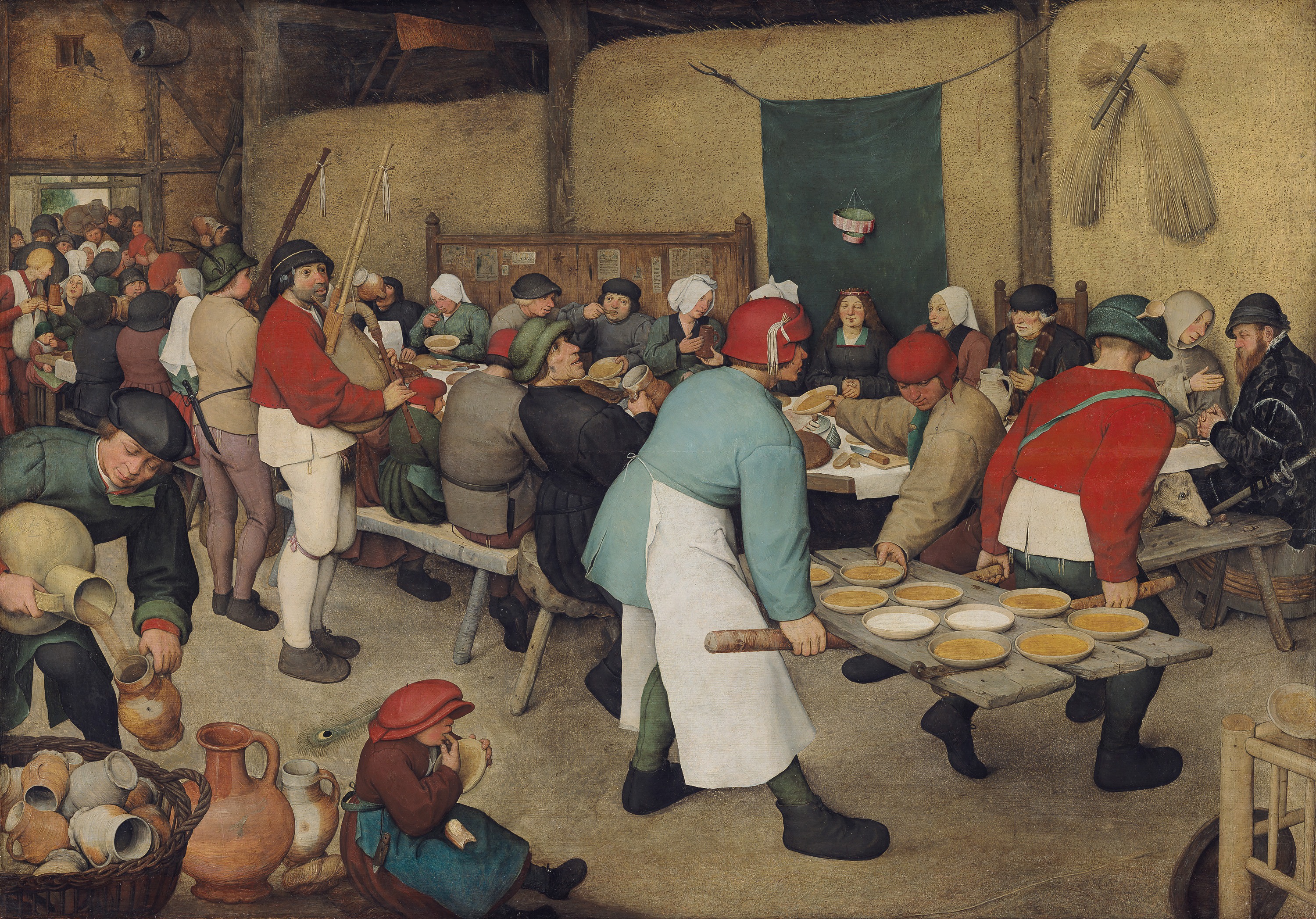
Pieter Bruegel the Elder’s Peasant Wedding (1568) presents a vernacular interior filled with labor, food service, and communal ritual. The dense composition invites viewers to read social roles and behavior—an example of how everyday life became a serious, carefully structured subject in Northern art. Source
This did not mean such scenes were merely casual snapshots. They could include:
moral lessons
social commentary
religious echoes
celebrations of community life
By painting common people and ordinary routines, artists broadened the cultural meaning of art. They suggested that the experiences of non-elites mattered and that daily life revealed important truths about society. In this way, Northern Renaissance art made everyday life a serious subject rather than a background detail.
Major Themes in Northern Everyday-Life Art
One major theme was individuality. Faces were not generic. Even in donor portraits or crowded scenes, artists often distinguished one person from another through expression, posture, and dress.
A second theme was material reality. Northern art paid unusual attention to objects because objects shaped human experience. Food, tools, textiles, and furnishings could reveal wealth, labor, taste, and moral values. The world of possessions and work was treated as part of what defined human life.
A third theme was the relationship between the sacred and the ordinary. Even when the subject was religious, Northern painters frequently set holy events in recognizable homes, towns, or landscapes. This made spiritual stories feel immediate and accessible. The divine could be imagined within the everyday world, not only in distant or idealized settings.
Important Artists and Examples
Jan van Eyck is often associated with meticulous surface detail and convincing interiors. His portraits and domestic settings show how realism could elevate ordinary surroundings.
Albrecht Dürer brought intense observation to portraits, self-portraits, animals, and landscape studies. His work showed that close study of the visible world was itself a serious artistic pursuit.
Pieter Bruegel the Elder is especially important for scenes of peasant life, seasonal labor, and village gatherings. His paintings made rural communities and common activities central rather than marginal.
Why This Mattered in AP European History
Northern Renaissance art reflected a broader cultural shift in what Europeans considered meaningful to see and represent. Art no longer focused only on ideal heroes, rulers, or exclusively sacred figures. It increasingly recognized the value of:
the individual person
the everyday environment
the social world of ordinary people
This change helped expand the range of acceptable artistic subjects. It also reveals a society paying closer attention to human experience as it was actually lived. For AP European History, the key idea is not just that Northern artists painted realistically, but that they used realism to give dignity, visibility, and significance to common life.
Practice Questions
Identify one way Northern Renaissance artists used naturalism to make ordinary life a worthy subject. (2 marks)
1 mark for identifying a specific feature such as detailed domestic interiors, individualized faces, realistic textures, or scenes of work or community life.
1 mark for explaining that this lifelike treatment gave common people or everyday settings artistic importance.
Explain how Northern Renaissance art reflected changing attitudes toward ordinary individuals and daily life in Europe from about 1450 to 1600. (5 marks)
1 mark for a defensible claim that Northern artists increasingly treated non-elites and everyday experience as meaningful subjects.
1 mark for discussing naturalistic techniques such as close observation, precise detail, or realistic light and texture.
1 mark for using one relevant example, such as portraiture, domestic interiors, markets, peasant festivals, or seasonal labour.
1 mark for explaining how such works emphasized individuality, social identity, or community life.
1 mark for linking the art to broader cultural change, such as growing interest in lived experience, the individual, or the secular dimensions of daily life.
FAQ
These objects let artists combine realism with symbolism. A dog might suggest fidelity, fruit could hint at fertility or the Fall, and a candle might evoke divine presence or mortality.
Meanings were not always fixed. Patrons, region, and context all mattered, so viewers had to read both the object itself and its place in the scene.
Northern painters often worked in organised workshops. Assistants prepared panels, mixed pigments, transferred designs, and sometimes painted less important areas.
Masters then refined faces, hands, fabrics, and reflective surfaces. This system made very detailed painting practical and helped preserve a recognisable style across multiple commissions.
Seasonal imagery reflected the rhythm of life in many northern regions, where farming, weather, and local custom shaped daily experience very visibly.
These images also appeared in devotional books and elite commissions. They could celebrate rural order, mark the passage of time, and connect human labour to the wider structure of creation.
Yes. Women could be patrons, owners, and viewers of art, especially in urban households, courts, and convents. Their choices influenced what kinds of domestic and devotional images were commissioned.
At the same time, many representations of women reflected social expectations about virtue, marriage, household management, and obedience, so the images often reveal both agency and constraint.
Wooden panels, especially oak, gave painters a smooth, stable surface for tiny brushstrokes and layered glazes. That suited the Northern taste for exact detail.
Panels also worked well for portable altarpieces and household images. In many northern settings, they were simply more practical than large fresco cycles, which depended on different architectural conditions.