AP Syllabus focus:
'The invention of printing accelerated the dissemination of new ideas across Europe.'
The printing press transformed communication in early modern Europe by making texts cheaper, faster, and more consistent, allowing ideas to move across regions and social groups with unprecedented speed.
Why the printing press mattered
Before printing, books in Europe were copied by hand. These manuscripts were expensive, slow to produce, and vulnerable to copying errors. Because texts were scarce, new arguments in religion, scholarship, and practical knowledge usually spread slowly and reached limited audiences.
In the mid-fifteenth century, printers developed a method that combined metal type, oil-based ink, and the screw press.
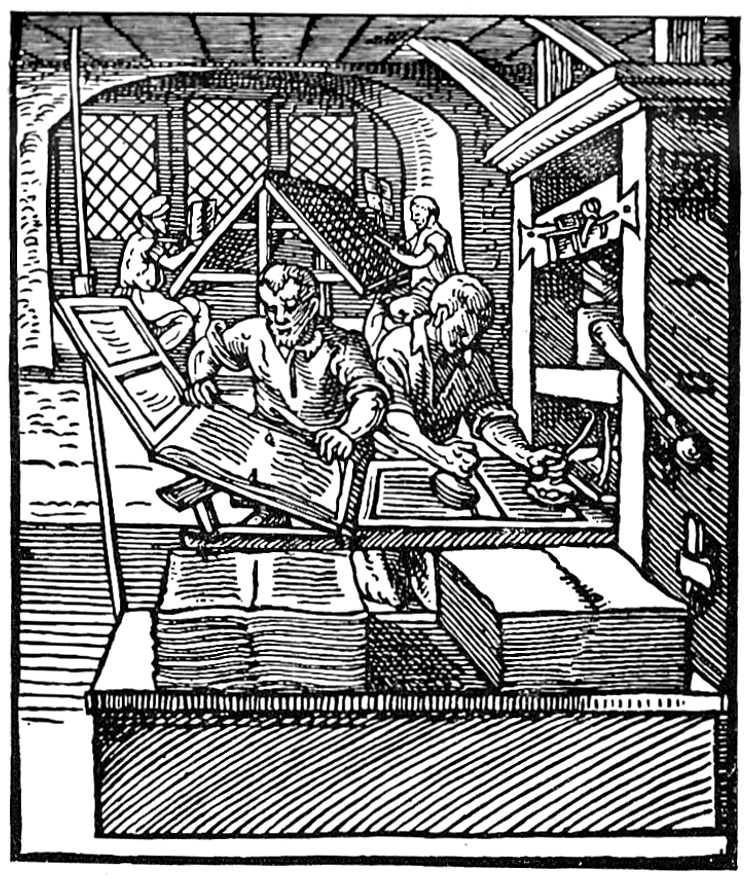
This woodcut depicts a print shop at work, including the press itself and the labor division between setting type, inking, and pulling impressions. It helps visualize how printing turned text reproduction into a repeatable mechanical process, enabling large numbers of near-identical copies to be produced quickly. Source
The key innovation was movable type.
Movable type refers to individual metal letters that could be arranged, inked, pressed onto paper, and then reused to print many copies of a text.
This method did not create ideas by itself, but it changed the speed, scale, and consistency of communication. A work that once existed in only a few handwritten copies could now appear in hundreds of nearly identical printed versions.
How printing accelerated the spread of ideas
Faster reproduction and wider circulation
Printing greatly reduced the time needed to reproduce a text. Once a printer set a page of type, many copies could be produced far more quickly than a scribe could write them by hand.
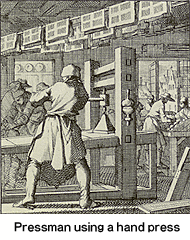
This image shows a pressman using a hand press, illustrating the physical step where pressure transfers ink from a prepared forme onto paper. Seeing the press in use clarifies why printing dramatically increased output per unit time compared with manual copying, even when labor and setup time were still significant. Source
This had several major effects:
Lower costs made books, pamphlets, and printed sheets more accessible.
Larger print runs allowed the same work to appear in multiple towns and regions.
More reliable copies reduced the distortions caused by repeated hand copying.
Repeated editions kept successful works in circulation over longer periods.
Because printed works could be produced in quantity, they moved through networks of printers, merchants, and booksellers linking major European cities. New ideas no longer depended only on direct teaching or the slow transport of manuscripts.
Standardization and shared knowledge
Printing also helped create more stable texts. When many readers used the same edition, scholars and students could work from a common version instead of many different manuscript copies. This made debate more precise and allowed arguments to spread with greater clarity.
Standardization mattered because ideas gained influence when they could be read, cited, compared, and criticized by people in different places. Printing supported this process by giving readers access to the same words, images, and page layouts.
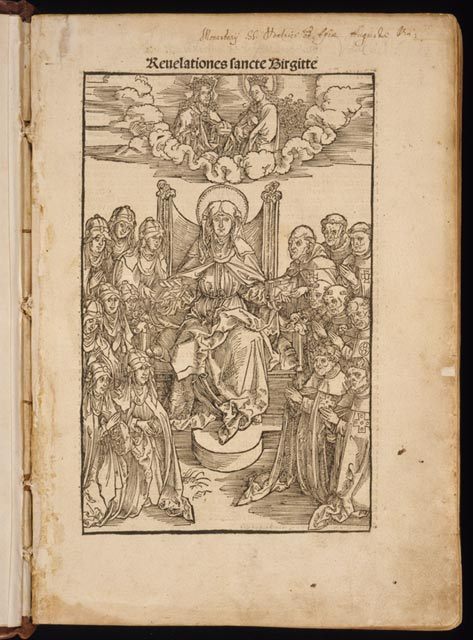
This page from a printed book shows a repeatable layout in which text and a woodcut illustration are integrated on the same leaf. As books circulated in consistent editions, readers in different cities could reference the same visual and textual framing, supporting more precise scholarly and religious debate across Europe. Source
What kinds of ideas spread more quickly?
Scholarly and humanist ideas
Printed books made it easier to circulate classical texts, commentaries, letters, and educational works. Scholars could compare versions, identify errors, and communicate findings more effectively. Intellectual exchange became less local and more European in scope.
A thinker no longer had to rely only on a court, monastery, or university circle. A printed work could travel far beyond its place of origin and reach readers the author would never meet.
Religious criticism and reforming ideas
Printing was especially powerful in religious life. Sermons, devotional works, Bible editions, and religious criticism could circulate among lay readers as well as clergy. This made communication less dependent on church institutions alone.
Printed religious arguments spread quickly because they could be reproduced in large numbers and read aloud to groups. Even people who could not read directly could still encounter printed ideas through public reading, preaching, and discussion.
Practical and technical knowledge
Printing also spread information with immediate practical value. Calendars, almanacs, medical guides, maps, and manuals moved knowledge beyond elite scholarly circles. This broadened the social reach of print and helped create a larger reading public.
Why print changed intellectual life
A broader audience for debate
As printed material became more available, reading expanded beyond a narrow clerical and aristocratic elite. Urban professionals, merchants, teachers, and some artisans gained easier access to texts. This did not produce universal literacy, but it widened the audience for written debate.
A broader audience changed the nature of authority. Readers could compare texts, encounter competing claims, and form opinions from multiple written sources rather than relying only on local oral authority or inherited tradition.
More permanent arguments
Printing preserved arguments in durable form. A critic could respond to a published work, and others could read both texts and join the discussion. This created a more public and cumulative intellectual culture.
As a result:
controversies lasted longer because texts remained available
ideas could be revisited and reprinted
authors became more conscious of a wider audience
reputations increasingly depended on printed works
Limits and responses
Censorship and control
The spread of print did not mean complete freedom of expression. Political and religious authorities recognized its power and tried to regulate it through licensing, censorship, and bans on certain works. Their efforts show how seriously rulers and church leaders viewed the new technology.
Printers therefore operated in a world of opportunity and risk. A press could spread influential ideas quickly, but it could also attract official punishment if those ideas challenged established authority.
Uneven access
Printing did not affect all Europeans equally. Access remained greatest in towns and cities, and many people still depended on oral communication. Books were cheaper than manuscripts, but they were not free, and literacy remained uneven.
Even where literacy was limited, printed texts still shaped conversation because literate individuals could read them aloud, summarize them, or adapt them into sermons and speeches. In that way, print extended the reach of written arguments into spaces where books themselves remained scarce.
Practice Questions
Explain one way the printing press accelerated the spread of new ideas in Europe. (2 marks)
1 mark for identifying one valid way, such as faster reproduction, lower cost, wider circulation, or more standardized texts.
1 mark for explaining how that factor helped ideas reach more people or travel more quickly across Europe.
Evaluate the extent to which the printing press transformed intellectual and religious life in Europe from c. 1450 to c. 1600. (6 marks)
1 mark for a clear thesis that makes a defensible argument about the extent of change.
1 mark for relevant context, such as the limits of manuscript culture before printing.
2 marks for specific evidence, such as cheaper books, larger print runs, standardized editions, wider circulation of religious criticism, or broader access to scholarly texts.
1 mark for analysis explaining how printing transformed intellectual life.
1 mark for analysis explaining how printing transformed religious life and/or discussing limits such as censorship or uneven literacy.
FAQ
Printing thrived where several advantages came together:
strong trade connections
access to paper and skilled labour
universities or schools that created demand
wealthy patrons and book buyers
Cities with busy commercial links could import materials, sell books widely, and attract trained workers. A successful centre usually combined learning with business opportunity.
No. Manuscripts continued to be used for a long time.
They remained useful for private notes, drafts, official records, and texts that were too specialised or too risky to print. Luxury handwritten books also kept social prestige.
Print expanded rapidly, but scribal culture survived beside it rather than disappearing at once.
Illustrations, especially woodcuts, made printed works more accessible.
They could:
attract buyers in crowded markets
reinforce a message quickly
help semi-literate audiences follow an argument
give a memorable visual form to a religious or political idea
Images also travelled well because the same block could be used repeatedly, giving many readers a familiar visual message.
Women often worked in family printing businesses, even if records understate their role.
They could help with:
proofreading
bookselling
binding
bookkeeping
managing workshops after a husband's death
In some towns, widows legally continued a press and published under their own names. Their participation shows that print was not only an intellectual system but also a household business.
Printers had to balance ideas with profit.
They often looked for:
steady demand from schools, churches, or officials
works likely to sell quickly
texts backed by patrons
books unlikely to be banned
Many printers were businesspeople first. They might publish serious scholarship, but they also relied on practical or popular works to keep a shop financially stable.