AP Syllabus focus:
“Physical factors (climate, landforms, and water bodies) and human factors (culture, economics, history, and politics) influence population distribution.”
Where people live is shaped by a combination of environmental conditions and human decisions, creating distinct spatial patterns that reflect both natural constraints and cultural preferences.
Factors Shaping Where People Live
Human settlement patterns emerge from the interplay of physical factors and human factors, each influencing how densely and where populations cluster at different scales. These influences help geographers explain why some world regions attract large populations while others remain sparsely inhabited. Understanding these factors is essential for interpreting global and regional population distributions.
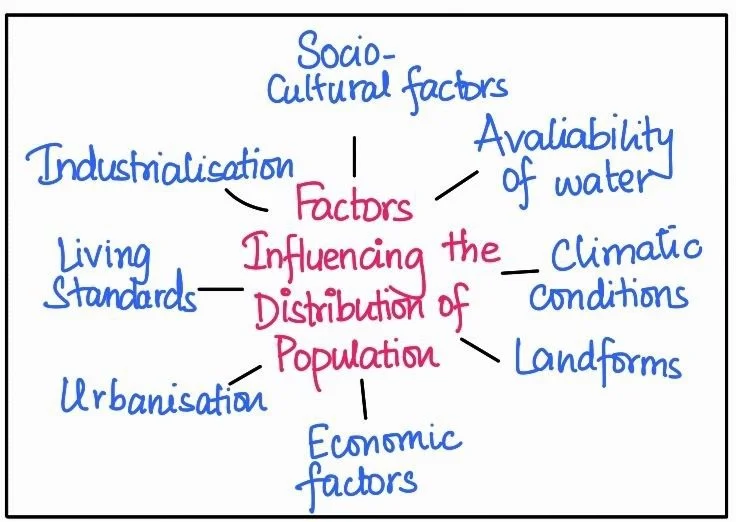
Concept map of key factors influencing the distribution of population, including climate, landforms, availability of water, economic factors, and socio-cultural influences. This visual reinforces how both physical and human conditions jointly shape where people live. The diagram also includes extra terms such as industrialisation and living standards that extend beyond AP syllabus wording but still illustrate broader human factors affecting settlement patterns. Source.
Physical Factors Influencing Population Distribution
Physical geography provides the foundational conditions that either support or hinder human settlement. These natural features often determine where early populations concentrated and continue to shape modern patterns.
Climate
Climate plays a central role in shaping livability and the potential for agriculture.
Climate: Long-term patterns of temperature and precipitation that influence environmental conditions and human activities.
Most people live in temperate climates with moderate temperatures and reliable rainfall. These areas support intensive agriculture, reduced disease burdens, and comfortable living conditions. In contrast, extreme climates—including polar cold, desert dryness, or tropical heat and humidity—discourage dense settlement due to challenges in agriculture, infrastructure maintenance, and health. Temperate mid-latitude regions in Europe, eastern China, and the eastern United States exemplify how moderate climate conditions support high population densities.
Landforms
Topography shapes accessibility, agricultural potential, and the feasibility of building settlements.
Plains and lowlands promote dense settlement because they facilitate farming, transportation, and construction.
Mountainous regions often restrict population due to steep slopes, thin soils, and isolated locations.
Coastal lowlands attract settlement for their economic opportunities and relatively flat terrain.
Places such as the North China Plain and the Indo-Gangetic Plain demonstrate how flat terrain supports some of the world’s largest population clusters.
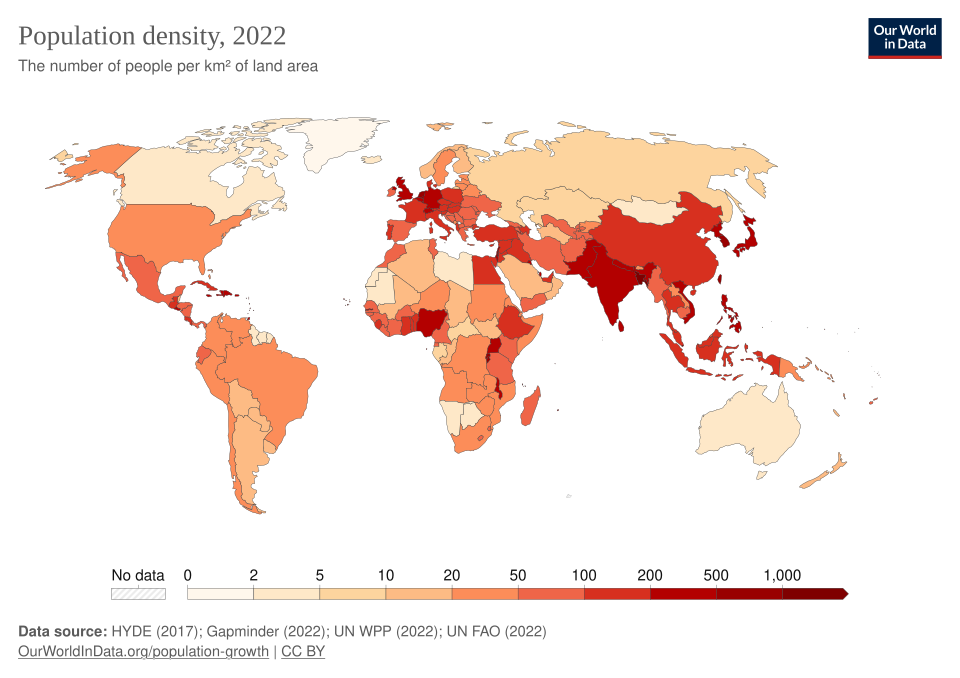
Map of world population density, with darker shades showing regions where people are most concentrated. The pattern highlights dense populations in fertile river valleys and temperate coastal lowlands, and sparse populations in deserts, polar regions, and high mountains. The detailed country-level shading provides additional information beyond the syllabus but helps illustrate how physical factors shape real-world population patterns. Source.
Water Bodies
Proximity to water has historically been one of the strongest determinants of where people live.
Water bodies: Natural features such as rivers, lakes, and oceans that provide resources and transportation routes.
Access to freshwater supports drinking supplies, agriculture, sanitation, and industry. Major river valleys, including the Nile, Tigris-Euphrates, and Ganges, have long sustained some of the world’s oldest and densest populations. Coastal regions continue to attract settlement due to transportation corridors, fishing resources, and opportunities for trade and development. Even today, a significant share of the world’s population lives within a short distance of a coast or major river system.
Human Factors Influencing Population Distribution
Physical factors set the stage, but human decisions explain many contemporary patterns of settlement. Social, economic, cultural, and political processes shape where people choose or are able to live.
Culture
Cultural factors influence preferred locations for settlement and create patterns such as ethnic enclaves or religious clustering.
Cultural ties may draw people to areas that share the same language, religion, or traditions.
Cultural landscapes—visible imprints of human activity—often reinforce settlement patterns by making areas feel familiar or supportive to particular groups.
Historic examples include communities forming around shared religious institutions or migrant groups clustering in urban neighborhoods with established social networks.
Economics
Economic opportunities strongly attract population, especially in urban and industrial areas.
Economic opportunity: The availability of jobs, resources, and financial prospects that attract workers and investment.
People tend to concentrate where employment is abundant, including manufacturing centers, service-based cities, ports, and technology hubs. Urbanization trends worldwide illustrate how economic pull factors shape dense metropolitan populations. Regions with diversified economies, such as Western Europe or coastal China, often experience particularly high concentrations of people due to job availability and infrastructure development.
History
Historical processes often establish patterns of settlement that persist for centuries.
Colonialism shaped global settlement by establishing administrative centers, plantation systems, and port cities.
Historical trade routes often became corridors of long-term population concentration.
Cultural hearths—places where civilizations originated—remain highly populated due to long-standing development and agricultural stability.
Historical continuity explains why many of the world’s oldest cities remain among its most populated.
Politics
Political stability, governance, and policy decisions affect where people live by shaping safety, rights, and access to services.
Stable governments with strong institutions attract populations seeking security and opportunity.
Political conflict, in contrast, can lead to depopulation as people migrate away from unsafe regions.
Government planning, including investment in infrastructure or creation of special economic zones, can intentionally direct population growth.
Policies related to land use, zoning, and development influence urban form and the distribution of residents within cities and regions.
Integrating Physical and Human Factors
Population distribution results from a dynamic combination of environmental constraints and human choices. While natural features determine a region’s basic suitability for settlement, human factors explain many contemporary patterns, including urbanization and migration. Understanding these factors enables geographers to interpret the spatial organization of human populations and the forces shaping where people live.
Practice Questions
Question 1 (1–3 marks)
Explain one way in which a physical factor influences global population distribution.
Mark scheme
• 1 mark for identifying a relevant physical factor (e.g., climate, landforms, water availability).
• 1 mark for describing how this factor encourages or discourages settlement.
• 1 mark for linking the factor to a clear pattern or outcome in global population distribution.
Question 2 (4–6 marks)
Using examples, analyse how both physical and human factors interact to shape patterns of population distribution.
Mark scheme
• 1 mark for identifying at least one physical factor influencing population distribution.
• 1 mark for identifying at least one human factor influencing population distribution.
• 1 mark for explaining how a physical factor shapes settlement patterns.
• 1 mark for explaining how a human factor shapes settlement patterns.
• 1 mark for demonstrating interaction between physical and human factors.
• 1 mark for using at least one appropriate and relevant example to support the analysis.
FAQ
Microclimates create small-scale variations in temperature, moisture, and wind that make specific areas more or less attractive for settlement.
For example, south-facing slopes in temperate regions receive more sunlight and are often preferred for housing or farming.
Sheltered valleys can support agriculture even in otherwise harsh environments.
Urban heat islands may also draw or repel residents depending on the season and comfort levels.
These subtle variations help explain why population density can differ significantly across short distances within the same region.
Abundant water does not guarantee high population density because other limiting factors may override its benefits.
• Terrain may be too steep or rugged for large-scale settlement.
• Water may be present but difficult to access due to seasonal flooding or poor infrastructure.
• Disease prevalence, such as in tropical wetlands, can discourage long-term settlement.
• Economic isolation or lack of investment may limit development opportunities.
Thus, water availability interacts with multiple physical and human constraints.
Communities often inherit long-standing attitudes about risk-prone areas, influencing present-day settlement even when conditions have changed.
Many floodplains or volcanic areas remained sparsely populated for generations due to ancestral avoidance.
In some regions, traditional knowledge discouraged living near unstable slopes or drought-prone zones.
Even when modern engineering reduces hazards, these cultural memories can continue to influence where people prefer to live.
Transportation routes often follow physical features but also amplify their impact on population distribution.
• River valleys become settlement corridors because flat terrain enables both farming and easy movement.
• Mountain passes attract towns where travel is possible through otherwise restrictive terrain.
• Coastal zones develop dense populations due to maritime trade and accessible terrain.
Thus, transport networks combine with physical geography to create strongly linear population clusters.
Cultural or spiritual value does not always correlate with settlement suitability.
Sacred mountains, pilgrimage sites, or ancestral homelands may hold deep symbolic meaning but offer limited resources, harsh climates, or difficult terrain.
In some cases, cultural norms intentionally restrict permanent settlement to preserve the landscape’s symbolic or ritual function.
This results in landscapes that are culturally central yet lightly inhabited, demonstrating how cultural importance and population density do not always align.