AP Syllabus focus: ‘Comparative advantage occurs when a producer has a lower opportunity cost of producing a good compared to others.’
Comparative advantage explains why different producers (especially countries) can benefit from producing different goods, even when one producer seems more efficient overall. The key is comparing opportunity costs, not just output per worker or per hour.
Core idea: lower opportunity cost
A producer’s comparative advantage depends on what they must give up to produce one more unit of a good. This “give up” is the opportunity cost measured in units of the next-best alternative.
Comparative advantage: The ability of a producer to make a good at a lower opportunity cost than another producer.
Comparative advantage is always relative (compared with someone else) and good-specific (a producer can have it in one good but not another).
Opportunity cost as a ratio
When a producer can make two goods (X and Y) with fixed resources, the opportunity cost of X is the amount of Y sacrificed when shifting resources toward X.
= decrease in output of good Y (units)
= increase in output of good X (units)
This ratio perspective is the same idea as the slope concept from a production trade-off: it is about what you give up, not what you gain.
How to identify comparative advantage (no shortcuts)
To determine who has comparative advantage in a good, you must compare opportunity costs across producers.
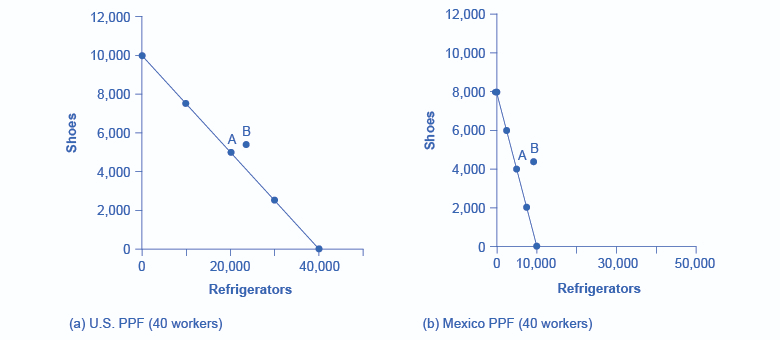
A two-country, two-good PPF setup used to visualize specialization and gains from trade, with linear frontiers implying constant opportunity costs. Comparing the slopes across countries provides a visual shortcut for identifying which producer has the lower opportunity cost in a given good. This is the graphical counterpart to calculating opportunity costs from output-per-resource tables. Source
Step-by-step method
Choose the good you’re testing (e.g., Good X).
For each producer, determine: “To get 1 more unit of X, how many units of Y must be given up?”
Compare the two opportunity costs:
The producer with the lower opportunity cost of X has the comparative advantage in X.
The other producer will have the comparative advantage in Y (in a two-good world), because opportunity costs trade off.
Acceptable information formats
Comparative advantage can be identified from:
Output-per-resource data (e.g., per day, per worker), by translating to opportunity costs
Directly stated opportunity costs (already in “units of the other good”)
A two-good trade-off schedule (how output changes when shifting production)
Comparative advantage vs other “advantages” (common confusion)
Students often confuse comparative advantage with being “better” in an absolute sense.
Key distinctions to keep straight
Absolute productivity: producing more with the same resources (about levels of output)
Comparative advantage: producing with a lower opportunity cost (about trade-offs)
A producer can be highly productive in both goods and still have comparative advantage in only one of them, because comparative advantage depends on relative efficiency between goods, not overall efficiency.
Interpreting comparative advantage for countries (AP Macroeconomics context)
In macroeconomics, comparative advantage is most commonly applied to international production decisions. Countries face resource constraints (labor skills, capital, land, climate, institutions, technology), so producing more of one category often means producing less of another.
What “lower opportunity cost” means at a national level
A country has comparative advantage in a good when reallocating resources toward that good requires giving up less of other goods than another country would give up. This can arise from:
Factor endowments (e.g., arable land, energy resources)
Workforce characteristics (education, experience)
Technology and infrastructure
Organisational capacity and institutions
Comparative advantage is not a moral claim that a country “should” produce something; it is a positive (descriptive) claim about trade-offs under scarcity.
Common pitfalls that lose points
Using money prices alone: price differences can reflect taxes, market power, or exchange rates; comparative advantage is about real trade-offs.
Mixing up “lower cost” with “lower opportunity cost”: a lower dollar cost is not automatically a lower opportunity cost.
Forgetting the “per unit” nature: comparative advantage compares the sacrifice required for one additional unit (or a consistent unit change).
Declaring one producer “has comparative advantage in everything”: with two goods and well-defined trade-offs, comparative advantage cannot be in both goods at once.
Practice Questions
(2 marks) Define comparative advantage and state the basis on which it is determined.
1 mark: Correct definition: producer can produce a good at a lower opportunity cost than another producer.
1 mark: States basis: determined by comparing opportunity costs (trade-offs) between producers.
(6 marks) Country A can produce either 10 tonnes of wheat or 5 cars with a fixed set of resources. Country B can produce either 12 tonnes of wheat or 12 cars with a fixed set of resources.
(a) Calculate the opportunity cost of 1 car in each country in terms of wheat. (2 marks)
(b) Identify which country has the comparative advantage in cars and justify using opportunity cost. (2 marks)
(c) Identify which country has the comparative advantage in wheat and justify using opportunity cost. (2 marks)
(a) 1 mark: A: tonnes of wheat.
1 mark: B: tonne of wheat.(b) 1 mark: B has comparative advantage in cars.
1 mark: Justification: lower opportunity cost of cars (1 tonne vs 2 tonnes of wheat).(c) 1 mark: A has comparative advantage in wheat.
1 mark: Justification: lower opportunity cost of wheat (equivalently, car in A vs car in B).
FAQ
Yes. Comparative advantage can shift with changes in productivity and relative trade-offs.
Drivers include:
Technological change and diffusion
Human capital development and learning-by-doing
Infrastructure improvements lowering input losses
Institutional reforms affecting efficiency and resource allocation
These changes alter opportunity costs, not just output levels.
No. One country can be more productive in both goods and still have comparative advantage in only one good, because comparative advantage depends on relative opportunity costs between goods within each country.
In a two-good setting, lower opportunity cost in one good implies higher opportunity cost in the other.
With many goods, producers can have comparative advantage in multiple goods, but not “everything” simultaneously. The logic generalises by ranking goods by opportunity cost and focusing production where relative opportunity cost is lowest compared with other producers.
Specialisation patterns become more complex, but the decision rule remains opportunity-cost-based.
Comparative advantage is an economic concept based on opportunity cost under scarcity. Competitive advantage is a business strategy concept (brand, market power, product differentiation, distribution networks) that may influence profitability but does not necessarily reflect underlying opportunity costs.
They can overlap, but they are not the same test.
Yes. Exchange rate movements can change observed money costs and export prices without changing real opportunity costs. For example, a currency depreciation can make exports cheaper in foreign currency terms, increasing sales, even if the underlying resource trade-offs are unchanged.
To assess comparative advantage, focus on real production trade-offs rather than nominal prices alone.