AP Syllabus focus: ‘Terms of trade are determined by opportunity costs and define mutually beneficial exchange between trading partners.’
Terms of trade translate comparative advantage into a concrete trading ratio. By linking exchange rates to opportunity costs, they explain how two parties can trade voluntarily and both end up better off than without trade.
What “Terms of Trade” Means in AP Macro
Terms of trade connect production trade-offs to the price at which goods (or services) are exchanged between trading partners. In AP Macroeconomics, think of them as the negotiated “exchange rate” between two products that makes specialisation and trade worthwhile for both sides.
Terms of trade (ToT): the rate at which one good is exchanged for another in trade, typically stated as “units of good X per unit of good Y.”
Because the syllabus focus is that terms of trade are determined by opportunity costs, the key is comparing each partner’s internal trade-offs (what they give up to produce) to the external trade ratio (what they can get by trading).
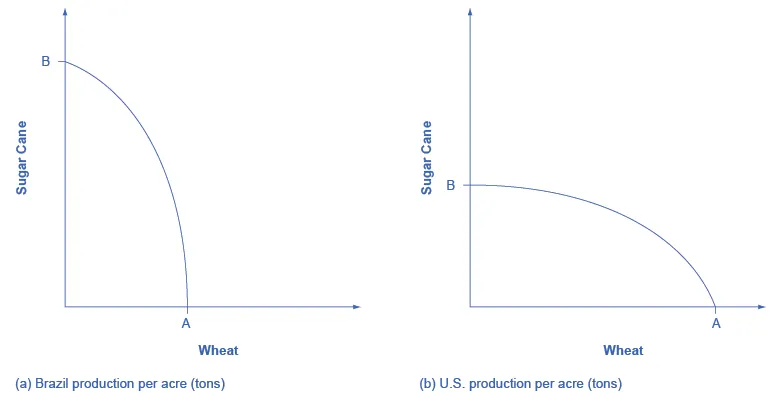
Two production possibility frontiers (PPFs) illustrate that the slope of each PPF reflects opportunity cost. The flatter PPF (U.S.) implies a lower opportunity cost of the x-axis good, while the steeper PPF (Brazil) implies a higher opportunity cost—setting up comparative advantage and a feasible range for mutually beneficial trade. Source
Opportunity Cost as the Anchor for Terms of Trade
Opportunity cost is the value of the next best alternative forgone. In trade, each producer has an opportunity cost of producing one good in terms of the other good. Those costs set the boundaries for a mutually acceptable trade ratio.
= units of forgone per 1 additional unit of
= changes in output of and (units of output)
The intuition: if a country can produce at a low cost in terms of forgone , it can “afford” to specialise in and trade for .
The “Mutually Beneficial” Range (How ToT Gets Determined)
For trade to be mutually beneficial, the terms of trade must fall between the two partners’ opportunity costs.
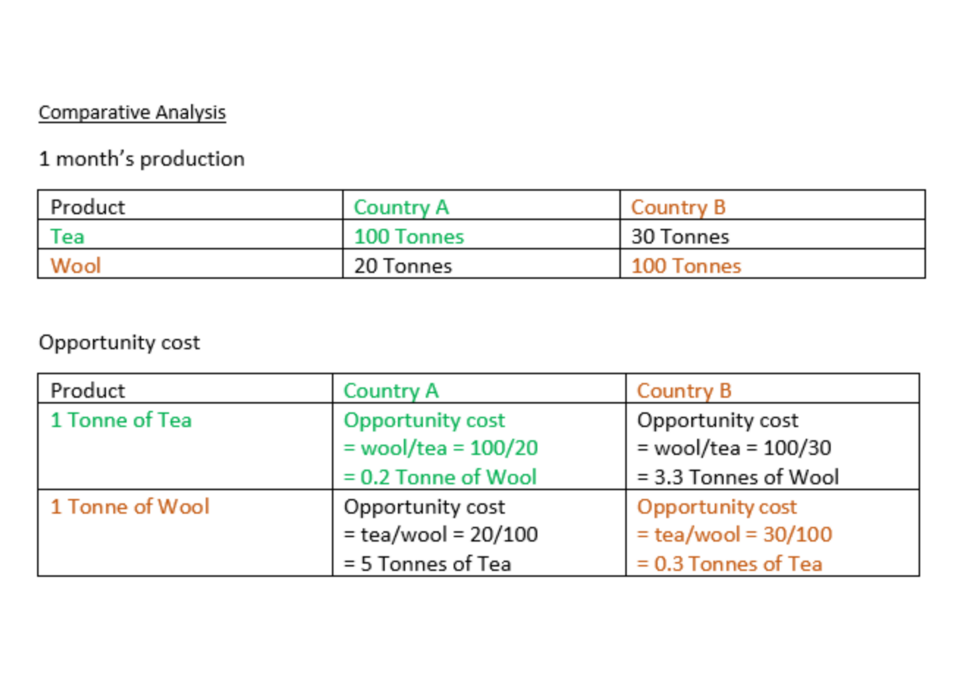
A worked comparative-advantage example shows how opportunity costs are calculated for two goods and two producers, and how those costs determine who specializes in what. This is the same logic behind the mutually beneficial terms-of-trade interval: any trading ratio must lie between the partners’ opportunity costs to make voluntary exchange possible. Source
Why a range exists
Each partner will compare the proposed trade ratio to producing the good domestically.
A partner accepts trade only if it can obtain the imported good at a “cheaper” rate than its own opportunity cost.
Therefore, the bargaining space is bounded by both sides’ opportunity costs.
What “between opportunity costs” implies
If the ToT are exactly equal to one partner’s opportunity cost, that partner is indifferent (no gain versus self-production).
If the ToT fall outside the opportunity-cost bounds, one partner would lose and refuse the trade.
When the ToT lie strictly between the two opportunity costs, both can gain from trade through better consumption possibilities.
Interpreting ToT as an Exchange Price
Terms of trade function like a relative price between goods:
“Units of for one unit of ” is a price of measured in .
A more favourable ToT for a partner means it receives more imports per unit of exports (or gives up fewer exports per unit of imports).
In AP-style reasoning, you don’t need market microfoundations; you need the logic that opportunity costs set the feasible and acceptable exchange rates, and those rates determine who benefits more.
Distribution of Gains: Who Benefits More?
Even when trade is mutually beneficial, the distribution of gains from trade depends on where the ToT settle within the opportunity-cost range:
ToT closer to Partner A’s opportunity cost tend to give Partner B a larger share of the gains.
ToT closer to Partner B’s opportunity cost tend to give Partner A a larger share of the gains.
The exact ToT can be influenced by negotiating power, urgency of demand, or availability of alternative partners (these affect bargaining, not the fundamental bounds).
Common AP Pitfalls to Avoid
Confusing terms of trade (a ratio) with trade balance (exports minus imports).
Saying “any” trade ratio works; it must be consistent with both sides’ opportunity costs to be voluntary and beneficial.
Treating ToT as fixed: they are determined through exchange and can change, but they cannot persistently violate the opportunity-cost boundaries if both sides are acting in self-interest.
Practice Questions
(2 marks) Define “terms of trade” and state the condition under which terms of trade are mutually beneficial for both trading partners.
1 mark: Correct definition of terms of trade as the exchange rate/ratio between two goods.
1 mark: States that mutually beneficial ToT must lie between the two partners’ opportunity costs (or each partner faces a better rate than domestic opportunity cost).
(6 marks) Country A and Country B can each produce goods and . Explain how opportunity costs determine the range of acceptable terms of trade and how the final terms of trade affect the distribution of gains from trade.
2 marks: Explains that each country has an opportunity cost of in terms of (and/or vice versa), representing internal trade-offs.
2 marks: States and explains that acceptable ToT must fall between the two countries’ opportunity costs for trade to be mutually beneficial/voluntary.
2 marks: Explains distribution: ToT closer to one country’s opportunity cost gives the other country a larger share of gains; ToT position determines how gains are split.
FAQ
In AP trade basics, ToT usually means a barter-like exchange ratio between two goods.
In broader macro, a ToT index often refers to $P_{exports}/P_{imports}$, tracking how export prices compare to import prices over time.
Yes. You can quote “$X$ per $Y$” or “$Y$ per $X$”.
It matters only for interpretation: one is the reciprocal of the other, so be consistent about which good is the numeraire.
Changing ToT can shift how gains are divided.
If a partner’s ToT become more favourable, it can obtain more imports per unit of exports, increasing its share of the gains, even if trade remains mutually beneficial.
They can effectively tighten or shift what each side is willing to accept.
A trade cost adds to the “delivered” cost of imports, meaning the agreed ToT must compensate for those added costs to remain attractive.
Constraints can limit bargaining:
Lack of alternative trading partners
Urgency (perishability, shortages)
Contractual commitments or switching costs
These factors affect negotiated outcomes even though opportunity costs still define the basic feasibility of mutual benefit.