AP Syllabus focus: ‘Specialization based on comparative advantage allows producers to trade and achieve consumption beyond their PPC.’
Specialization and trade explain why economies can enjoy higher living standards even when resources are scarce. By focusing production and exchanging output, individuals, firms, and countries can expand consumption possibilities beyond what they could achieve alone.
Core idea: specialize, then trade
Specialization means concentrating resources on producing a narrower range of goods and services. The motivation is that different producers face different opportunity costs, so output can be rearranged to increase total production.
When producers specialize based on comparative advantage, they allocate more resources to the good they can produce at a lower opportunity cost, and less to the other good. Then, through trade, they swap some of what they produce for what they no longer make (or make less of).
Key terms you must use precisely
Specialization: The allocation of resources toward producing a smaller set of goods and services, often focusing on items produced at lower opportunity cost.
Specialization is not limited to countries; it applies to workers (division of labor), firms, regions, and entire economies.
How specialization connects to the PPC
A production possibilities curve (PPC) shows the maximum combinations of two goods that can be produced with current resources and technology.
Without trade, a producer must both produce and consume somewhere on or inside its own PPC.
With specialization and trade:
Production choices shift toward the good of comparative advantage (a movement along the PPC toward one axis).
Consumption choices can end up at a point that would be unattainable without trade—conceptually “outside” the producer’s own PPC—because consumption is no longer tied to what that producer makes.
This is the syllabus point: specialization based on comparative advantage allows producers to trade and achieve consumption beyond their PPC.
Why trade makes “beyond the PPC” possible
Trade separates production from consumption.
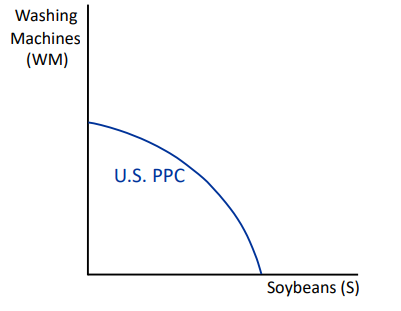
A curved U.S. PPC together with a straight consumption possibilities curve (CPC) that is tangent to the PPC at the optimal specialization point. The CPC represents all consumption bundles reachable after specializing at the tangency point and trading at a fixed terms of trade, which is why consumption can be achieved at combinations not available under autarky. Source
Even if each producer stays within its production limits, exchanging output can reallocate goods so that:
Each party receives a bundle of goods that better matches its preferences.
Total output across trading partners is higher than it would be without specialization.
Each party can consume more of at least one good without consuming less of the other (a gain from trade).
A useful way to describe this is that trade creates a wider set of feasible consumption bundles than autarky (no trade), because producers exploit differences in opportunity cost.
Conditions for mutually beneficial trade
For specialization and trade to expand consumption possibilities for both parties, the trade arrangement must satisfy:
Different opportunity costs between trading partners (the basis for comparative advantage)
A trade price (exchange rate) that lies between the two parties’ opportunity costs, so both sides find the trade preferable to producing the traded good themselves
Willingness and ability to exchange (markets, contracts, payment, enforceable property rights)
Specialization can raise productive efficiency (reinforcing gains)
In practice, specialization may also increase productivity over time, which can further expand consumption possibilities:
Learning by doing: repetition improves skill and reduces waste
Better matching of tasks and talent: workers and capital are used where they are most effective
Economies of scale: producing larger quantities can lower average costs, making output more attainable with the same resources
These effects strengthen the central mechanism: specializing (especially where opportunity cost is lowest) can increase total output available for trade.
Common misunderstandings to avoid
“Beyond the PPC” does not mean producing beyond the PPC. It refers to consuming a combination that would be impossible without trade, given the producer’s own production limits.
Absolute advantage is not required. A producer can benefit from specializing even if it is less productive in both goods, as long as its opportunity cost differs.
Specialization does not require producing only one good. Partial specialization can still create gains if it better aligns production with lower opportunity costs.
Practice Questions
Q1 (3 marks) Define specialisation and explain how trade can allow a country to consume a combination of goods that lies beyond its own PPC.
1 mark: Correct definition of specialisation (concentrating resources on fewer goods/services).
1 mark: Explains that trade separates production from consumption (country can produce one mix but consume another).
1 mark: Links to PPC idea that consumption can be outside its own PPC due to exchanging output produced under comparative advantage.
Q2 (6 marks) Using the concepts of comparative advantage and the PPC, explain why two countries that specialise and trade can both experience gains in consumption possibilities. Include one condition required for the gains to be realised.
1 mark: States that comparative advantage is based on lower opportunity cost.
2 marks: Explains specialisation shifts production towards the good with lower opportunity cost for each country (movement along each PPC).
2 marks: Explains trade allows each to consume a bundle not attainable under autarky (consumption beyond own PPC) because total output is higher and goods are reallocated.
1 mark: Gives one valid condition (e.g. trade price between opportunity costs; sufficiently low trading costs; ability to exchange/enforce contracts).
FAQ
Not always. Output gains depend on whether resources can move efficiently and whether production can scale up.
Limits can include:
skills mismatches and retraining time
capital immobility
bottlenecks in infrastructure and energy
They reduce the net gains from exchange by making imported goods effectively “more expensive” in real terms.
If these costs are high enough, the trade price may no longer sit between the two opportunity costs, so mutually beneficial trade can disappear.
Governments and firms may value resilience and diversification.
Reasons include:
supply-chain risk and strategic industries
volatile world prices
desire to maintain domestic employment in key sectors
Yes. Changes in technology, education, resource discovery, or productivity can alter opportunity costs.
As opportunity costs shift, the pattern of specialisation that maximises gains from trade can also change, sometimes requiring costly adjustment.
They distort the trade price faced by buyers and sellers.
By pushing the domestic price away from the mutually beneficial range (between opportunity costs), barriers can reduce specialisation, shrink trade volumes, and move consumption closer to the autarky set rather than beyond the PPC.