AP Syllabus focus: ‘Absolute advantage occurs when a producer can produce more output than others using the same amount of resources.’
Absolute advantage is about straightforward productive capacity: who can make more of a good with the same inputs. In AP Macroeconomics, it helps you compare productivity across people, firms, regions, or countries.
Core Idea: Producing More with the Same Resources
What “same amount of resources” means
Resources are the inputs used to produce output, such as:
Labor (worker-hours)
Capital (machines, tools)
Land/natural resources
Entrepreneurship/organization
The comparison must hold inputs constant (or measure output per unit of input) to be meaningful.
Definition
Absolute advantage: the ability of a producer to generate more output than another producer using the same quantity of inputs (or, equivalently, to produce the same output using fewer inputs).
Absolute advantage is a productivity concept: it focuses on how much is produced, not on prices, profits, or fairness.
Measuring Absolute Advantage
Productivity as the key metric
A common way to identify absolute advantage is to compare output per unit of input (especially output per labor-hour when labor is the only input being considered).
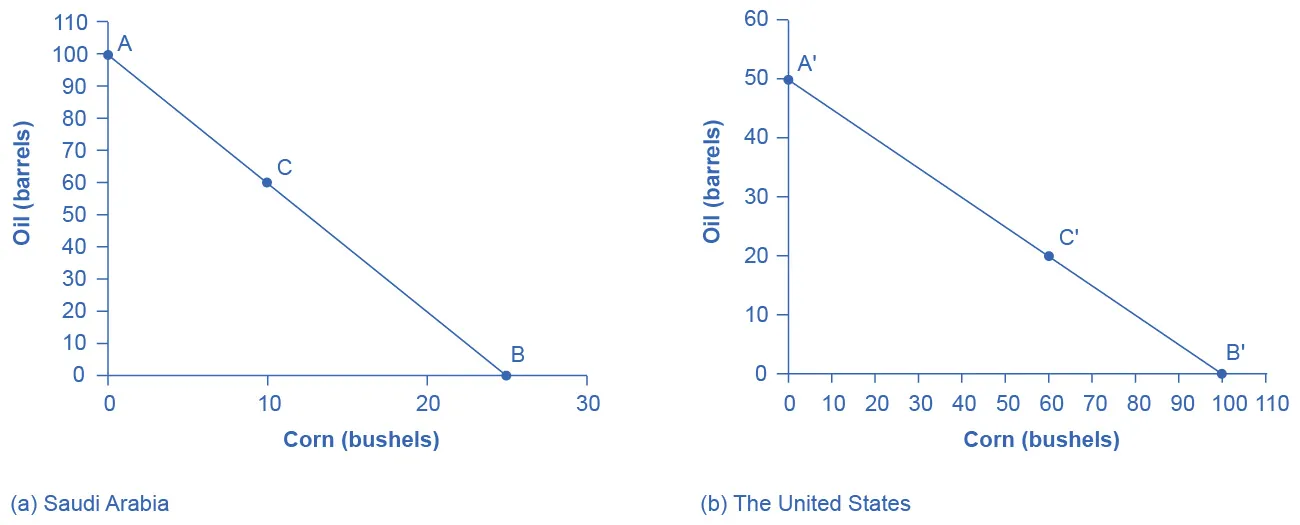
Production possibilities frontiers (PPFs) for two countries using the same total labor-hours show each producer’s maximum feasible output combinations. The producer whose frontier reaches higher quantities of a given good (holding the input constraint fixed) has an absolute advantage in that good because it can generate more output from the same resources. The labeled axes and points make the output-per-input comparison visually concrete. Source
Higher productivity implies absolute advantage in that good.
The same logic works for any single input measure (e.g., output per machine-hour), as long as the input is comparable across producers.
= output per unit of input (e.g., units per labour-hour)
= quantity of output (units)
= amount of input used (labour-hours, machine-hours, etc.)
How to identify it (no calculations required)
Hold the input constant (e.g., 1 hour of labor) and compare outputs.
The producer with higher output has the absolute advantage.
If two producers can produce the same output with the same inputs, neither has absolute advantage.
Where Absolute Advantage Comes From
Common sources of higher productivity
Absolute advantage can result from:
Technology (better machines, software, production techniques)
Human capital (education, training, experience)
Natural endowments (fertile land, minerals, climate suitability)
Infrastructure (transport, energy reliability, communications)
Managerial efficiency and better organization of production
Learning by doing and accumulated know-how over time
These factors increase output from the same resource base, shifting what a producer can accomplish with given inputs.

An outward shift of the production possibility frontier illustrates higher productive capacity: with the same underlying resource constraints, more of both goods can be produced than before. In AP-style interpretation, the rightward shift is a visual shorthand for productivity improvements driven by technology, human capital, or better organization. The paired curves make the “more output from the same resources” logic intuitive. Source
Interpreting Absolute Advantage Carefully
Single input vs. multiple inputs
In real economies, production uses many inputs. For clean comparisons, problems often simplify to:
One dominant input (commonly labor), or
A single “resource bundle” treated as equivalent across producers
If input bundles differ (e.g., one producer uses more skilled labor or more advanced capital), “same amount of resources” may require careful interpretation.
Output quantity vs. output value
Absolute advantage is based on physical output (or real production capability), not necessarily:
Higher revenue (which can reflect higher prices)
Higher profits (which depend on costs and market structure)
Not a complete guide to specialization decisions
Absolute advantage tells you who is more productive in a particular good. It does not, by itself, answer every question about how producers should allocate resources across different goods, because real choices often depend on constraints, goals, and relative trade-offs.
What AP Students Should Be Able to Do
State the meaning of absolute advantage using the syllabus wording (more output with the same resources).
Identify which producer has absolute advantage using output-per-input comparisons.
Explain plausible reasons a producer might have absolute advantage (technology, skills, resources, efficiency).
Distinguish absolute advantage (productivity) from measures based purely on prices, revenues, or total size of an economy.
Practice Questions
Define absolute advantage and state the condition under which a producer is said to have it.
1 mark: Defines absolute advantage as producing more output with the same resources (or same output with fewer resources).
1 mark: Mentions comparison between two producers (relative concept).
1 mark: Clearly states the “same quantity of inputs/resources” condition.
A country is described as having an absolute advantage in producing electric vehicles. Explain what this means and provide two distinct reasons why this absolute advantage might exist.
2 marks: Explains meaning: higher productivity in electric vehicles; more output from the same inputs (or fewer inputs for the same output).
2 marks: Reason 1 explained (e.g., superior technology, skilled workforce, natural resources, infrastructure, managerial efficiency).
2 marks: Reason 2 explained and distinct from Reason 1.
FAQ
Yes. If it can produce more of multiple goods with the same inputs than another producer, it can hold absolute advantage in several goods.
This often happens when one producer has broadly better technology or higher-skilled labour.
Only if the comparison standardises inputs into a comparable unit (e.g., a common-cost “bundle”) or isolates a single input (like machine-hours).
Otherwise, “same amount of resources” is ambiguous.
Not directly. Absolute advantage is about physical productivity (output per input), not cost.
However, input prices can affect competitiveness even when productivity is higher.
Yes. It can shift with changes in:
technology adoption
training and education
infrastructure investment
resource discoveries or depletion
These alter output achievable from the same inputs.
No. Total production can be higher simply because the producer is larger.
Absolute advantage requires higher output using the same amount of resources (a productivity comparison), not just a bigger scale.