AP Syllabus focus: ‘The PPC can show efficient production, inefficient production with underutilized resources, and unattainable output combinations.’
The production possibilities curve (PPC) helps you visualise whether an economy is using its scarce resources effectively. This page focuses on identifying efficiency, inefficiency from underutilisation, and unattainable combinations using the PPC.
Core idea: what the PPC represents
A production possibilities curve (PPC) is a boundary showing the maximum combinations of two goods an economy can produce with current resources and technology. Every point has an interpretation about how fully resources are being used.
When using a PPC, always assume:
The economy produces only two categories of output (a simplification).
Technology and the quantity/quality of resources are fixed.
Output is produced efficiently only if resources are allocated and utilised effectively.
Efficiency on the PPC
A point on the PPC indicates productive efficiency: the economy is producing the maximum possible output for a given mix of the two goods.
Productive efficiency: producing a given level of output at the lowest possible cost, meaning no resources are wasted.
On a PPC diagram, productive efficiency means:
All available resources are fully employed (no widespread idle labour/capital).
Resources are used in their best feasible production roles (given current technology and institutions).
You cannot increase production of one good without decreasing production of the other (a binding trade-off).
Why “on the curve” matters
Being on the PPC is not a claim that the economy is producing the “best” mix for society; it is only about feasibility and full utilisation. The PPC itself cannot tell you which point is socially preferred; it only shows what is possible.
Inefficiency and underutilised resources (inside the PPC)
A point inside the PPC indicates inefficiency, typically due to underutilised resources. Output is lower than what could be produced with the same resources and technology.
Underutilised resources: labour, capital, or other productive inputs that are available but not being fully used (e.g., unemployment, idle factories).
A point inside the PPC implies at least one of the following:
Unemployment (cyclical or structural) reduces total labour input used.
Idle capital (machines, factories, infrastructure not operating at capacity).
Misallocation of resources (inputs are used in less productive tasks than feasible).
Low effort/ineffective organisation (coordination failures, logistical bottlenecks).
Market failures or policy distortions that prevent resources moving to productive uses.
Interpreting a move from inside to the PPC
A movement from an interior point to a point on the PPC represents:
Improved utilisation (using existing resources more fully), not growth.
The economy producing more of one or both goods without needing new resources or new technology.
A reduction in waste and slack, often associated with recovery from recession or improved coordination.
This distinction matters: reaching the PPC is about closing an “efficiency gap,” not shifting the entire boundary.
Unattainable output combinations (outside the PPC)
A point outside the PPC is unattainable with current resources and technology.
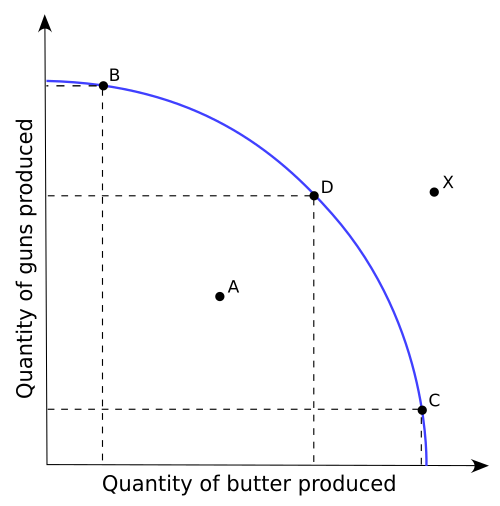
This PPF diagram visually separates feasible production (on or inside the frontier) from infeasible combinations (outside the frontier). Point A illustrates underutilisation (productive inefficiency), while points B–D represent full utilisation on the frontier. Point X lies beyond current productive capacity, reinforcing the idea that “unattainable” means not possible without more resources, better technology, or both. Source
It represents a combination of outputs that cannot be produced at the same time given present constraints.
Unattainable combination: an output bundle beyond the economy’s current productive capacity, requiring more resources, better technology, or both.
Outside points are useful because they clarify scarcity:
Desires for higher output of both goods may exist, but scarcity prevents achieving that bundle now.
To make an outside point attainable, the economy would need an outward shift of the PPC (from more resources or improved technology), but that is a separate concept from identifying unattainable points.
Common AP-level graph reading skills
Classifying points quickly
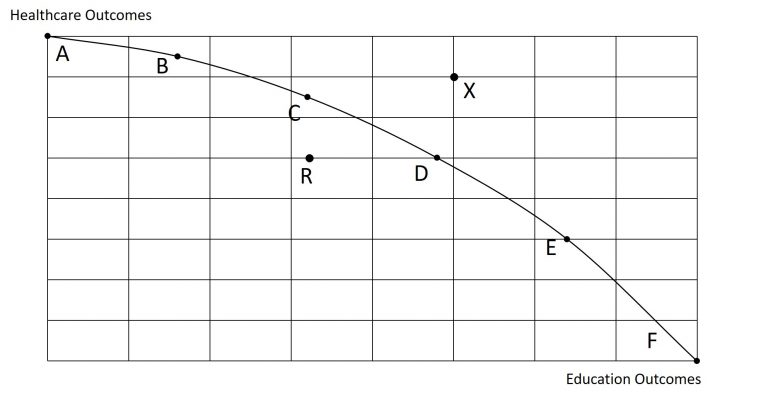
This production possibilities frontier shows three key regions at a glance: points on the curve (A–F) are productively efficient, a point inside the curve (R) reflects underutilised or misallocated resources, and a point outside the curve (X) is unattainable with current resources and technology. The labeled points make it easy to practice AP-style “classify the point” questions using the on/inside/outside rule. Source
On the curve: productive efficiency (full utilisation; feasible maximum).
Inside the curve: inefficiency due to underutilisation or misallocation (feasible but not maximum).
Outside the curve: unattainable given current resources and technology.
Language to use precisely
Use “efficient” and “inefficient” in the PPC sense:
“Efficient” means productively efficient (not wasting resources).
“Inefficient” means output is below potential due to underutilised or poorly allocated resources. Avoid implying that “efficient” automatically means “fair” or “best for society,” since equity and societal preferences are not shown by the PPC.
What causes underutilisation in real economies (conceptual link)
Underutilisation is especially associated with downturns:
When aggregate spending falls, firms cut production, leading to layoffs and idle capacity.
Sticky wages/prices or uncertainty can slow adjustments, keeping the economy inside the PPC.
Frictions (skills mismatch, geographic immobility) can keep workers unemployed even when some jobs exist.
Within the PPC framework, these are all explanations for why the economy might operate below its potential without changing its resource base.
Distinguishing “inefficient” from “unattainable”
Students often confuse points inside and outside the PPC. Use this rule:
Inside: you could reach the PPC with better utilisation or allocation of current resources.
Outside: you cannot reach it without expanding capacity (more/better resources or technology).
If a policy is described as “reducing unemployment” or “increasing capacity utilisation,” it relates to moving toward the PPC, not beyond it.
Practice Questions
(2 marks) On a PPC diagram, what does a point inside the curve represent?
Identifies it as inefficient production / underutilisation of resources (1)
Explains that more of one or both goods could be produced with current resources and technology (1)
(6 marks) A country is producing at a point inside its PPC. Explain what this indicates about its resource use and why an output combination outside its PPC is not currently possible.
States that a point inside the PPC indicates productive inefficiency (1)
Explains underutilised resources such as unemployment and/or idle capital (1)
Links underutilisation to output being below the maximum feasible with current resources and technology (1)
States that a point outside the PPC is unattainable with current resources and technology (1)
Explains that achieving the outside point would require more resources and/or improved technology (1)
Uses correct PPC language: “movement to the curve” versus “beyond the curve” (1)
FAQ
Micro-level efficiency can coexist with macro-level slack.
Some sectors may operate on best practice while others face weak demand, closures, or mismatches.
PPC “inside” can reflect economy-wide unemployment or idle capital even if surviving firms minimise costs.
Idle capacity is a specific form of underutilisation.
Idle capacity: capital (plants/machines) not running at potential output.
Underutilised resources: broader category including labour, land, entrepreneurship, and capital not fully employed.
Yes, depending on the type of unemployment and assumptions.
If unemployment is frictional or voluntary, the economy could still be considered fully utilising available resources.
The PPC model usually treats “full employment” as the normal benchmark, not zero unemployment.
The PPC shows feasibility and productive efficiency, not preferences.
Social optimality needs information about benefits, costs, and distribution.
Two different points on the PPC can both be efficient but reflect very different societal priorities.
Potential output is estimated, not directly observed.
Data limitations, informal activity, and changing productivity make the true frontier uncertain.
Short-run shocks can temporarily distort observed output without permanently changing productive capacity.