AP Syllabus focus: ‘The PPC shifts when factors of production or technology change, and economic growth causes an outward shift.’
A production possibilities curve (PPC) is a simple model of an economy’s productive capacity. This page focuses on how and why that capacity changes over time, causing outward or inward PPC shifts.
What a PPC Shift Means
A PPC shift is a change in the maximum attainable combinations of two goods (or categories of goods) that can be produced with available resources and current technology. A shift is different from:
Movement along the PPC: reallocating existing resources between the two goods.
Point inside the PPC: inefficiency or underutilisation; capacity is unchanged.
When the PPC shifts, the economy’s potential output changes, not just the mix of output.
Economic growth as an outward shift
Economic growth: an increase in an economy’s productive capacity, shown on a PPC as an outward shift.
On a PPC, economic growth causes an outward shift because the economy can now produce more of at least one good without producing less of the other.
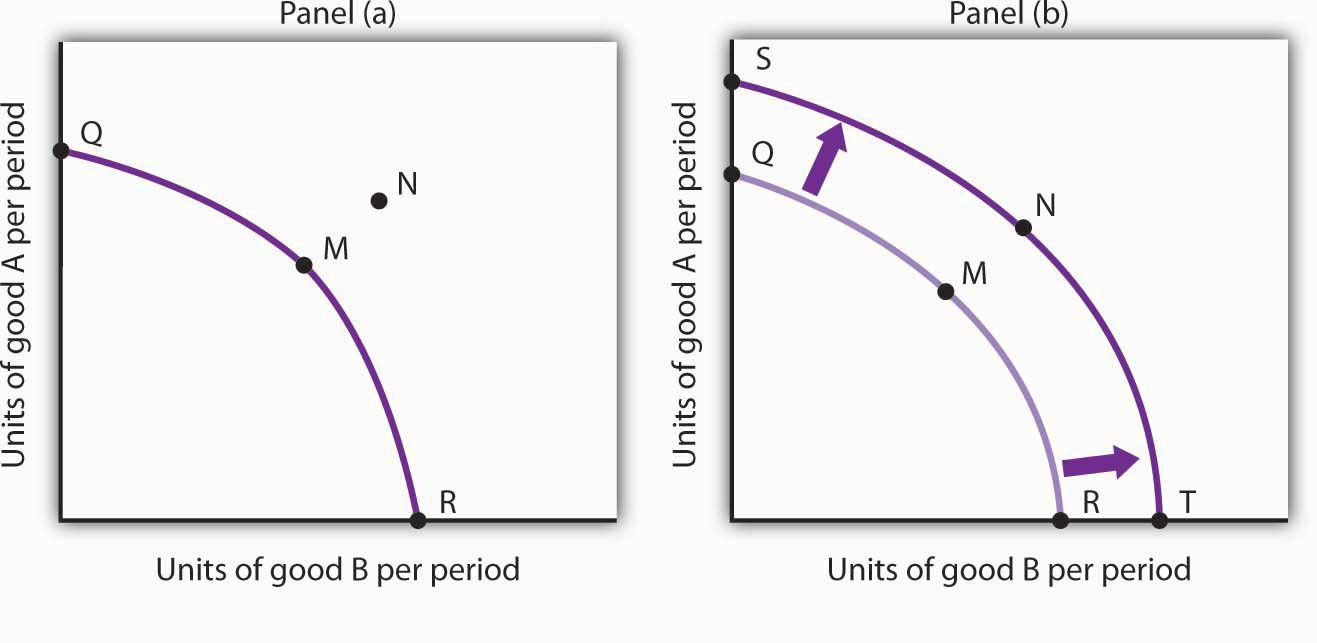
This two-panel PPC diagram illustrates how economic growth expands an economy’s feasible set of output combinations. In panel (a), point N is unattainable given the original PPC; in panel (b), an outward-shifted PPC makes N feasible, emphasizing that growth changes maximum possible output (productive capacity), not merely the allocation along the existing curve. Source
Causes of Outward Shifts (Growth)
The syllabus emphasises two drivers: factors of production and technology. Growth occurs when quantity or quality of inputs rises, or when inputs are used more productively.
Increases in factors of production
Most factors of production are scarce, so expanding them relaxes scarcity constraints and shifts the PPC outward. Key channels include:
Land (natural resources): new resource discoveries, improved access, or better resource management.
Labor: population growth, higher labor force participation, immigration, improved health, or increased hours.
Capital: a larger stock of machinery, tools, factories, and infrastructure (often from investment).
Entrepreneurship: improved business formation, management practices, and willingness to innovate.
Human capital improvements (skills, education, training) are often treated as a quality increase in labor, raising what the same number of workers can produce.
Technological progress
Technology means improved methods of production, not just computers. Better technology increases output from the same inputs, shifting the PPC outward. It can be:
Broad-based (raising productivity in many sectors), shifting the PPC outward for both goods.
Biased toward one good (e.g., a breakthrough in agriculture), shifting capacity outward more in that direction.
A PPC can shift outward even if the total quantity of inputs is unchanged, provided technology increases productivity.
Causes of Inward Shifts (Contraction)
Economic contraction (capacity decline): a decrease in an economy’s productive capacity, shown on a PPC as an inward shift.
An inward shift reflects a reduction in available inputs or a deterioration in productivity. It is not the same as a recessionary point inside the PPC (which is underutilisation, not reduced capacity).
Examples of capacity-reducing shocks
Loss of capital: war, natural disasters, or rapid depreciation without replacement.
Reduced labor supply/quality: emigration, ageing workforce, disease, declining education quality.
Resource depletion or access limits: exhausted mines, drought, or legal restrictions that reduce usable land.
Technological setbacks: loss of know-how, infrastructure breakdowns, or regulations that reduce productivity.
Interpreting Which Way the PPC Shifts
A quick interpretation checklist:
If an event changes maximum possible output, think shift.
If an event changes actual current output (e.g., unemployment), think inside vs. on the curve, not a shift.
If capacity expands mainly for one good, expect a pivot (outward more on one axis), not a parallel shift.
What “outward” means on a graph
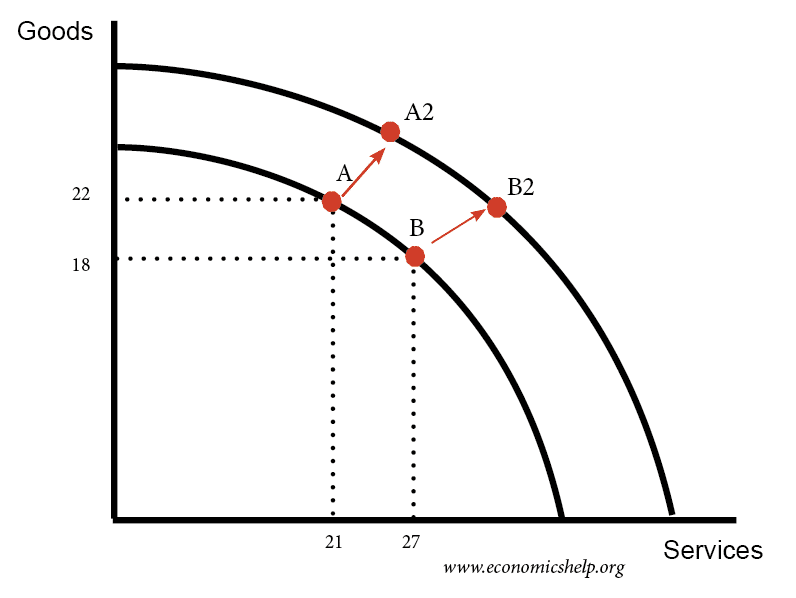
This PPC graphic shows the frontier shifting outward from an initial curve to a new curve, indicating increased productive capacity. The arrows and labeled points highlight that, after growth, the economy can attain combinations that were previously infeasible, clarifying the meaning of “outward” as “farther from the origin.” Source
Outward shift: new PPC lies outside the old PPC; more combinations are attainable.
Inward shift: new PPC lies inside the old PPC; fewer combinations are attainable.
Common AP Pitfalls
Confusing economic growth (outward PPC) with allocative decisions (moving along the PPC).
Treating underutilised resources as an inward shift; it is usually a point inside the PPC.
Assuming all technology shifts both axes equally; technology can be good-specific and cause a pivot.
Practice Questions
(2 marks) Explain what happens to a PPC when technology improves.
1 mark: States the PPC shifts outward (increases productive capacity).
1 mark: Explains technology raises productivity/maximum output from the same inputs.
(5 marks) Distinguish between (i) an outward shift of the PPC and (ii) a movement from a point inside the PPC to a point on the PPC. Use factors of production in your explanation.
1 mark: Outward shift = higher productive capacity/new maximum combinations.
1 mark: Caused by increased factors of production and/or better technology.
1 mark: Inside-to-on movement = improved utilisation/efficiency, not higher capacity.
1 mark: Mentions unemployment/idle resources as reason for being inside PPC.
1 mark: Connects factors of production to capacity (quantity/quality of land, labour, capital, entrepreneurship).
FAQ
Yes. If new resources or technology are specific to one sector, the PPC can pivot outward more along that axis, indicating asymmetric capacity gains.
Capital deepening means more capital per worker. It raises labour productivity, allowing higher maximum output, so the PPC can shift outward.
Institutions (property rights, contract enforcement) can raise productivity by improving incentives and reducing waste, effectively increasing what existing inputs can produce.
Not always. Some may reduce measured capacity for certain goods short-run (inward/pivot), but others induce innovation that later increases productivity and shifts outward.
It depends on the source: disaster recovery can be quick, education-driven human capital growth is slower, and major infrastructure or R&D effects may take years to materialise.