AP Syllabus focus: ‘Comparative advantage means a producer can make a good or service at a lower opportunity cost than another producer.’
Comparative advantage explains how specialisation and exchange can make people, firms, or countries better off. The key is opportunity cost: what must be given up to produce one more unit of something else.
Core Idea: Comparative Advantage Comes from Opportunity Cost
Opportunity Cost as the Relevant Cost
When resources are scarce, producing more of one good usually requires producing less of another.
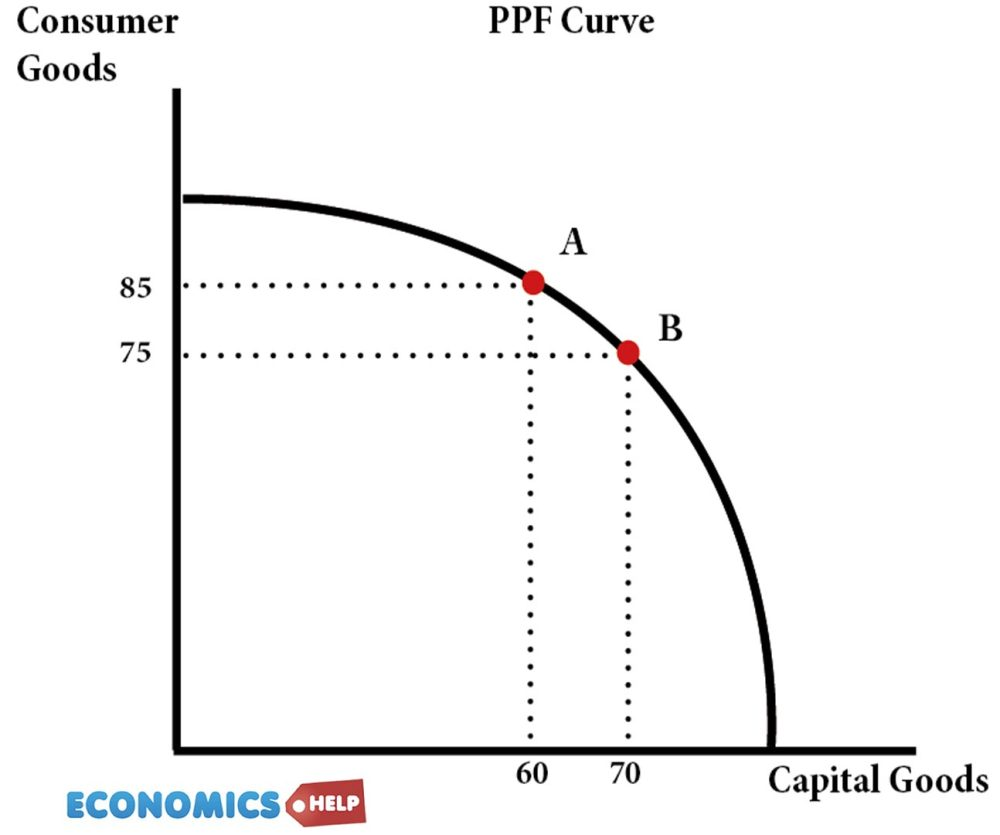
A production possibilities frontier (PPF) showing the trade-off between two goods (consumer goods and capital goods). Moving along the curve from one point to another illustrates that producing more of one good requires giving up some of the other, which is the opportunity cost. Points on the curve are productively efficient combinations given current resources and technology. Source
The forgone alternative is the true economic cost of a choice.
Opportunity cost: The value of the next best alternative forgone when a choice is made.
Opportunity cost is relative, not absolute: it depends on what you must give up, not just how many units you can produce.
= the good/service being increased (units)
= the good/service reduced (units)
This ratio-style interpretation is what you use whenever trade-offs can be expressed as “how much of one good must be sacrificed to get more of another.”
Comparative Advantage Defined
Comparative advantage is about producing at a lower opportunity cost than someone else, even if one producer is better at producing everything.
Comparative advantage: The ability to produce a good or service at a lower opportunity cost than another producer.
Because opportunity costs differ across producers, there are potential gains from trade whenever each side specialises in the good for which it has the lowest opportunity cost.
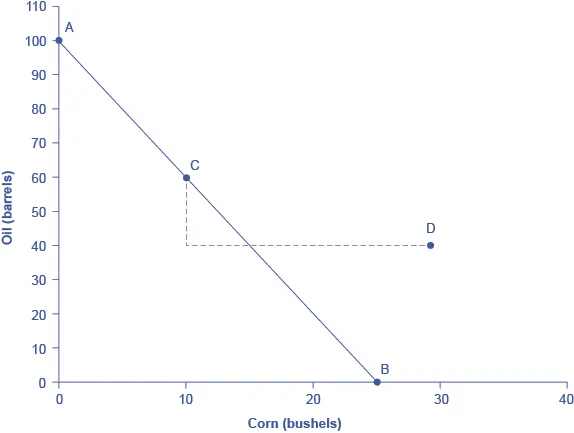
A PPF diagram for one trading partner that marks a pre-trade point and a post-trade consumption point beyond the domestic frontier. The move beyond the PPF illustrates gains from trade: specialization changes what is produced, and trade changes what is consumed. The visual reinforces that comparative advantage-based exchange can make both sides better off even with fixed resources. Source
How to Identify Comparative Advantage (Conceptually)
Use Relative, Not Absolute, Comparisons
To determine who has comparative advantage in a good, compare opportunity costs:
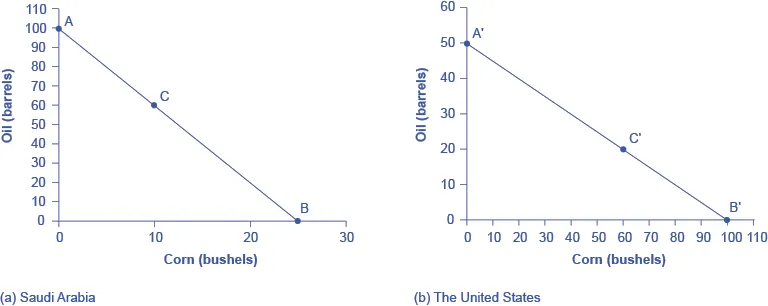
Two country-specific PPFs (Saudi Arabia vs. the United States) for corn and oil, drawn as straight lines to emphasize constant opportunity cost. The slope of each frontier shows how many units of one good must be sacrificed to gain one more unit of the other, which is exactly the opportunity cost comparison used to determine comparative advantage. Differences in slopes reflect different relative productivities across producers. Source
Producer A has comparative advantage in good X if A’s opportunity cost of X is lower than Producer B’s opportunity cost of X.
Equivalently, Producer B must then have comparative advantage in the other good (in a two-good world), because the opportunity costs move in opposite directions.
Why Opportunity Costs Differ
Differences in opportunity cost come from differences in relative productivity:
If a producer is much better at making one good than another (comparatively), giving up that strong-good production is especially costly.
If a producer is relatively more balanced (or relatively better at the other good), the sacrifice is smaller for the alternative good.
Common Pitfalls AP Students Should Avoid
Confusing comparative advantage with being “the best” overall; that is absolute advantage, which is not the basis for most trade gains.
Using money prices as opportunity costs without a clear basis; in this topic, opportunity cost is fundamentally about real trade-offs in output.
Ignoring that comparative advantage is defined per good: one producer can have comparative advantage in one good, while another has it in the other.
Practice Questions
Define comparative advantage and state the criterion used to determine which producer has comparative advantage in producing a good.
1 mark: Correct definition: lower opportunity cost than another producer.
1 mark: Correct criterion: compare opportunity costs; the producer with the lower opportunity cost in that good has comparative advantage.
Two producers, A and B, can each produce two goods, X and Y. Explain how opportunity cost is used to determine comparative advantage in good X, and explain why comparative advantage (not absolute advantage) is the basis for gains from trade.
1 mark: Opportunity cost described as the next best alternative forgone (or Y sacrificed to gain X).
2 marks: Correct method: compute/compare opportunity cost of X for A and for B; lower opportunity cost implies comparative advantage in X.
1 mark: Clear statement that comparative advantage can exist even if one producer has absolute advantage in both goods.
2 marks: Explanation of gains from trade: specialisation according to comparative advantage reduces total opportunity cost / increases total possible consumption compared with no trade.
FAQ
Yes. If the “worse” producer is relatively less bad at one good, its opportunity cost for that good can be lower.
Comparative advantage depends on relative trade-offs, not absolute output.
With more than two goods, a producer can have comparative advantage in multiple goods, but scarcity still forces prioritisation.
You compare opportunity costs pairwise or by ranking lowest opportunity costs across goods.
It depends on how easily resources shift between uses.
If resources are specialised, reallocating them can raise the amount of the other good forgone per additional unit, changing opportunity cost as output changes.
In output terms, it depends on relative productivity (trade-offs in quantities). In cost terms, wages can matter if they change the real sacrifice of inputs across uses.
What matters is the relative cost of producing one good instead of another.
Yes. Changes in skills, management, or production methods can alter relative productivity, shifting opportunity costs.
Even gradual learning-by-doing in one sector can change which good has the lower opportunity cost.