AP Syllabus focus: ‘Absolute advantage means a producer can make more of a good or service than another producer using the same resources.’
Absolute advantage is a simple productivity comparison used to describe who can produce more with the same inputs. It helps you read basic production data and make clear, input-based comparisons between producers.
Core idea: producing more with the same resources

A production possibilities frontier (PPF) showing the maximum feasible combinations of two goods (“guns” and “butter”) given fixed resources and technology. Points on the curve represent efficient production, while a point inside the curve represents inefficient use of resources (output below potential with the same inputs). This diagram supports the idea that holding resources constant defines a clear production limit against which “more output from the same inputs” can be compared. Source
What absolute advantage means
Absolute advantage: The ability of a producer (person, firm, or country) to make more output of a good or service than another producer using the same resources.
In AP Microeconomics, “resources” means productive inputs such as labor time, capital (machines/tools), land, and entrepreneurship. The comparison must hold inputs constant: if two producers use the same quantity and quality of inputs, the one with greater output has the absolute advantage in that good.
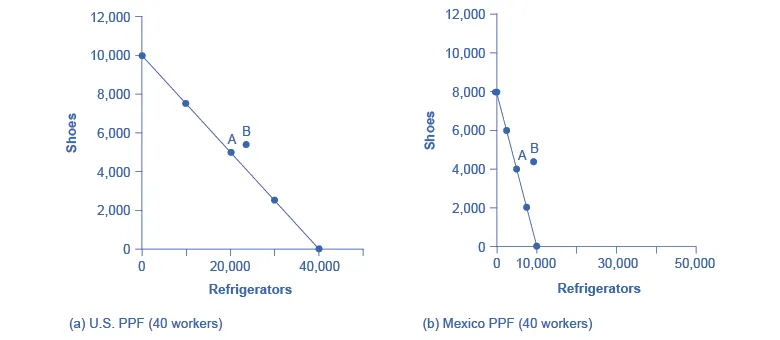
Two linear PPFs (United States vs. Mexico) drawn with the same worker endowment, each showing the maximum possible output of two goods. The country whose frontier reaches a higher intercept on a given axis can produce more of that good with the same resources, illustrating absolute advantage as a productivity comparison. The straight-line shape also makes it easy to read constant tradeoffs while keeping the resource constraint explicit. Source
What it does (and does not) tell you
Absolute advantage is about physical output per given input, not about who earns higher profit.
It does not require prices, wages, or costs to be known, as long as “same resources” is clearly defined.
Two producers can each have an absolute advantage in different goods, or one producer can have an absolute advantage in multiple goods.
Measuring absolute advantage (how to recognise it)
Use output per fixed input (productivity language)
Absolute advantage is essentially a comparison of productivity under a shared input standard (for example, per hour of labor or per machine).
= Output produced per unit of input (e.g., units per hour)
= Quantity of the good or service produced (units)
= Fixed amount of resources used (e.g., labour-hours, machine-hours)
If Producer A’s productivity is higher than Producer B’s productivity when measured using the same input unit, Producer A has the absolute advantage.
Equivalent way: compare required inputs for the same output
Sometimes information is given as “hours needed to produce one unit.”
This is still an absolute advantage comparison: using the same resources means the producer that needs fewer inputs to make one unit can produce more with a fixed input amount.
Keep the input comparison consistent
To make a valid absolute advantage claim, the “same resources” condition must be clear and consistent:
Same time period (per hour, per day, per year)
Same input definition (labour-hours vs number of workers)
Same technology and operating conditions as stated in the problem
Same good/service definition (don’t compare different product versions)
Where absolute advantage comes from (typical causes)
Technology: better machines, improved processes, automation
Human capital: worker skills, education, training, experience
Natural resources: fertile land, mineral deposits, climate advantages
Capital availability: more or higher-quality tools and equipment
Organisation and management: better coordination, lower downtime, better logistics
These factors raise output achievable from a given bundle of inputs, which is exactly what absolute advantage measures.
Common AP pitfalls to avoid
Confusing total output with “same resources”: higher total production does not prove absolute advantage if one producer used more inputs.
Treating lower price or lower cost as absolute advantage without an input-based comparison.
Ignoring input quality differences (e.g., skilled vs unskilled labour) when the prompt implies resources are not comparable.
Mixing input units (workers vs worker-hours), which can reverse comparisons.
Practice Questions
(2 marks) Define absolute advantage and state the information needed to identify which producer has it.
1 mark: Correct definition: producing more output using the same resources.
1 mark: States needed information: comparable input amount (e.g., labour-hours) and resulting output for each producer (or inputs required for the same output).
(5 marks) Two firms use identical machines for 8 machine-hours. Firm X produces 40 units of a component; Firm Y produces 32 units. (a) Which firm has the absolute advantage? (1 mark) (b) Calculate each firm’s productivity in units per machine-hour. (2 marks) (c) Explain, using your results, why this supports your answer in (a). (2 marks)
(a) 1 mark: Firm X.
(b) 1 mark: X productivity ; 1 mark: Y productivity .
(c) 1 mark: X produces more output per identical input; 1 mark: therefore X can produce more with the same resources, matching the definition.
FAQ
Yes, because absolute advantage is relative.
If another producer’s productivity rises (e.g., new technology), the first producer may lose absolute advantage despite unchanged output per input.
They may use a standardised input bundle or a productivity measure that aggregates inputs.
In practice, the comparison must specify which resource is being held constant, otherwise “same resources” is ambiguous.
For a meaningful comparison, outputs should be comparable in quality and specifications.
If quality differs, “more output” may not reflect greater productive capability; analysts may adjust output into quality-equivalent units.
Absolute advantage is not the only consideration.
Firms may outsource due to capacity constraints, risk management, flexibility, or strategic focus, even if they can produce more per unit of input internally.
No.
It can be measured per labour-hour, per machine-hour, per acre of land, or per dollar of a specified input—so long as the same resource measure is applied consistently across producers.