AP Syllabus focus: ‘Mutually beneficial trade occurs when terms of trade fall between the opportunity costs faced by trading partners.’
Trade creates gains only if the exchange rate makes both sides better off than producing alone. This page explains how terms of trade relate to each side’s opportunity cost and when trade is mutually beneficial.
Core idea: the bargaining range
When two producers can trade, there is typically a range of prices (exchange rates) that allows both to gain from specialization. That range is pinned down by each producer’s opportunity cost of the exported good in terms of the imported good.
Key term
Terms of trade — the rate at which one good is exchanged for another (the “price” of exports in units of imports).
A trade is mutually beneficial when each side can obtain the imported good at a lower opportunity cost through trade than through self-production.
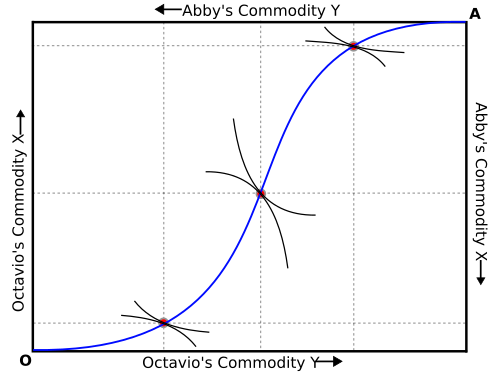
An Edgeworth box showing two goods and two traders, with the contract curve marking Pareto-efficient allocations. Starting from an initial endowment, any voluntary trade must move to a point where both traders can reach a higher indifference curve (a “mutually beneficial” improvement). The economy’s bargaining outcomes are therefore constrained: trade can expand mutual gains, but it cannot pass beyond the set of allocations where no further mutually beneficial trades exist. Source
Opportunity cost sets the limits
Each trading partner has a maximum “acceptable” price for what it imports and a minimum “acceptable” price for what it exports, based on its own production trade-offs.
Suppose goods are X and Y.
If a country can produce X cheaply (low opportunity cost), it tends to export X and import Y.
For that country to agree to trade, the amount of Y it receives per unit of X must be at least as good as what it could have produced by reallocating resources at home.
Mutually beneficial terms of trade condition
The mutually beneficial exchange rate must lie between the two partners’ opportunity costs (measured in the same direction).
= A’s opportunity cost of 1 unit of X in terms of Y (Y per X)
= B’s opportunity cost of 1 unit of X in terms of Y (Y per X)
= agreed terms of trade, measured as units of Y received per unit of X traded (Y per X)
A term of trade below the exporter’s opportunity cost won’t be accepted by the exporter (it could “buy” more Y by producing it indirectly at home). A term of trade above the importer’s opportunity cost won’t be accepted by the importer (it could obtain Y more cheaply without trading).
Interpreting “between opportunity costs”
“Between” has a precise meaning: the ToT must make the imported good relatively cheaper for each side than self-production.
What each side compares
For a proposed ToT stated as “ trades for ”:
The exporter of X asks: “Is at least the Y I give up when I produce 1 more X?”
If yes, trading X for Y beats converting resources into Y domestically.
The importer of X (exporter of Y) asks: “Is giving up no more than the Y I would give up to produce 1X at home?”
If yes, importing X beats producing X domestically.
Edge cases
If ToT equals one side’s opportunity cost exactly, that side is typically indifferent between trading and not trading (no gain on the margin).
If both sides have the same opportunity cost, there is no bargaining range; trade may not create gains from specialization.
What shifts the terms of trade (conceptually)
The syllabus focus is the condition for mutual benefit, but it helps to know what can move the agreed ToT within the acceptable range:
Relative bargaining power (who has better alternatives)
Preferences (how strongly each side values the imported good)
Market conditions (competition among potential trading partners)
These factors affect where the ToT lands within the range, not the fact that the range is bounded by opportunity costs.
Common AP pitfalls to avoid
Confusing absolute advantage with the ToT condition: mutually beneficial trade depends on opportunity costs, not absolute output levels.
Using opportunity costs measured in opposite directions (e.g., mixing “X per Y” with “Y per X”); the ToT and both opportunity costs must be in the same units.
Claiming “any trade is beneficial”: if the ToT falls outside the opportunity-cost bounds, at least one party loses relative to self-production.
Practice Questions
(2 marks) Define “terms of trade” and state the condition under which trade is mutually beneficial in terms of opportunity cost.
1 mark: Terms of trade = rate at which one good exchanges for another.
1 mark: Mutually beneficial if ToT lies between the two parties’ opportunity costs (measured consistently).
(6 marks) Country A has an opportunity cost of . Country B has an opportunity cost of .
(a) Identify the range of mutually beneficial terms of trade expressed as per . (2 marks)
(b) Explain briefly why a ToT of would not be accepted by both countries. (2 marks)
(c) Explain briefly why a ToT of would not be accepted by both countries. (2 marks)
(a)
1 mark: lower bound per .
1 mark: upper bound per .
(b)
1 mark: per is below A’s (A requires at least ).
1 mark: therefore A would not trade/export X at that ToT.
(c)
1 mark: per exceeds B’s of (too costly for B to import X).
1 mark: therefore B would not trade/import X at that ToT.
FAQ
Convert everything into the same direction.
If ToT is “$mX$ for $1Y$”, rewrite as “$1X$ for $\frac{1}{m}Y$” (or convert both opportunity costs to X per Y).
Compute the implied exchange rate: $\text{ToT} = \frac{P_X}{P_Y}$ in “Y per X” terms (or its reciprocal).
Then compare that implied ToT to the two opportunity costs in the same units.
No. Both can gain, but the split depends on where the ToT falls within the range.
A ToT closer to one country’s opportunity cost gives more of the total gain to the other country.
Yes. Shifts in bargaining conditions can move the agreed ToT within the same bounds, for example:
new alternative trading partners
changes in tastes
market power in negotiations
Say the party is indifferent because trading yields the same cost as self-production.
In exam explanations, note there is no gain for that party, so it may trade for non-economic reasons (variety, relationships) but not for efficiency gains.