AP Syllabus focus: ‘Specialization according to comparative advantage, rather than absolute advantage, allows trading partners to consume beyond their PPCs.’
Trade links scarcity to choice across countries: by specialising in what each produces relatively efficiently and exchanging output, both partners can expand feasible consumption, even when one producer is better at everything.
Core idea: why specialisation matters
When resources are limited, every producer faces trade-offs. The key insight is that trade-offs differ across producers, so production can be reorganised to raise total output of the goods the group values.
Specialisation: concentrating resources on producing a narrower range of goods and services rather than producing many items.
Specialisation increases the amount available for exchange.
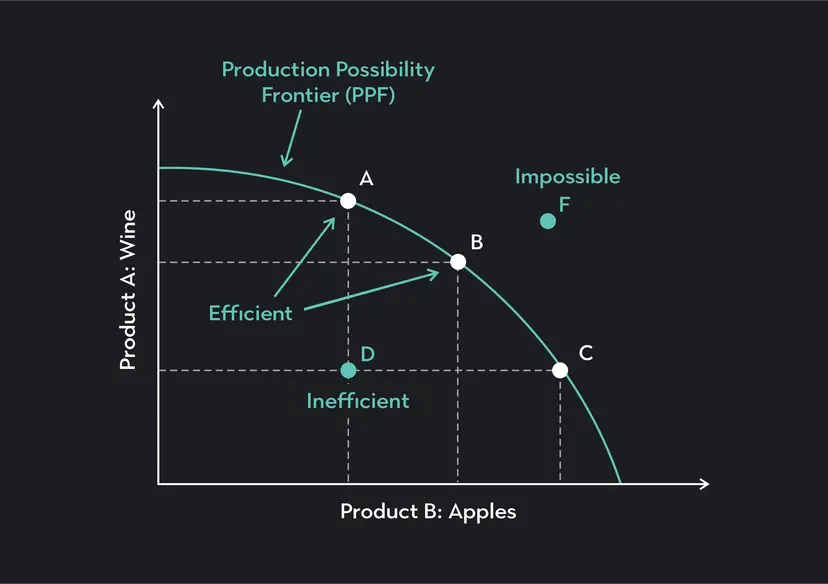
A production possibilities curve (PPC) showing efficient points on the frontier, inefficient points inside the curve, and unattainable points outside the curve. This visual anchors the idea that scarcity creates trade-offs, and that moving along the PPC reflects opportunity cost. Source
The relevant benchmark is each producer’s own production possibilities curve (PPC), which shows the maximum combinations of two goods it can produce with current resources and technology.
Comparative advantage (not absolute advantage) drives gains
Even if one country can produce more of both goods (has absolute advantage in both), it can still gain from specialising if its trade-offs differ.
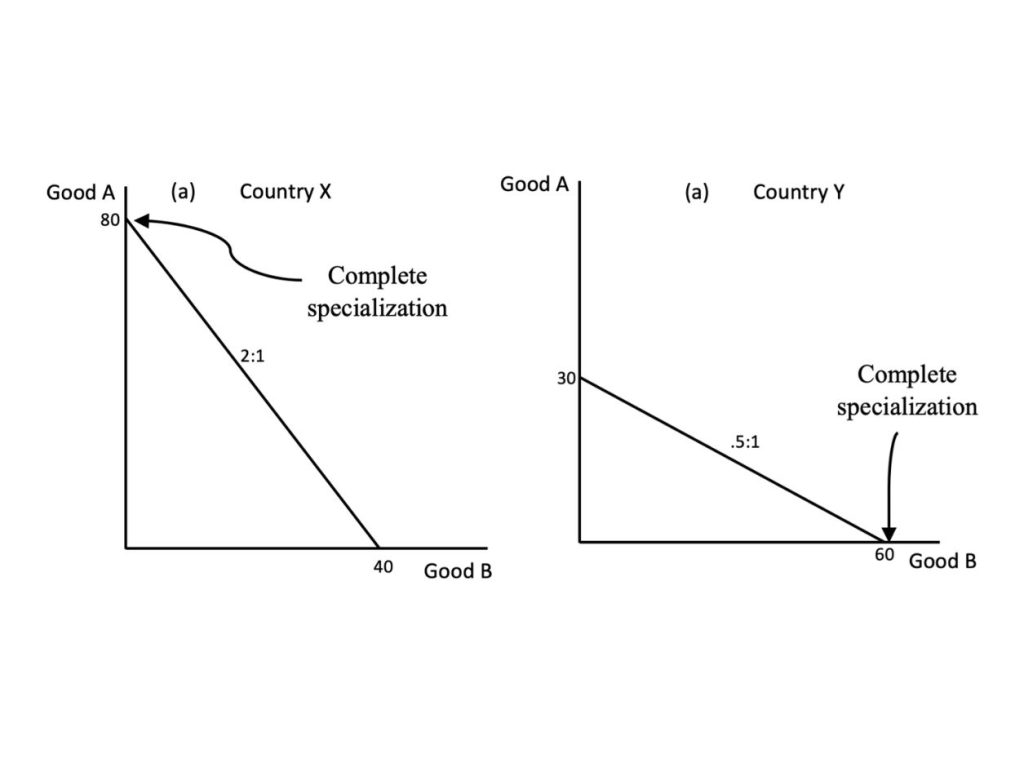
Two country PPCs under constant opportunity costs, where the slope of each PPC reflects opportunity cost and therefore comparative advantage. The figure makes it easy to see why different trade-offs (different slopes), not absolute output levels, determine the efficient pattern of specialization. Source
Comparative advantage: the ability to produce a good at a lower opportunity cost than another producer.
Opportunity cost is what must be given up to get more of something else. It is comparative advantage—not “who is best overall”—that determines the most efficient pattern of specialisation.
= opportunity cost of 1 more unit of , measured in units of
= change in output of (units of )
= change in output of (units of )
Gains from trade: consuming beyond the PPC
If each producer shifts resources toward the good in which it has comparative advantage, total potential production across both producers rises. Trade then allows each to obtain some of the other good without having to produce it domestically.
How “beyond the PPC” is possible
A point outside a country’s PPC is unattainable by domestic production alone, but it can become attainable through trade because:
the country produces closer to (or at) a point on its PPC that emphasises its comparative-advantage good
it exports some of that output
it imports the other good in exchange
the resulting consumption bundle can lie outside its own PPC, reflecting access to world production possibilities rather than only domestic ones
This does not violate scarcity: the economy is not producing beyond its PPC.
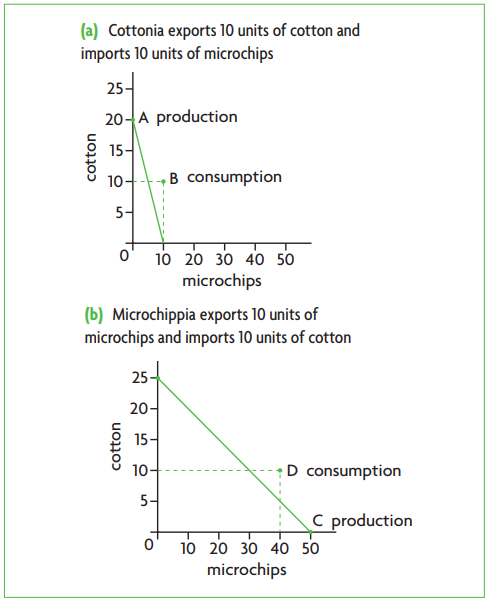
A gains-from-trade diagram in which each country specializes according to comparative advantage, produces at a point on its PPC, and then trades to reach a consumption point outside its own PPC. The labeled production and consumption points make the distinction clear: trade changes feasible consumption (via exchange), not the domestic production frontier itself. Source
It is consuming beyond its PPC by leveraging another producer’s different opportunity costs.
What must be true for mutual gains
For both trading partners to gain from trade in this model:
each must be able to specialise at least partially (resources can be reallocated across industries)
the traded exchange must allow both to obtain the imported good at an effective cost lower than producing it themselves (i.e., consistent with comparative advantage)
there must be some feasible exchange of goods/services (a market or other trading arrangement) that makes the trade possible
Common pitfalls to avoid
Confusing absolute advantage with the basis for trade; absolute advantage affects who can produce more, but comparative advantage determines efficient specialisation.
Treating gains from trade as guaranteed for every individual; the model predicts higher total consumption possibilities, but it does not by itself describe how gains are distributed within an economy.
Practice Questions
(3 marks) Explain how specialisation according to comparative advantage can allow a country to consume beyond its PPC.
1 mark: defines comparative advantage as lower opportunity cost.
1 mark: explains specialisation in the comparative-advantage good raises total output available for exchange.
1 mark: explains trade enables consumption outside the domestic PPC (consume beyond, not produce beyond).
(6 marks) Two countries produce goods and . Country A has an absolute advantage in producing both goods. Using opportunity cost reasoning and the PPC concept, explain why both countries can still gain from trade if each specialises according to comparative advantage.
1 mark: states absolute advantage in both goods does not eliminate gains from trade.
2 marks: explains comparative advantage via differing opportunity costs and why each country should specialise where its opportunity cost is lower.
2 marks: links specialisation to PPC movements (produce a PPC point more focused on the comparative-advantage good).
1 mark: explains trade enables consumption beyond each country’s PPC.
FAQ
They reduce gains by using real resources (fuel, time, insurance) that could have produced goods.
Trade is more likely to be beneficial when these costs are low relative to the production efficiencies from specialisation.
Specialisation can be limited by:
increasing opportunity costs as production expands
risk management (e.g., food security)
capacity constraints and adjustment frictions
Partial specialisation can still generate gains.
It can shift with changes in:
technology and productivity
education and skill accumulation
resource discovery or depletion
infrastructure and institutions
These factors alter opportunity costs and thus specialisation patterns.
Yes. Industries facing import competition may contract, lowering wages or employment in specific regions or skill groups.
Whether everyone benefits depends on how the gains are distributed and whether policies help with adjustment.
Exchange rates affect relative prices faced by buyers and sellers, influencing trade volumes.
Large misalignments or volatility can weaken specialisation incentives by making export revenues and import costs less predictable.