AP Syllabus focus: ‘For consumers, total benefits are measured as utility; for firms, total benefits are measured as total revenue.’
Total benefits describe what an economic decision delivers on the “benefit side” before subtracting costs. In AP Microeconomics, consumers’ total benefits are captured by utility, while firms’ total benefits are captured by total revenue.
What “Total Benefits” Means in AP Microeconomics
Total benefits are the overall gains from choosing a particular action or quantity, measured in a way that fits the decision-maker.
For a consumer, benefits come from satisfaction or enjoyment from consumption.
For a firm, benefits come from money received from selling output.
This split matters because consumers and firms “count” benefits differently, even when they interact in the same market.
Total Benefits for Consumers: Utility
Utility as the measure of benefit
When the syllabus says total benefits for consumers are measured as utility, it means the consumer’s benefit is the satisfaction from consuming goods and services, not the dollars paid.
Utility: The satisfaction or value a consumer receives from consuming a good or service.
Utility is a model-based measure: economists use it to represent preferences and compare choices, even though utility itself is not directly observable.
How to interpret total utility
Total utility rises as consumption increases, but it typically rises at a decreasing rate for many goods because extra units tend to add less additional satisfaction than earlier units.
Utility focuses on the consumer’s perspective (taste, preferences, context).
Utility depends on the bundle consumed, not just one good in isolation.
Utility is distinct from spending: a higher price does not automatically mean higher utility.
What utility does (and does not) tell you
Utility is most useful for:
Comparing which option provides more satisfaction to the same consumer.
Explaining why consumers may be willing to pay more for some goods than others.
Translating “preferences” into a consistent framework for choice.
Utility is less suited for:
Comparing satisfaction across different people (interpersonal comparisons are not required and are usually avoided).
Claiming exact, measurable “units” of happiness in real life; the model is primarily about consistent ranking and choice.
Total Benefits for Firms: Total Revenue
Total revenue as the measure of benefit
For firms, the syllabus measure of total benefits is total revenue: the money a firm brings in from sales. This is not profit; it ignores costs.
Total revenue: The total amount of money a firm receives from selling its output.
Total revenue is a clean, market-based measure: it links the firm’s benefit directly to price and quantity sold.
A key implication is that a firm can increase total revenue by changing output, changing price, or both, depending on market conditions and consumer responsiveness.
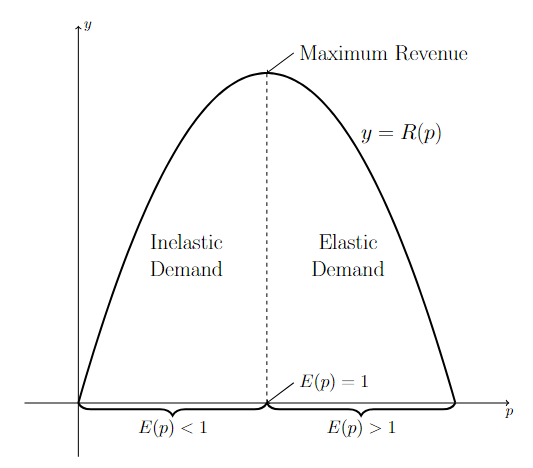
This graph plots total revenue as a function of price and labels the regions where demand is inelastic versus elastic. It highlights that total revenue is maximized at the unit-elastic point (where elasticity equals 1), and that moving toward this point tends to raise total revenue. This supports the idea that depends jointly on price and quantity demanded, not on price alone. Source
= Total revenue (dollars per time period)
= Price per unit (dollars per unit)
= Quantity sold (units per time period)
Interpreting total revenue in decision-making
Total revenue connects to the firm’s goal of improving outcomes, but it must be interpreted carefully.
Higher TR does not guarantee a better outcome if costs rise even more.
Changes in P and Q are jointly determined by the market structure and demand conditions the firm faces.
Total revenue is a “top-line” metric: it captures inflows from sales, not the net gain from production.
Connecting the Two Measures Without Mixing Them
It is tempting to treat dollars as the universal measure of benefit, but AP Microeconomics keeps the measures aligned to the decision-maker.
Consumers: benefit is utility, because choices aim to maximise satisfaction subject to constraints.
Firms: benefit is total revenue, because selling output generates monetary returns.
Both concepts represent “total benefits,” but they answer different questions:
Utility: “How much satisfaction do I get from what I consume?”
Total revenue: “How much money do I receive from what I sell?”
Using the correct benefit measure is essential before moving on (elsewhere in the course) to comparing benefits with costs to evaluate decisions.
Practice Questions
(2 marks) State what is used to measure total benefits for (i) consumers and (ii) firms in AP Microeconomics.
(1) Consumers: total benefits measured as utility.
(1) Firms: total benefits measured as total revenue.
(6 marks) Explain why total revenue is an appropriate measure of total benefits for a firm, and why utility is used instead for consumers. Include one reason why total revenue should not be confused with profit.
(1) TR measures the firm’s money receipts from sales/output.
(1) TR depends on price and quantity sold (relationship described).
(1) TR is appropriate because firms receive benefits in monetary terms from market transactions.
(1) Utility captures consumer satisfaction/preferences from consumption rather than monetary receipts.
(1) Utility is used because consumers aim to obtain satisfaction from goods and services, not revenue.
(1) TR is not profit because profit subtracts costs; TR ignores costs.
FAQ
In some models, money can proxy utility via willingness to pay, but it is not the same concept.
Willingness to pay reflects a trade-off using a budget constraint, while utility is the underlying satisfaction that motivates the trade-off.
Utility is best treated as ordinal: it ranks preferences (A preferred to B).
Some diagrams use “utils” for convenience, but AP reasoning typically relies on comparisons and consistent choice rather than measurable happiness units.
Quality changes can shift demand, altering the price a firm can charge and the quantity it can sell.
Total revenue captures the market outcome of quality changes (through $P$ and $Q$) but does not separately record the cost of improving quality.
Preferences differ due to tastes, income situation, prior consumption, and context.
Because utility is subjective, identical consumption bundles can generate different satisfaction levels across individuals without implying any “error” in the model.
TR ignores important dimensions of a firm’s objectives and constraints, such as:
risk and revenue volatility
long-run brand investment and customer retention
timing (cash flow versus recorded revenue)
It is a useful benefits measure for sales outcomes, but it is incomplete without complementary information.