AP Syllabus focus: ‘Rational decision-making includes opportunity cost when evaluating the total economic cost of any choice.’
Opportunity cost is the core tool economists use to interpret real-world choices under scarcity. This page explains how opportunity cost shapes rational decision-making by identifying what must be given up when selecting any option.
Opportunity Cost and Choice Under Scarcity
Whenever resources (time, money, labor, or materials) are limited, choosing one option means not choosing others. The value of what you give up is a cost, even if no money changes hands.
Opportunity cost: The value of the next best alternative forgone when a choice is made.
Opportunity cost is forward-looking: it depends on the best available alternative at the moment of decision, not on what was intended earlier.
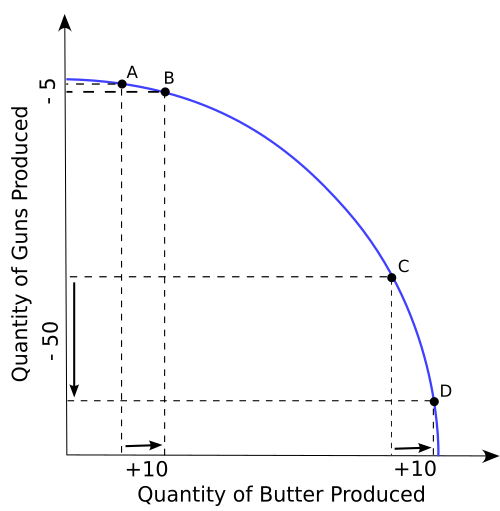
A production possibilities frontier (PPF) with highlighted movements between points on the curve, illustrating that increasing output of one good requires sacrificing some output of the other good. The horizontal and vertical changes between points make the opportunity cost concrete as a measurable trade-off on the frontier. Source
It also depends on context: as circumstances change, the next best alternative (and therefore opportunity cost) can change.
What “Next Best” Really Means
The “next best” alternative is the single most valuable option among all the options you are not choosing. That matters because:
You do not add up every forgone alternative; you identify the best forgone one.
Opportunity cost is measured in value, which may be:
A dollar amount (foregone income, avoided spending)
Time value (hours that could have been used differently)
Foregone output (units of another good that could have been produced)
Rational Decision-Making Using Opportunity Cost
The syllabus emphasis is that rational decision-making includes opportunity cost when evaluating the total economic cost of any choice. In practice, rational decision-making means comparing alternatives based on what you gain versus what you give up, including non-obvious trade-offs.
Rational decision-making: Choosing the option that best achieves an objective given constraints, using relevant costs and benefits (including opportunity cost).
A key implication is that the “cost” of an action is not limited to out-of-pocket spending. A choice can be expensive in economic terms even when it is free in accounting terms, because it uses scarce resources that could have produced value elsewhere.
Identifying Opportunity Costs in Decisions
To apply opportunity cost correctly, follow this logic:
Define the decision-maker and the objective (profit, utility, cost minimisation, performance).
List feasible alternatives given constraints.
Determine the next best alternative.
Identify the value you would have received from that next best alternative.
Treat that value as part of the decision’s total economic cost for comparison purposes.
Common Pitfalls to Avoid
Students often miss opportunity cost because it is implicit. Watch for these traps:
“Free” choices: Free admission, zero-interest offers, or gifts can still have opportunity costs (time, foregone use, foregone earning).
Ignoring time: Time spent on one activity displaces time from work, study, rest, or leisure; that displaced value is an opportunity cost.
Focusing on averages: Rational choice is about comparing alternatives at the decision point, not just comparing historical averages.
Why Opportunity Cost Improves Economic Reasoning
Including opportunity cost makes analysis more accurate because it reflects the reality of scarcity:
It forces recognition of trade-offs, even when they are not priced in markets.
It supports consistent comparisons across alternatives by using a common idea: what must be sacrificed.
It clarifies why two people can face different costs for the same action (their next best alternatives differ).
Opportunity Cost as a Unifying Concept
Opportunity cost links individual choices to broader economic outcomes:
If opportunity costs rise, people are more likely to switch away from an activity.
If opportunity costs fall, an activity becomes more attractive relative to alternatives.
Changes in constraints (like wages, available time, or competing opportunities) can change behaviour by changing opportunity cost.
Practice Questions
(2 marks) Define opportunity cost and explain why it is included in rational decision-making.
1 mark: Correct definition (value of next best alternative forgone).
1 mark: Explains inclusion because it is part of total economic cost / reflects trade-offs under scarcity.
(5 marks) Explain how a rational decision-maker would use opportunity cost to compare two feasible alternatives when one has no explicit monetary payment.
1 mark: States that the “free” option can still have an opportunity cost.
1 mark: Identifies next best alternative as the relevant comparison.
1 mark: Explains valuing what is forgone (e.g., time, income, output) as a cost.
1 mark: Links to evaluating total economic cost (not just explicit payments).
1 mark: Concludes that the choice depends on which option yields higher net advantage given the objective.
FAQ
They use a proxy based on the best available measure (e.g., wage rate for time, rental value for owned assets), chosen to match the decision-maker’s next best option.
Yes, if there is no scarce resource being displaced or the next best alternative truly has zero value (rare in practice, especially once time is considered).
Because people have different constraints and alternatives. The same hour may forgo paid work for one person but only low-value leisure for another.
Decision-makers compare expected values of alternatives. Opportunity cost becomes the expected value of the next best alternative given available information.
A trade-off is the general situation of giving something up to get something else. Opportunity cost is the specific value of the next best option sacrificed.