AP Syllabus focus: ‘The optimal choice is the one that maximizes total net benefits, which equal total benefits minus total costs.’
Choosing well in economics means comparing what you gain to what you give up. This page explains how to compute net benefits and use them to identify the optimal choice among alternatives.
Core Idea: Net Benefits Drive Optimal Choice
Economic decisions are typically choices among mutually exclusive alternatives (do A or do B). The decision rule in this subtopic is simple: pick the option with the highest total net benefits.
Net benefits: The difference between an option’s total benefits and total costs.
Net benefits organize decision-making because they put positives and negatives into a single measure. If two options both generate benefits, the optimal choice is not “the one with benefits,” but the one with the greatest benefits after accounting for costs.
Total Benefits and Total Costs (What Counts)
To apply the net-benefit rule, you must identify the relevant total benefits and total costs of each option, measured over the same time period and for the same decision-maker.
Total benefits (TB)
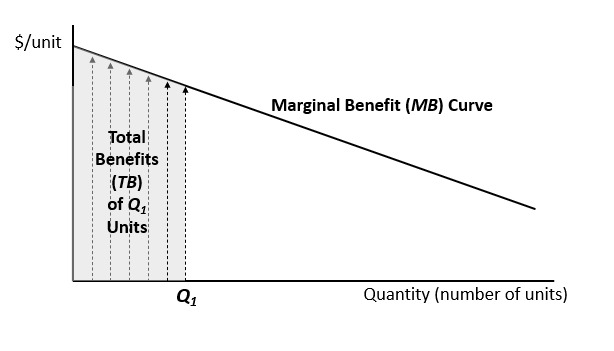
A marginal benefit (MB) curve is shown with the key interpretation that the area under the curve up to a chosen quantity equals total benefits (TB). This helps connect the idea of benefits to a measurable total that can be compared against total costs when computing net benefits. Source
Total benefits are the full gains from an option.
For a consumer, benefits are commonly thought of as satisfaction/value received.
For a firm, benefits are commonly tied to total revenue or other objective-defined gains.
The key is consistency: define benefits in a way that fits the decision-maker’s goal, then use that same definition across all options.
Total costs (TC)
Total costs are the full sacrifices required by an option.
Costs include not only out-of-pocket payments, but also the value of what must be given up when resources are used in one way rather than another (the opportunity cost).
Costs can be monetary or non-monetary (time, inconvenience, foregone alternatives), as long as they are relevant to the choice being evaluated.
If costs are understated (for example, by ignoring what must be given up), net benefits will be overstated and the decision rule will mislead.
The Net Benefits Equation and Decision Rule
= net benefits of an option (in comparable “benefit units” or dollars)
= total benefits generated by the option (same units as )
= total costs of the option (same units as and )
This relationship implies a ranking rule: compute for each alternative and choose the one with the largest value.
Identifying the Optimal Choice
The syllabus requirement is: “The optimal choice is the one that maximizes total net benefits, which equal total benefits minus total costs.” Practically, that means the optimal choice is the alternative for which the gap between benefits and costs is largest.
How to apply the rule (without doing unnecessary work)
List feasible alternatives (including “do nothing,” if it is a real option).
For each alternative, identify its TB and TC using the same perspective and time horizon.
Compute NB = TB − TC for each alternative.
Choose the alternative with the highest NB.
Interpreting NB values
: benefits exceed costs for that option (it is worthwhile relative to its own costs).
: benefits just cover costs (indifferent at the margin of choosing that option versus not, depending on the set of alternatives).
: costs exceed benefits (that option reduces overall well-being relative to its cost).
Importantly, the optimal choice among multiple alternatives is the one with the maximum net benefits, even if more than one option has positive net benefits.
Common Pitfalls When Maximising Net Benefits
Mixing perspectives
Net benefits depend on whose benefits and costs are counted.
A choice that maximizes a consumer’s net benefits may not maximize a firm’s net benefits.
Be explicit about the decision-maker (individual, firm, or society) before comparing alternatives.
Inconsistent measurement
To compare alternatives correctly:
Measure benefits and costs in consistent units (often dollars, but any consistent metric can work).
Use the same timeframe for each alternative so totals are comparable.
Double-counting or omitting items
Don’t count the same effect in both TB and TC.
Don’t ignore key trade-offs that change the true cost of an option.
Practice Questions
(2 marks) Define total net benefits and state the rule for choosing the optimal option among alternatives.
1 mark: Defines total net benefits as total benefits minus total costs ().
1 mark: States the optimal choice is the option that maximises total net benefits (highest ).
(6 marks) A decision-maker is choosing among three mutually exclusive options. Explain how the decision-maker should determine which option is optimal using the concept of total net benefits. In your answer, include what must be measured and how options are compared.
1 mark: Identifies that each option’s total benefits (TB) must be determined.
1 mark: Identifies that each option’s total costs (TC) must be determined.
1 mark: States that total net benefits are calculated as for each option.
1 mark: Explains that options must be measured consistently (same units/timeframe/perspective).
1 mark: Explains that the options are compared by ranking their values.
1 mark: States that the optimal option is the one with the highest (maximised) (not merely positive ).
FAQ
When outcomes are uncertain, decision-makers often compare expected net benefits: expected TB minus expected TC.
They may also account for risk preferences (risk-averse decision-makers may prefer a lower expected $NB$ with more certainty).
Yes, as long as benefits and costs are measured consistently.
Common approaches include converting time to money using a value of time, or using a consistent utility/point scale when monetary conversion is not possible.
Minimising costs ignores the benefit side and can select an option that is cheap but low-value.
Maximising $NB$ selects the option with the best trade-off between value gained (TB) and sacrifices made (TC).
If benefits and costs occur at different times, the relevant totals depend on the period being evaluated.
Longer horizons can change which option has the highest $NB$ if one option has higher upfront costs but larger later benefits.
They may face different costs (e.g., time constraints) or value benefits differently.
Optimality is conditional on the decision-maker’s own TB and TC, so the same set of options can produce different maximising choices.