AP Syllabus focus: ‘Some decisions require comparing total benefits and total costs, while others can be analyzed using marginal changes.’
Decisions in microeconomics can be evaluated by looking at overall (total) outcomes or by focusing on the effect of small changes (marginal outcomes). Choosing the right approach prevents incorrect inferences about “best” actions.
Total Analysis Versus Marginal Analysis
Two ways to evaluate choices
Many economic choices involve changing an activity level (producing more, consuming another unit, operating one more hour). Others involve choosing among discrete alternatives (option A vs option B). The appropriate method depends on the structure of the decision.
Total analysis: A decision approach that compares total benefits and total costs across alternatives or activity levels.
Total analysis is most natural when you are selecting among a few distinct options or when changing the decision changes the entire scale of costs and benefits.
Marginal analysis: A decision approach that evaluates whether a small change (often “one more unit”) increases benefits by more than it increases costs.
Marginal analysis is most natural when decisions are incremental and can be adjusted step-by-step.
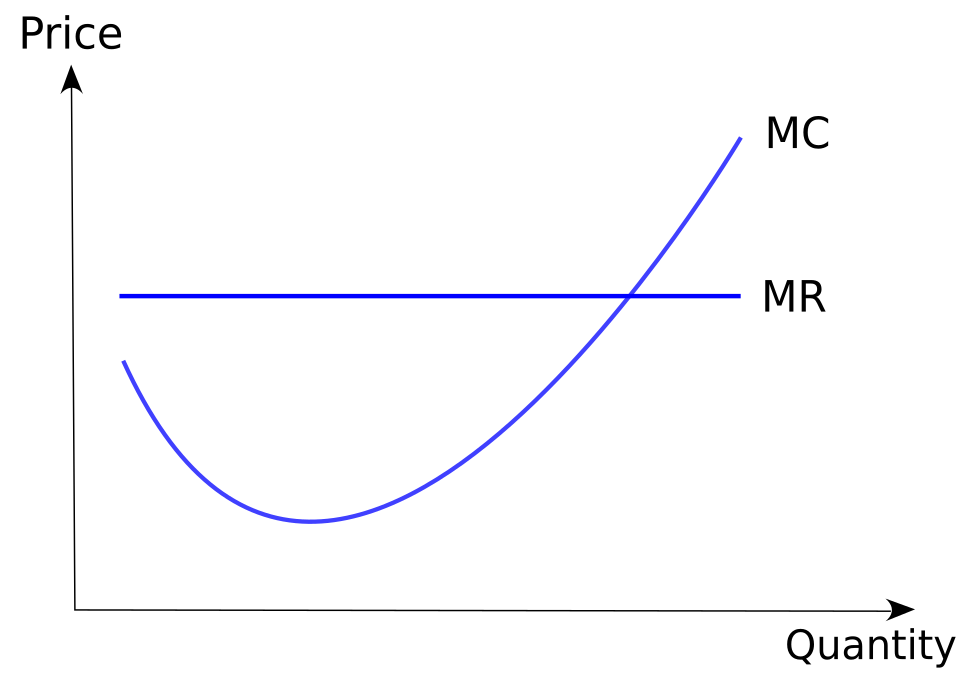
A typical marginal cost (MC) curve showing marginal cost per additional unit on the vertical axis and quantity on the horizontal axis. This picture reinforces that marginal analysis evaluates the next increment (e.g., “one more unit”) rather than total outcomes across entire options. Source
What “total” focuses on
Total benefits and total costs add up the full amounts associated with a choice at a given activity level. Total analysis asks, in effect, “Which option gives the better overall outcome?”
Use total analysis when:
The decision is all-or-nothing or involves discrete alternatives (choose one plan, one technology, one contract).
The relevant costs/benefits change in large jumps rather than smooth increments.
You need a full comparison because the alternatives are not meaningfully “one more unit” apart.
Common pitfalls in total analysis:
Comparing totals without ensuring the alternatives are comparable in scale (e.g., different quantities or time horizons).
Ignoring that an alternative may have a higher total benefit only because it involves a much higher total cost.
What “marginal” focuses on
Marginal analysis asks whether increasing (or decreasing) the activity level is worthwhile at the margin. It is built for choices like “Should I do a bit more?” rather than “Which complete plan should I choose?”
Use marginal analysis when:
The decision variable is continuous or repeatable (units of output, hours, miles, customers served).
You can adjust gradually and stop at the point where further changes no longer improve outcomes.
You want the decision rule for expanding or contracting an activity based on the additional benefit and additional cost.
A key idea is that totals can be rising while marginal gains are falling; marginal analysis helps identify when “more” stops being worth it.
= marginal benefit per additional unit (benefit per unit)
= marginal cost per additional unit (cost per unit)
change in quantity (units)
In practice, marginal analysis compares MB and MC for the next small change, using the sign and size of that comparison to guide whether to increase, decrease, or hold steady.
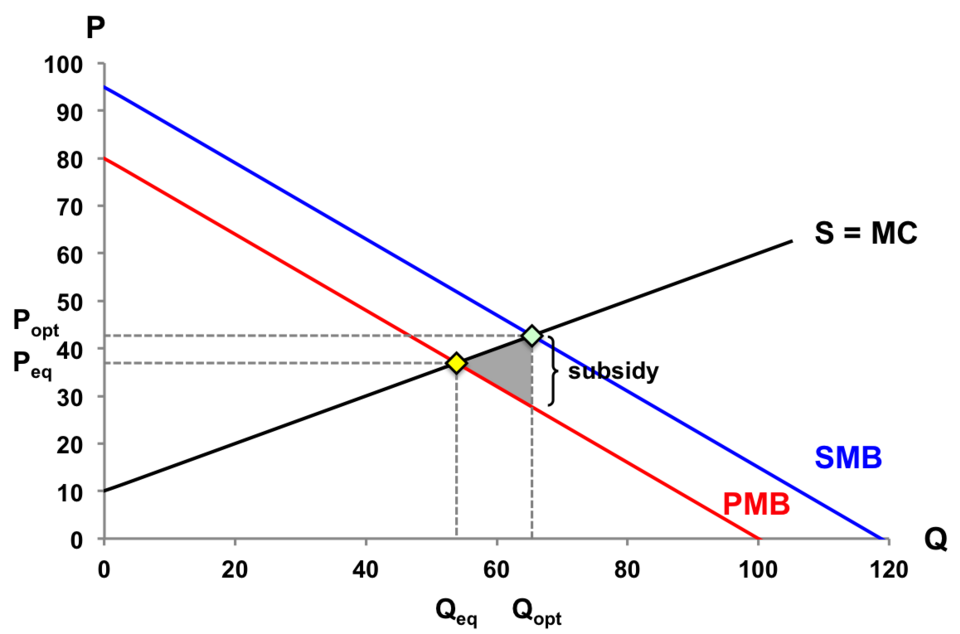
A labeled supply-and-demand style diagram where “demand” is interpreted as marginal benefit and “supply” as marginal cost, marking equilibrium vs an efficient/optimal outcome. The key takeaway is that an efficient quantity occurs where the relevant marginal benefit curve intersects the relevant marginal cost curve, making the vs. decision rule visible on a graph. Source
How to choose the correct approach
Pick the method that matches the decision’s “granularity”:
If you are choosing among separate bundles of outcomes, totals are often clearer.
If you are adjusting an activity level, marginal comparisons are often clearer.
When both are available, they should be consistent: total outcomes are the accumulation of marginal changes. Apparent conflicts usually come from using marginal reasoning on a discrete jump, or using totals when the decision is actually incremental.
Data and measurement considerations
Whether totals or marginals are more informative can depend on what information is observable:
Totals are often easier to report (total revenue, total cost, total satisfaction).
Marginals can be inferred from changes in totals, but require careful definition of the “next unit” and consistent measurement intervals.
If the “unit” is large (e.g., adding an entire new shift), marginal analysis may resemble a discrete comparison and should be treated cautiously.
Practice Questions
Question 1 (3 marks) Define marginal analysis and state one situation in which total analysis would be more appropriate than marginal analysis.
1 mark: Correct definition of marginal analysis as evaluating the additional (incremental) benefit and additional (incremental) cost of a small change.
1 mark: Identifies total analysis as comparing total benefits and total costs across discrete alternatives or activity levels.
1 mark: Appropriate situation where total analysis fits (e.g., choosing between two contracts/technologies/plans that are discrete rather than “one more unit”).
Question 2 (6 marks) A firm is considering whether to expand output gradually over time. Explain how marginal analysis would guide this decision, and explain why relying only on total benefits and total costs could lead to a poor expansion decision.
1 mark: States that marginal analysis compares and for the next unit (or small increment).
1 mark: Explains expansion is justified when for the next increment; not justified when .
1 mark: Recognises the decision is incremental/adjustable, making marginal analysis suitable.
1 mark: Explains totals can keep rising even if marginal gains fall, so totals alone may hide when additional expansion is no longer worthwhile.
1 mark: Notes that averages/totals can mislead about the “next unit” (the relevant comparison is at the margin).
1 mark: Clear link to the risk of over-expanding or under-expanding if the marginal information is ignored.
FAQ
If the “next unit” is a large jump (e.g., a new machine), treat it as a discrete alternative.
You can still use incremental thinking, but compare the full added benefits and added costs of the lump, not a tiny $\Delta Q$.
They can appear to if the decision is framed inconsistently (different time periods, different quantities, or different units).
When the same decision and units are used, totals should reflect the accumulation of marginal changes.
Total benefits typically increase with activity, even when each extra unit adds very little.
Decisions depend on whether the extra benefit is worth the extra cost, not whether the total is higher.
A larger $\Delta Q$ produces a “coarser” marginal estimate (more like an average over a range).
Smaller, consistent increments make marginal comparisons more reliable for step-by-step decisions.
Use changes in totals over consistent increments: compute $\Delta TB$ and $\Delta TC$ for the same $\Delta Q$.
Check that the increment matches the actual decision step (e.g., per unit, per hour, per batch).