AP Syllabus focus: ‘In rational consumer choice theory, consumers choose the combination of goods that maximizes total utility.’
Consumers face many possible consumption bundles but can purchase only some of them. Utility maximisation explains how a rational consumer selects the bundle that delivers the greatest overall satisfaction, given the limits they face.
Core idea: choosing the best bundle
Utility as a model of satisfaction
Utility: A measure of satisfaction or value a consumer receives from consuming goods and services.
In AP Microeconomics, utility is used to model choice, not to claim that happiness can be measured precisely. The key prediction is that consumers can compare bundles and choose the one they prefer.
Total utility: The total satisfaction from consuming a particular bundle (specific quantities) of goods and services.
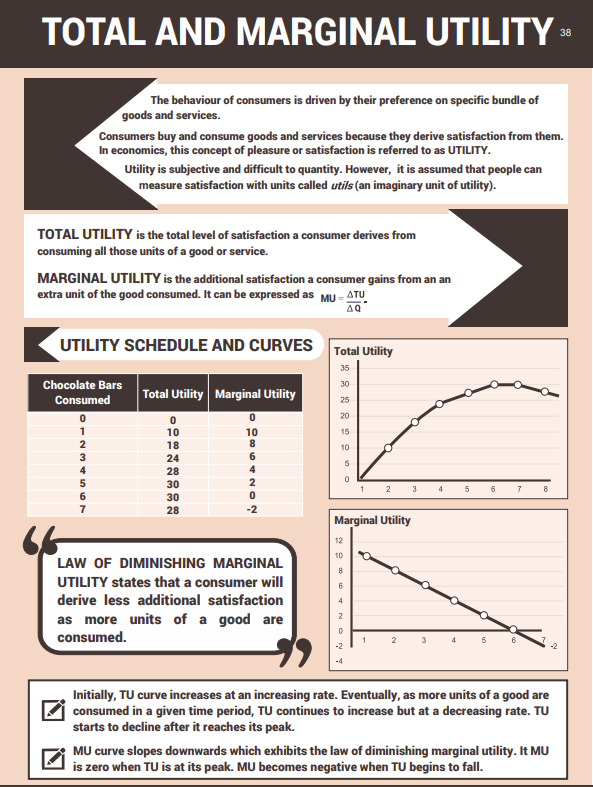
This figure pairs a total utility curve with a marginal utility curve to show how total satisfaction changes as consumption rises. The marginal utility curve typically declines, and when marginal utility hits zero, total utility reaches its peak—linking “total utility” to the incremental gains from one more unit. Source
Total utility increases when a consumer moves to a more preferred bundle, and it provides a single way to represent the consumer’s overall evaluation of what they consume.
Rational choice and consistent preferences
Utility maximisation relies on the assumption that consumers are rational in the sense that they:
Have well-defined preferences over bundles (they can rank alternatives).
Make consistent choices (if bundle A is preferred to B, they will not choose B when A is feasible).
Prefer “more” of a good to “less,” holding everything else constant, for goods they value (this helps explain why trade-offs matter).
What it means to “maximise total utility”
The optimisation problem (conceptually)
The consumer’s task is to find the best feasible bundle—the one with the highest total utility among all bundles they can afford given income and prices.
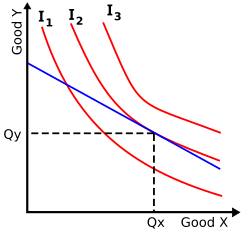
An indifference-curve map with a budget line illustrates utility maximization under scarcity. The optimal bundle is the tangency point between the budget line and the highest reachable indifference curve, representing the most preferred affordable consumption bundle. Source
= Total utility from consuming units of good and units of good
= Quantities chosen (units of each good)
This representation highlights two essential parts:
Objective: maximise (choose the most preferred bundle).
Constraint: choice is limited by real-world scarcity (not every bundle is attainable).
“Best” means best among attainable alternatives
Utility maximisation is always relative to constraints. A consumer might prefer a bundle with more of everything, but if it is not feasible, it is irrelevant for explaining observed choice. The chosen bundle is the one that:
Is feasible (affordable given income and prices), and
Provides higher total utility than any other feasible bundle.
How preferences map into choices
Bundles and trade-offs
Because resources are scarce, consumers typically face trade-offs between goods. Utility maximisation captures the idea that:
A consumer is willing to give up some of one good to get more of another if the resulting bundle raises total utility.
The chosen bundle reflects the consumer’s relative valuation of the goods at the margin, even though the goal is to maximise total utility.
Stability of preferences (ceteris paribus)
For the model to make clear predictions, economists usually assume that, over the decision period:
Tastes and preferences are relatively stable
Income and prices are treated as given
The consumer chooses the utility-maximising bundle given those conditions
If income, prices, or preferences change, the feasible set or the utility rankings may change, so the utility-maximising choice may also change.
Why this matters in AP Microeconomics
Utility maximisation provides the foundation for explaining:
Why consumers pick particular combinations of goods rather than only one good
How scarcity and constraints shape consumer choice
How economists connect an internal goal (maximising total utility) to observable outcomes (the bundle purchased)
Practice Questions
(2 marks) In rational consumer choice theory, what does it mean to say a consumer “maximises total utility”?
1 mark: States the consumer chooses the most preferred bundle/highest satisfaction.
1 mark: Makes clear it is the highest total utility among feasible/affordable bundles given constraints (income/prices).
(5 marks) Explain how utility maximisation can predict a consumer’s chosen bundle when there are two goods, and , and not all bundles are affordable.
1 mark: Defines utility as satisfaction/value from consumption.
1 mark: States total utility depends on quantities of both goods (a bundle).
1 mark: Explains the consumer ranks/compares bundles using preferences (consistent choice).
1 mark: Identifies the affordability/constraint idea (limited income and given prices restrict feasible bundles).
1 mark: Concludes the chosen bundle is the feasible one with the highest total utility.
FAQ
Not necessarily. In many models, utility is just a ranking device.
“Utils” can be a convenient way to talk about higher vs lower satisfaction without claiming a physical measurement.
Utility is an economic representation of preference, not a psychological measure.
The model only requires that choices reveal consistent rankings among bundles.
Yes. A consumer may be indifferent between bundles that yield equal utility.
This helps explain why multiple bundles can be equally acceptable even if only one is chosen.
They infer preference orderings from observed choices under constraints.
If choices are consistent, economists can model them “as if” the consumer maximises a utility function.
Often, yes, as a simplifying assumption.
More advanced approaches allow bounded rationality, but AP utility maximisation typically uses the rational-choice baseline.