AP Syllabus focus: ‘Consumers experience diminishing marginal utility as they consume additional units of goods and services.’
Diminishing marginal utility is a core idea for explaining why people value additional units of the same good less than earlier units. It helps connect consumer satisfaction to choices, prices, and the shape of demand.
Understanding Utility and Marginal Utility
Utility is the satisfaction or benefit a consumer gets from consuming a good or service. Economists treat utility as a useful model of preferences rather than a directly observable psychological measure.
Marginal utility (MU): the additional utility gained from consuming one more unit of a good or service, holding everything else constant.
Because decisions occur at the margin, marginal utility is the key concept for predicting whether a consumer wants “one more” unit.
= marginal utility (utils per unit, or satisfaction per additional unit)
= total utility (utils)
= quantity consumed (units of the good)
This relationship formalises that marginal utility depends on how total utility changes as consumption changes.
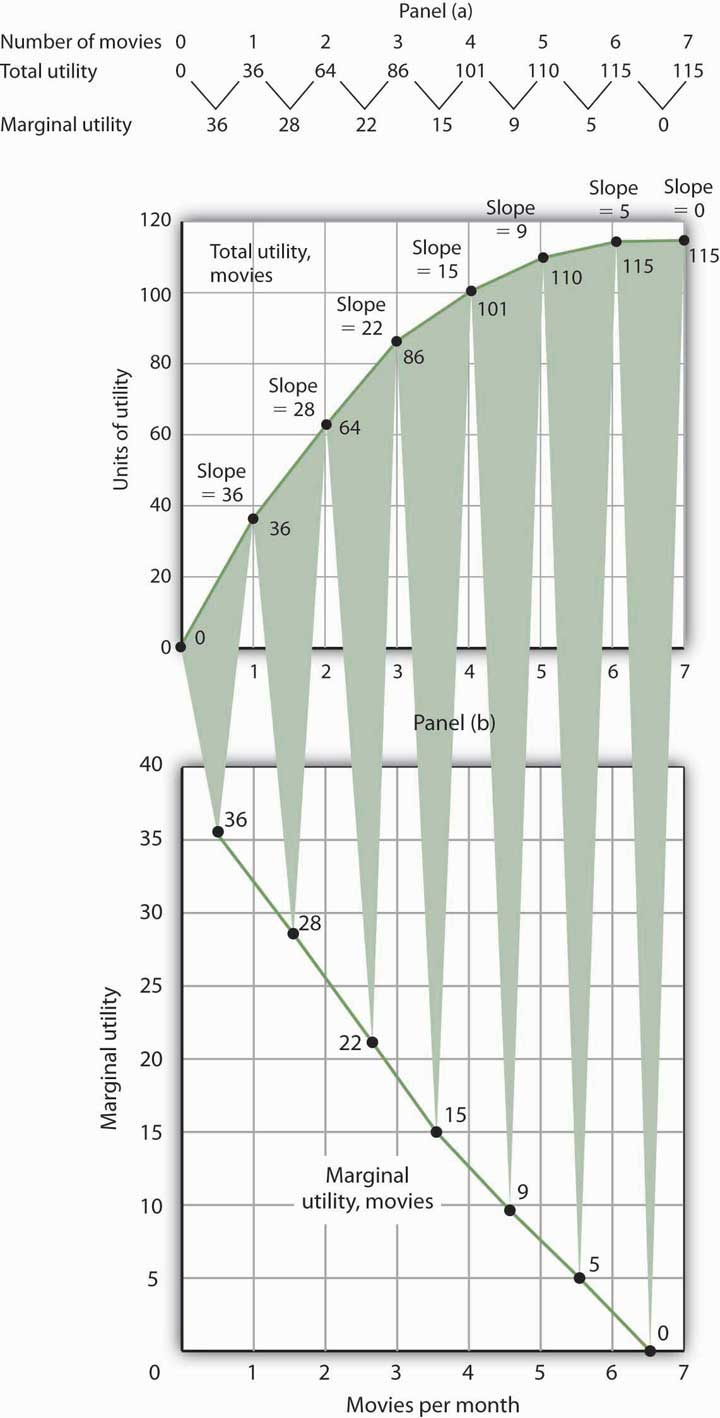
This figure plots total utility (top panel) and marginal utility (bottom panel) as consumption increases. It shows total utility rising at a decreasing rate while marginal utility declines, illustrating diminishing marginal utility and the idea that is the slope of the total utility curve. Source
Diminishing Marginal Utility (DMU)
Diminishing marginal utility means that as a consumer consumes more units of the same good in a given period, the marginal utility of each additional unit tends to fall. Early units satisfy the most urgent wants (e.g., hunger or basic convenience). Later units satisfy less urgent wants, so each extra unit adds less additional satisfaction.
What DMU Does (and Does Not) Claim
DMU is about additional satisfaction, not total satisfaction.
With DMU, total utility can still rise as consumption increases, but it rises by smaller and smaller amounts.
DMU does not require marginal utility to become zero or negative, though that can happen (e.g., “too much” of a good).
DMU is typically discussed holding other factors constant: tastes, income, the time period, and consumption of other goods.
Why DMU Happens
DMU is strongly linked to how consumers rank units of consumption when wants are progressively satisfied.
Satiation of the most pressing need: the first units address the highest-priority uses.
Variety and balance in consumption: consuming more of one identical good often crowds out other desired experiences.
Limited capacity to enjoy identical units: time, attention, and physical limits reduce the added benefit of more.
Graphical and Practical Implications
Marginal Utility and Willingness to Pay
A consumer’s willingness to pay for an additional unit is closely related to the marginal benefit they expect from that unit. When MU diminishes, the consumer typically values additional units less, which supports the idea that consumers demand more only at lower prices.
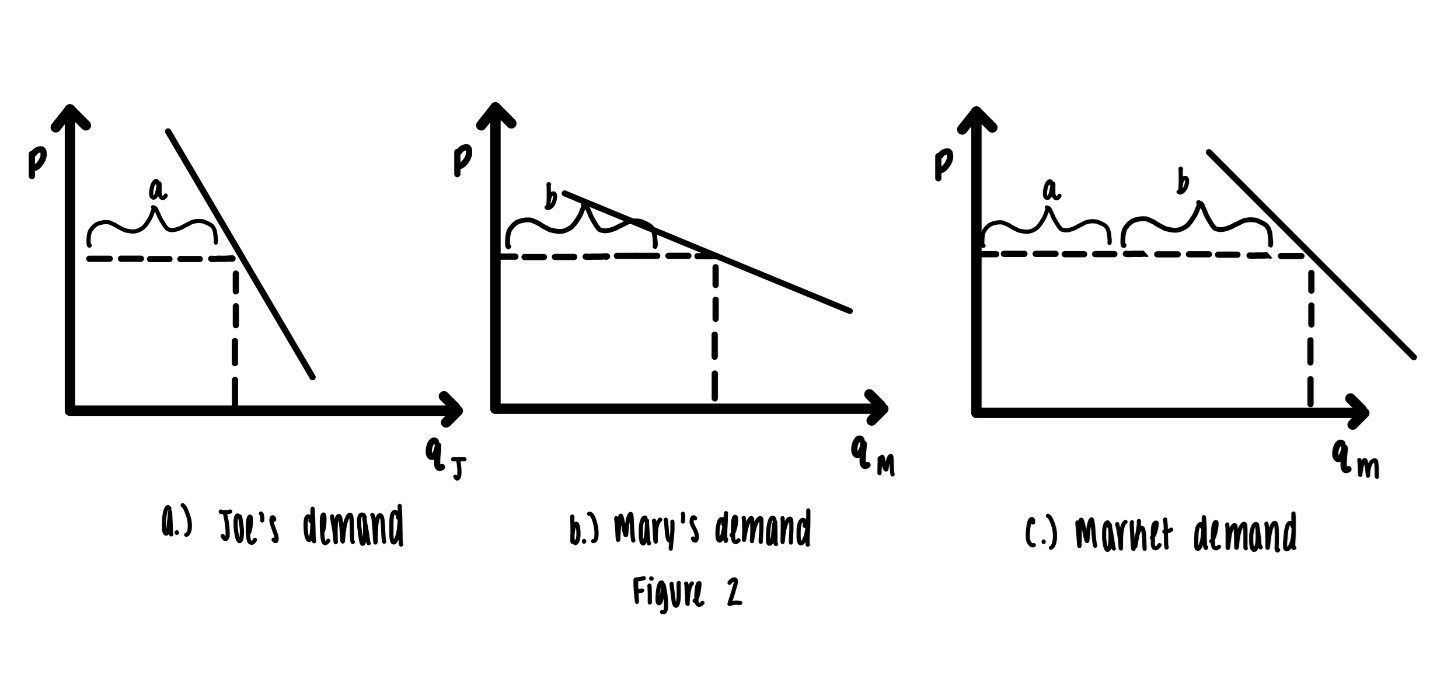
These panels show two individual demand curves and how adding quantities horizontally at the same price produces the market demand curve. This helps connect individual willingness to pay (marginal benefit) to the market-level demand students use throughout AP Micro. Source
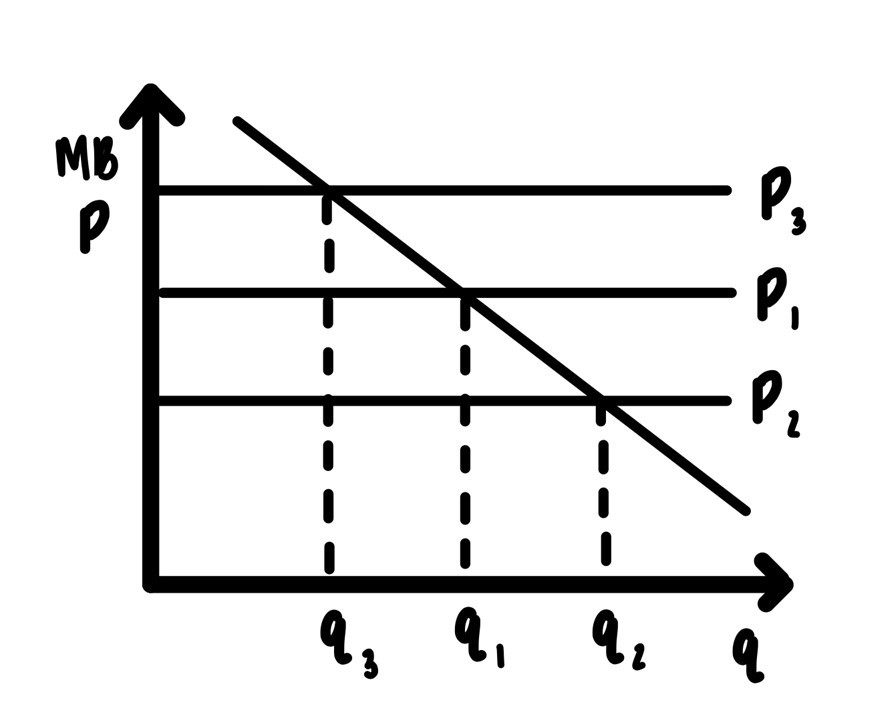
The downward-sloping marginal benefit (MB) curve shows that the consumer’s willingness to pay for additional units falls as quantity rises. Different prices correspond to different optimal quantities (where intersects the MB curve), reinforcing why a demand curve slopes downward when marginal utility diminishes. Source
Higher MU (early units) is consistent with higher marginal benefit.
Lower MU (later units) is consistent with lower marginal benefit.
Common Misinterpretations to Avoid
“DMU means you stop enjoying the good.” Not necessarily—enjoyment can increase in total even while MU falls.
“DMU is about prices.” DMU is about preferences and satisfaction; prices affect choices by changing the trade-offs consumers face.
“DMU applies across different goods automatically.” DMU is stated for additional units of the same good, over a relevant time frame.
When DMU Might Be Weak or Reversed
DMU is a tendency, not a law that holds perfectly in every context. Situations where MU may not fall smoothly include:
Learning or acquired taste: additional units initially increase enjoyment as the consumer becomes familiar.
Network or social effects in consumption: the value of an additional unit may rise if it enhances participation (context-dependent).
Discrete consumption units: some goods are lumpy, so MU may change in steps rather than gradually.
Even in these cases, AP Microeconomics typically treats DMU as a standard assumption for modelling consumer behaviour.
Practice Questions
(2 marks) Define diminishing marginal utility and state one implication it has for the marginal benefit of consuming additional units of a good.
1 mark: Correct definition: MU falls as more units of the same good are consumed (in a given period/ceteris paribus).
1 mark: Correct implication: marginal benefit/willingness to pay for additional units tends to decrease.
(5 marks) A consumer reports that the first unit of a snack provides high satisfaction, but each additional unit provides less extra satisfaction than the previous one. (a) (2 marks) Explain the difference between total utility and marginal utility. (b) (3 marks) Using the concept of diminishing marginal utility, explain why the consumer’s willingness to pay for later units would typically be lower than for earlier units.
1 mark: Total utility is the overall satisfaction from all units consumed.
1 mark: Marginal utility is the additional satisfaction from one more unit. (b)
1 mark: DMU: marginal utility decreases with additional units consumed.
1 mark: Lower MU implies lower marginal benefit from later units.
1 mark: Lower marginal benefit implies a lower maximum willingness to pay for later units (all else equal).
FAQ
Yes. Negative marginal utility means an extra unit makes the consumer worse off (e.g., discomfort or regret).
In that range, total utility falls when quantity increases, implying the consumer would prefer fewer units.
DMU is more likely within a short, fixed period because needs become satisfied quickly.
Over longer periods, consumption can be separated (e.g., one unit per day), which can make each unit feel more valuable than if consumed all at once.
No. DMU is about consumers and satisfaction from consumption.
Diminishing returns is about producers and how output changes when additional variable inputs are added to fixed inputs.
Variety can reduce the speed at which MU falls because each unit feels less “identical.”
By differentiating units, firms can make later units generate higher MU than they would if all units were the same.
Yes. Tastes, past consumption, context, and constraints can shift how quickly MU declines.
For example, someone who strongly prefers a good may experience a slower decline in MU over the relevant consumption range.