AP Syllabus focus: ‘Consumers allocate limited income by comparing the marginal utility of the last dollar spent on each good.’
Consumers rarely choose just one product; they divide limited income across many goods. Microeconomics models this allocation using marginal utility per dollar, a rule that predicts how rational consumers adjust purchases to maximize satisfaction.
Core idea: marginal utility per dollar
Consumers face prices and limited income, so the relevant comparison is not “Which good has higher marginal utility?” but “Which good gives more marginal utility for each dollar spent?”
Marginal utility (MU): The additional satisfaction (utility) a consumer receives from consuming one more unit of a good or service.
Because goods have different prices, MU must be scaled by cost to compare alternatives fairly.
Marginal utility per dollar: The additional utility gained from spending one more dollar on a good; used to guide how a budget is allocated across goods.
The decision rule (equimarginal principle)
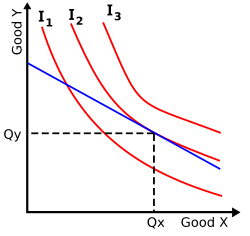
This diagram shows a consumer maximizing utility by choosing the highest attainable indifference curve subject to a budget constraint. The optimal bundle occurs at the tangency point, where the slope of the indifference curve (the marginal rate of substitution, tied to marginal utilities) matches the slope of the budget line (the price ratio). This provides an intuitive geometric complement to the equimarginal rule (equalizing marginal benefit per dollar across goods). Source
A utility-maximizing consumer allocates spending so that the marginal utility per dollar is equalized across all goods purchased, given income and prices. If not equal, the consumer can increase total utility by shifting a dollar of spending from the lower-MU-per-dollar good to the higher-MU-per-dollar good.
What “comparing the last dollar spent” means
The “last dollar” is the dollar that funds the most recent unit purchased of each good (which may be fractional in theory or “the next unit” in discrete choices). The consumer compares:
The MU generated by the next small increase in spending on Good X
Versus the MU generated by the next small increase in spending on Good Y
If one is larger, spending is reallocated toward it until the advantage disappears or a constraint binds (like zero consumption of a good).
Key equation used on AP Microeconomics
This relationship is commonly expressed using MU and price.
= marginal utility from one additional unit of the good (utils per unit)
= price of the good (dollars per unit)
With two goods, the optimal allocation condition is:
= marginal utilities from the last unit of each good (utils per unit)
= prices of each good (dollars per unit)
These equations capture the syllabus requirement: consumers allocate limited income by comparing the marginal utility of the last dollar spent on each good.
How adjustments happen when conditions change
The equal-MU-per-dollar outcome is not fixed; it responds to prices, income, and marginal utility.
Price changes
If a good’s price falls, for that good rises (for the current quantity). The consumer tends to buy more of it. As consumption increases, diminishing marginal utility typically lowers MU, pushing back down toward equality with other goods.
Changes in preferences or circumstances
If a good becomes more desirable (a taste shift), its MU at each quantity can rise, increasing . The consumer reallocates spending toward it until equalizes again.
Corner solutions and limited divisibility
Sometimes equalization cannot occur because:
A consumer chooses zero of a good (all spending on other goods)
Goods are indivisible (must be bought in whole units), so equality may be approximate rather than exact
Common interpretation errors to avoid
Comparing MU across goods without accounting for price; the correct comparison is .
Treating “equal MU per dollar” as meaning “buy equal quantities”; optimal quantities depend on prices and marginal utilities, not symmetry.
Forgetting the “last dollar” logic: the condition is about marginal (next) changes, not total utility.
Practice Questions
(2 marks) Explain what it means for a consumer to “allocate limited income by comparing the marginal utility of the last pound spent on each good.”
1 mark: States that the consumer compares marginal utility per unit of currency (e.g., ) across goods.
1 mark: States that spending is allocated so the last unit of spending yields the same marginal utility across goods (otherwise the consumer reallocates spending).
(6 marks) A consumer buys Goods X and Y. Using marginal utility per pound, explain the condition for utility maximisation and how the consumer should adjust purchases if .
1 mark: Correct utility-maximising condition: (or equal across all goods).
1 mark: Interprets the inequality as “X gives more marginal utility per pound than Y” at the current bundle.
1 mark: States the consumer should spend more on X (increase quantity of X).
1 mark: States the consumer should spend less on Y (decrease quantity of Y).
1 mark: Links adjustment to restoring equality of marginal utility per pound across goods.
1 mark: Notes that adjustment continues until equality holds (or a constraint/corner solution prevents it).
FAQ
Yes, because the rule is ordinal in practice.
Consumers only need to rank bundles consistently; observed choices can still reflect “as if” equalisation of marginal benefit per pound.
Equalisation may be approximate rather than exact.
Consumers compare $MU/P$ for the next available package/unit.
The best affordable combination is the one where no feasible swap increases total utility.
Then an additional unit provides no extra satisfaction (or reduces satisfaction).
In that case, $MU/P \le 0$ signals the consumer should not buy more of that good at the margin, holding other options constant.
They can be incorporated by using a “full price”.
Add monetary price plus monetised time/effort costs.
Then compare $MU$ to this full price to predict allocation more accurately.
Yes; consumers often rely on expected marginal utility.
They compare expected $MU/P$, updating choices as they learn (e.g., after trying a product), which can cause gradual reallocation of spending over time.