AP Syllabus focus: ‘When a market is already producing the efficient quantity, taxes, subsidies, price controls, or quantity controls reduce allocative efficiency.’
Government policies often aim to help consumers or producers, but they can unintentionally push markets away from efficiency. This page explains how common interventions change incentives and reduce allocative efficiency when markets were already efficient.
Allocative efficiency in a competitive market
In the AP Micro supply-and-demand model, an efficient quantity is the quantity that maximises total net benefits to society (buyers and sellers) when there are no market failures.
Allocative efficiency: A situation where the quantity produced is the efficient quantity, meaning the marginal benefit to consumers equals the marginal cost of production.
If a market is already producing the efficient quantity, any policy that changes the price paid by buyers, the price received by sellers, or the quantity traded creates a wedge between marginal benefit and marginal cost, reducing allocative efficiency.
= Marginal social benefit at a given quantity (dollars per unit)
= Marginal social cost at a given quantity (dollars per unit)
In a competitive market without externalities, MSB aligns with the demand curve (marginal willingness to pay) and MSC aligns with the supply curve (marginal cost). Competitive equilibrium then corresponds to the efficient quantity.
How intervention reduces allocative efficiency (when the market was already efficient)
The key mechanism: wedges and lost trades
When the market starts at the efficient quantity, intervention typically causes one (or more) of the following:
A wedge between the price buyers pay and sellers receive
A restriction or expansion of quantity away from
A reallocation away from highest-value uses (buyers) and lowest-cost suppliers (sellers)
Because the market was initially efficient, these changes cause mutually beneficial trades (where buyers’ willingness to pay exceeds sellers’ marginal cost) to be prevented, or cause inefficient trades to occur.
Taxes
A tax on a good raises the price paid by buyers and/or lowers the price received by sellers, creating a wedge. If the original equilibrium quantity was efficient:
The tax reduces quantity traded below the efficient quantity.
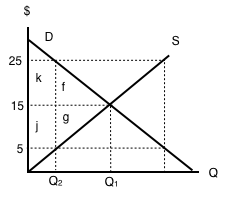
A per-unit tax drives a wedge between what buyers are willing to pay (demand) and what sellers require to supply (supply), reducing the quantity traded below the competitive equilibrium. The shaded region represents deadweight loss: gains from trade that disappear because some mutually beneficial transactions no longer occur. In an initially efficient market, this triangle is the allocative-efficiency loss created by the tax distortion. Source
Some trades that were efficient at the margin no longer occur.
The market outcome becomes allocatively inefficient because fewer units are exchanged than .
The efficiency loss comes from reduced gains from trade on the units no longer bought and sold, not from the transfer of tax revenue itself.
Subsidies
A subsidy encourages production/consumption by lowering buyers’ price and/or raising sellers’ price. If the original equilibrium quantity was efficient:
The subsidy increases quantity traded above the efficient quantity.
Extra units are produced where marginal cost exceeds marginal benefit at the margin.
The market outcome becomes allocatively inefficient because more units are exchanged than .
The inefficiency arises because society is effectively paying (through the subsidy) for units that are worth less to consumers than they cost to produce.
Price controls (price ceilings and price floors)
A binding price ceiling (maximum legal price) or price floor (minimum legal price) prevents the price from reaching the equilibrium that supported the efficient quantity:
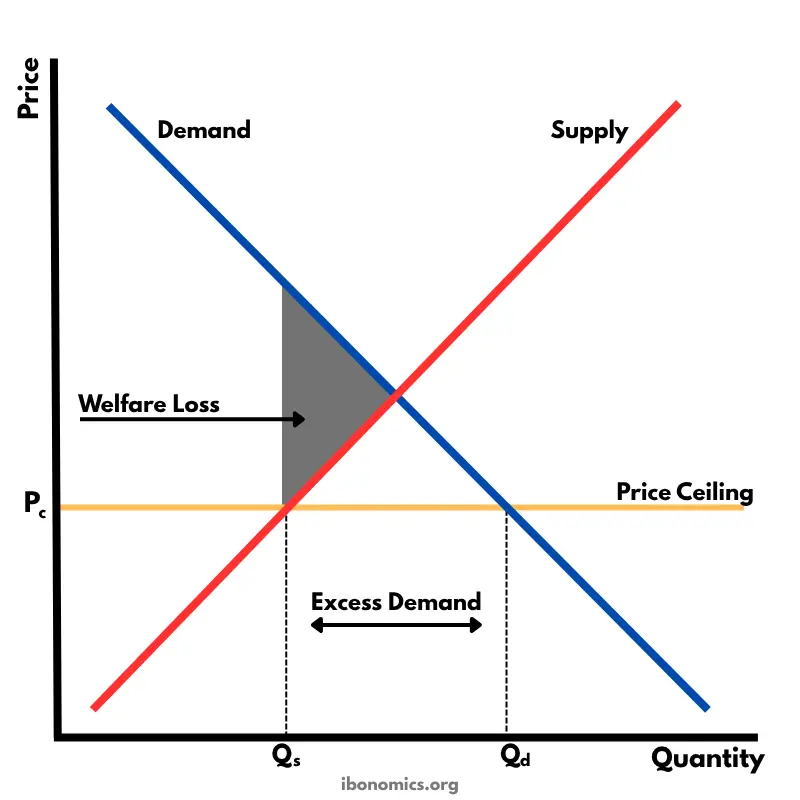
A binding price ceiling set below equilibrium reduces the quantity actually exchanged (transactions are limited by the lower quantity supplied), creating a shortage where quantity demanded exceeds quantity supplied. The shaded area shows the loss of total surplus from trades that would have occurred at the competitive equilibrium but are blocked by the ceiling. This is allocative inefficiency created by preventing the market from reaching the efficient quantity and allocating goods via willingness to pay. Source
A binding ceiling tends to reduce quantity traded (often through shortages and non-price rationing).
A binding floor can reduce quantity traded (often through surpluses and reduced purchases) or require non-market mechanisms to clear.
In both cases, when the market started efficient, forcing price away from equilibrium reduces allocative efficiency by preventing the market from selecting the efficient quantity and rationing goods to the highest-value users.
Quantity controls (quotas, licenses, rationing rules)
A quantity control directly limits or mandates the number of units exchanged:
If it caps quantity below , it prevents efficient trades.
If it requires quantity above , it forces inefficient trades.
Even when quantity equals by coincidence, quantity controls can still reduce allocative efficiency by changing who receives the good (allocation) away from those with the highest willingness to pay, depending on the rule used to distribute units.
What “already producing the efficient quantity” assumes
This syllabus point applies most cleanly under the standard AP assumption of no market failures:
No externalities affecting third parties
Many buyers and sellers with price-taking behaviour
Well-defined property rights and enforceable contracts
No significant informational or transaction-cost barriers affecting the marginal decision
Under these conditions, the competitive equilibrium quantity is efficient, so intervention moves the market away from allocative efficiency.
Practice Questions
(2 marks) Explain why a per-unit tax reduces allocative efficiency when a competitive market is initially producing the efficient quantity.
1 mark: Identifies that a tax creates a wedge between the price paid by consumers and the price received by producers.
1 mark: Explains that the wedge reduces quantity below the efficient level, so some trades with no longer occur (allocative inefficiency).
(6 marks) A competitive market is initially at the efficient quantity. The government introduces a binding price control. Explain how this can reduce allocative efficiency, referring to changes in price, quantity traded, and the allocation of goods.
1 mark: States that the market initially produces the efficient quantity (where marginal benefit equals marginal cost).
1 mark: Explains that a binding price control prevents the market price from adjusting to equilibrium.
1 mark: Explains that quantity traded moves away from the efficient quantity (typically falls under a binding ceiling or may fall under a binding floor).
1 mark: Links the quantity change to missed mutually beneficial trades or inefficient trades at the margin.
1 mark: Explains that allocation may shift away from highest willingness-to-pay consumers (e.g., non-price rationing under a ceiling or unsold surplus under a floor).
1 mark: Concludes that these effects mean at the traded quantity, so allocative efficiency falls.
FAQ
Allocative efficiency is about maximising total net benefits (where $MB=MC$).
Fairness is normative and can prioritise affordability, access, or income support even if $MB \neq MC$.
Look for market failures that break the link between private and social costs/benefits, such as:
external costs/benefits
market power
missing property rights or weak enforcement
If these exist, intervention might increase, not reduce, allocative efficiency.
Yes. Even if a policy moved quantity toward $Q^*$, enforcement costs and avoidance behaviour can reduce net benefits.
Those costs act like additional resource costs beyond the simple supply-and-demand wedge.
Because who gets the good may change. Allocation by queues, connections, or arbitrary rules can mean units do not go to those with the highest willingness to pay, reducing total net benefits.
Yes. A policy could move quantity closer to $MB=MC$ yet introduce large administrative costs, rent-seeking, or misallocation that outweighs the efficiency gain from better quantity targeting.